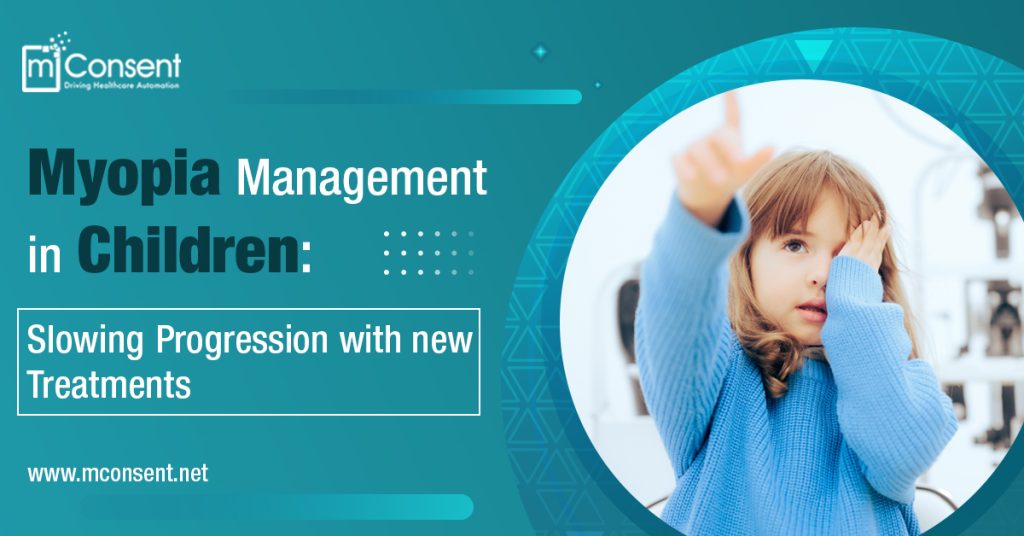



Childhood myopia has reached epidemic levels globally, with rapidly increasing prevalence and severity. This profound myopia significantly elevates risk for irreversible vision loss from retinal damage, glaucoma, cataracts and other ocular diseases later in life.
However, emerging treatments are giving optometrists new tools to slow myopia progression during childhood – providing hope for a generation of children.
This blog provides a comprehensive overview of the latest techniques for myopia control and management in pediatric patients.
 Myopia typically first develops and is diagnosed in school-age children between ages 6-12 years old. During childhood, myopia then progressively worsens each year as the eye elongates axially and becomes more nearsighted.
Myopia increases on average up to -1.00 diopter per year during pubertal growth spurts. High myopia of -6.00 diopters or worse is considered pathologic and leads to substantial lifetime risks of retinal detachments, myopic macular degeneration, glaucoma, cataracts and even blindness.
Myopia control targets intervention during these critical childhood years to slow the progression of myopia and prevent development of extremely high, pathological myopia later on.
Myopia typically first develops and is diagnosed in school-age children between ages 6-12 years old. During childhood, myopia then progressively worsens each year as the eye elongates axially and becomes more nearsighted.
Myopia increases on average up to -1.00 diopter per year during pubertal growth spurts. High myopia of -6.00 diopters or worse is considered pathologic and leads to substantial lifetime risks of retinal detachments, myopic macular degeneration, glaucoma, cataracts and even blindness.
Myopia control targets intervention during these critical childhood years to slow the progression of myopia and prevent development of extremely high, pathological myopia later on.
 opical ophthalmic solutions have also demonstrated meaningful effectiveness in controlling the progression of pediatric myopia, including:
Low-dose Atropine – Used nightly, dilute atropine eye drop solutions between 0.01% up to 0.05% can provide clinically significant control of myopia progression of around 60% over traditional drops.
The effect is achieved by atropine blocking scleral remodeling through the biomechanical effects on collagen and proteoglycans. Lower concentrations minimize side effects.
Pirenzepine Ophthalmic Gel – This topical antimuscarinic/anticholinergic gel has also been shown to be effective in slowing myopia progression in children by over 50% compared to placebo. Pirenzepine has fewer side effects than atropine for long-term use.
opical ophthalmic solutions have also demonstrated meaningful effectiveness in controlling the progression of pediatric myopia, including:
Low-dose Atropine – Used nightly, dilute atropine eye drop solutions between 0.01% up to 0.05% can provide clinically significant control of myopia progression of around 60% over traditional drops.
The effect is achieved by atropine blocking scleral remodeling through the biomechanical effects on collagen and proteoglycans. Lower concentrations minimize side effects.
Pirenzepine Ophthalmic Gel – This topical antimuscarinic/anticholinergic gel has also been shown to be effective in slowing myopia progression in children by over 50% compared to placebo. Pirenzepine has fewer side effects than atropine for long-term use.
 Increased time spent doing outdoor activities has been associated with significantly slower progression of myopia in children by approximately 20-50%.
Being outdoors provides sunlight exposure and release of retinal dopamine which may influence eye growth regulation.
Parents can be encouraged to have their children spend more time outdoors daily as a complementary approach to optical and pharmaceutical treatments.
Reducing near work activities may also be modestly beneficial for myopia progression.
Increased time spent doing outdoor activities has been associated with significantly slower progression of myopia in children by approximately 20-50%.
Being outdoors provides sunlight exposure and release of retinal dopamine which may influence eye growth regulation.
Parents can be encouraged to have their children spend more time outdoors daily as a complementary approach to optical and pharmaceutical treatments.
Reducing near work activities may also be modestly beneficial for myopia progression.
1. Understanding Myopic Progression:
Myopia typically first develops and is diagnosed in school-age children between ages 6-12 years old. During childhood, myopia then progressively worsens each year as the eye elongates axially and becomes more nearsighted.
Myopia increases on average up to -1.00 diopter per year during pubertal growth spurts. High myopia of -6.00 diopters or worse is considered pathologic and leads to substantial lifetime risks of retinal detachments, myopic macular degeneration, glaucoma, cataracts and even blindness.
Myopia control targets intervention during these critical childhood years to slow the progression of myopia and prevent development of extremely high, pathological myopia later on.
2. Optical Correction Strategies:
Traditional single vision glasses and soft contact lenses only correct the blurred vision from myopia, but do not slow the actual progression of the condition over time. However, specialty contact lenses and optical designs have demonstrated efficacy in controlling the progression of pediatric myopia: Overnight Orthokeratology – Rigid gas permeable contact lenses worn overnight can temporarily reshape the cornea to reduce myopic refractive error by up to 60% during waking hours. This is one of the most effective treatments for slowing the progression of myopia over multiple years of wear. Multifocal Soft Contact Lenses – Center-distance or multifocal soft contact lenses change the optics at the peripheral cornea and retina. This helps reduce relative peripheral hyperopic defocus, which influences axial elongation. Well-designed multifocal soft lenses can slow myopic progression by 50-70% over single vision contacts. Defocus-Incorporated Soft Contact (DISC) Lenses – DISC lenses incorporate myopic defocus into the contact lens design to create controlled optical signals that induce temporary, reversible changes in corneal topography and refractive error. This stratified lens optics has been shown to slow myopic progression by 40-50% over 4 years.3. Pharmaceutical Interventions:
opical ophthalmic solutions have also demonstrated meaningful effectiveness in controlling the progression of pediatric myopia, including:
Low-dose Atropine – Used nightly, dilute atropine eye drop solutions between 0.01% up to 0.05% can provide clinically significant control of myopia progression of around 60% over traditional drops.
The effect is achieved by atropine blocking scleral remodeling through the biomechanical effects on collagen and proteoglycans. Lower concentrations minimize side effects.
Pirenzepine Ophthalmic Gel – This topical antimuscarinic/anticholinergic gel has also been shown to be effective in slowing myopia progression in children by over 50% compared to placebo. Pirenzepine has fewer side effects than atropine for long-term use.
4. Lifestyle and Behavioral Modifications:
Increased time spent doing outdoor activities has been associated with significantly slower progression of myopia in children by approximately 20-50%.
Being outdoors provides sunlight exposure and release of retinal dopamine which may influence eye growth regulation.
Parents can be encouraged to have their children spend more time outdoors daily as a complementary approach to optical and pharmaceutical treatments.
Reducing near work activities may also be modestly beneficial for myopia progression.