
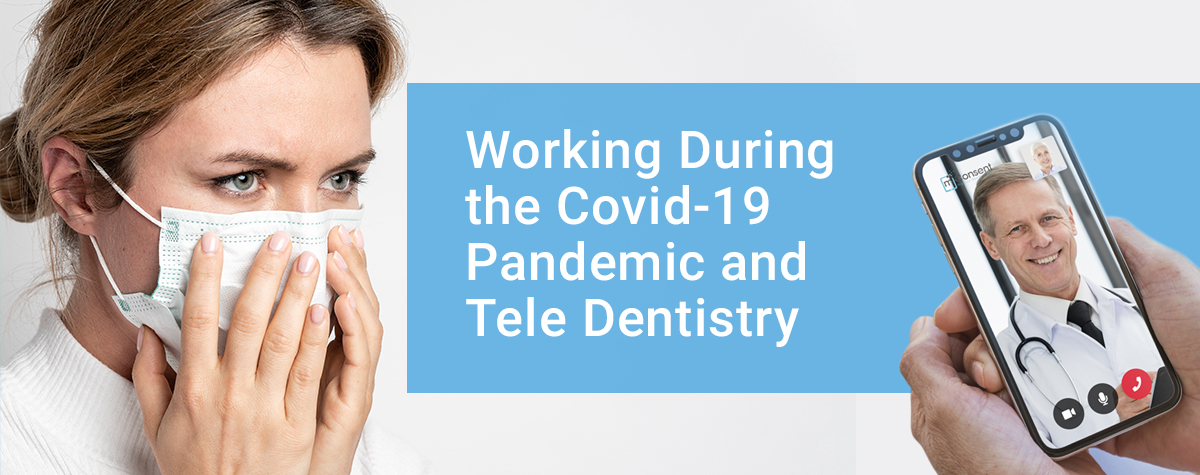
The COVID-19 pandemic means a time of uncertainty for dentists who are looking for ways to provide dental care to the patients. During this time, some dental offices have remained operating as per the American Dental Association (ADA) guidelines, others are only open for emergency patients while some dental offices have closed temporarily. As part of its plan to reduce the Covid-19 spread, the American Dental Association (ADA) has issued mandatory guidelines regarding emergency and non-emergency dental care, as well as teledentistry. Because of the existing health crises caused by the pandemic, teledentistry is rising as the most feasible option to provide dental care to the patients.
Teledentistry – An emerging Trend
Teledentistry is the approach where the patient receives dental services when the patient and the dentist are present at a different physical location. Teledentistry can be live and simultaneous or done at a separate time or place. Methods may include limited consultations and exams through a mobile device or computer or live patient monitoring.
As per ADA 1 , teledentistry is the use of telehealth systems and methodologies in dentistry, which include a wide range of tactics and technologies to provide virtual health, medical and education services. These technologies and tactics include:
- Live video (synchronous): This means a live video session between the dental care providers and patients using audiovisual telecommunications technology.
- Store-and-forward (asynchronous): It means communicating recorded health information (for instance, a patient’s radiographs, digital impressions, photographs, etc.) via a secure electronic communications system, to a dental care practitioner, who needs this information to assess a patient’s condition or refer a service outside of a real-time or live interaction.
- Remote patient monitoring (RPM): It means personal medical and health data collection from a patient in one location through electronic communication technologies, which is shared with a provider in a different location for use in dental care and related support of care.
- Mobile health: It means healthcare and public health practice and awareness supported by mobile communication devices like cell phones, personal digital assistants (PDA), and tablet computers.
- Online Appointments: It means using online forms (like mConsent) to get evaluated by a dental care provider without visiting them physically.
ADA’s Guidelines on Teledentistry
The ADA has issued guidelines for dentists to provide teledentistry services during the Covid-19 public health emergency. All dentists using telecommunication technology to provide dental services or assessments to determine if the appointment is urgent must follow the below codes to document and report the dental services:
- D0140 limited oral evaluation – problem-focused
- D0170 re-evaluation – limited, problem-focused (Patient with a not post-operative visit)
- D0171 re-evaluation – post-operative office visit
- D9992 dental case management – care coordination
Moreover, all dentists providing services in a teledentistry environment must report one or the other of the following codes aside from those mentioned above:
- D9995 teledentistry – synchronous; real-time encounter
- D9996 teledentistry – asynchronous; information saved and shared with a dentist for succeeding review
What is Synchronous Teledentistry (CDT Code D9995)?
It is the provision of patient care and information where a live, two-way communication between the patient at one location and the dentist at another location is going on, via audiovisual telecommunications technology.
What is Asynchronous Teledentistry (CDT Code D9996)?
It is also called “store-and-forward”; meaning sharing of recorded health information (e.g., photographs, radiographs, video, photomicrographs and digital impressions of patients) through a safe electronic communications system to the dentist who needs this information to assess a patient’s condition or refer a service outside of a real-time or live interaction.
Emergency Vs. Non-Emergency Distinctions
The ADA defines dental emergencies as those that are potentially life-threatening and necessitate abrupt treatment to stop constant tissue bleeding to lessen severe pain or infection. As per ADA, dental emergencies include:
- '
- Uncontrolled bleeding
- Cellulitis or a diffuse soft-tissue bacterial infection (intra-oral or extra-oral swelling that may affect patient’s airway)
- Trauma in facial bones (that may affect patient’s airway)
- Severe dental pain due to pulpal inflammation
- Pericoronitis or third-molar pain
- Surgical post-operative osteitis
- dry socket dressing changes
- Abscess or localized bacterial infection
- Tooth fracture
- Dental trauma with avulsion/luxation
- Dental treatment needed before critical medical procedures
- Final crown/bridge cementation
- Biopsy of abnormal tissue
The non-emergency dental procedures, on the other hand, include but are not limited to:
- '
- Initial or episodic oral examinations
- Routine radiographs
- Routine preventive and cleaning therapies
- Orthodontic procedures
- Extraction of asymptomatic teeth
- Restorative dentistry
- Aesthetic procedures
mConsent – Paperless Dental Forms is the Need of the Day
Because of the ADA guideline, it is evident that physical exposure between the dentists and patients must be minimized. The significance of online dental form software like mConsent has increased during the Covid-19 crises as it lets patients fill the form at the comfort of their homes while dentists can easily evaluate their situation to decide if it is an emergency or non- emergency situation.
mConsent’s online Electronic Medical Records (EMR) system provides Online Appointment Scheduling, Handwriting Recognition, Self Service Portal in one place. It serves as an extremely helpful tool for dental care providers to efficiently manage their process management by going paperless through the elimination of redundant paperwork and document control procedures. For patients also, it makes life easier by eliminating the need to visit the healthcare provider. Hence, mConsent enables a win-win situation.
Check out all the features of mConent to know how it helps you to stay compliant with ADA guidelines for your teledentistry practices.