



There’s a version of this story almost every dental practice knows.
A patient comes in, gets treated, leaves happy. Then three weeks later, someone on your front desk is chasing down a co-pay. The insurance claim is sitting in limbo. The invoice went out late. The reminder got buried in their inbox. And by the time you finally collect, if you collect, a hundred small inefficiencies have quietly eaten into what should have been straightforward revenue.
Nothing dramatic happened. No one made a catastrophic mistake. The money just… leaked. Stage by stage, across a process that nobody was watching end to end.
That’s the real shape of revenue loss in dental practices. It’s not one big problem. It’s six smaller ones, compounding.
What the Revenue Recovery Cycle Actually Is
Most practices think about billing as a back-office function — something that happens after the clinical work is done. But the revenue recovery cycle starts the moment a patient schedules treatment, and it doesn’t end until the balance is fully collected and reconciled.
Every step between those two points is a place where money can slip through.
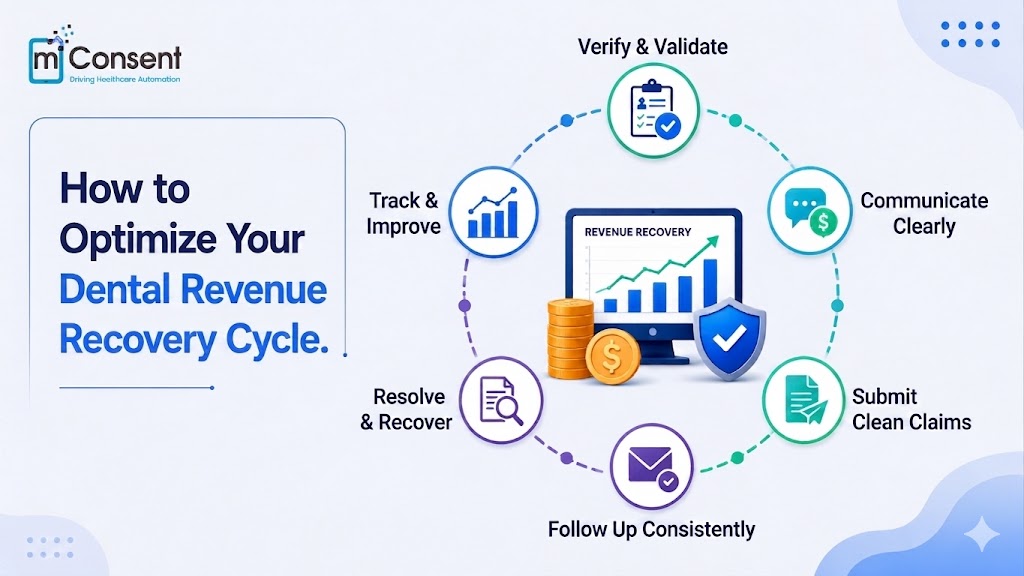
The cycle has six stages:
- Pre-treatment financial communication
- Point-of-service payment collection
- Insurance processing and follow-up
- Post-treatment patient billing
- Payment reminders and follow-ups
- Final recovery, aged receivables and write-off prevention
Practices that struggle with collections usually aren’t failing at all six. They’re failing at two or three, and those gaps are enough to create real financial drag. The goal of optimization isn’t to overhaul everything overnight. It’s to identify where your cycle is leaking and close those gaps systematically.
Stage 1: Pre-Treatment Financial Communication
Where it breaks
Patients sit down for a consultation, nod through the explanation, and leave without a clear sense of what they actually owe or when. They assumed insurance covers more than it does. They didn’t know there was a payment plan option. They weren’t asked to sign anything acknowledging the cost.
Then treatment happens, and the billing conversation becomes awkward — or worse, disputed.
What optimization looks like
The fix here isn’t about adding friction. It’s about adding clarity before treatment starts. That means presenting cost estimates patients can actually understand, verifying insurance coverage in advance so there are no surprises on the back end, and documenting financial consent digitally so there’s a clear record.
When patients walk in understanding what they’ll owe and how they can pay, collection becomes a logistics problem instead of a negotiation.
How mConsent supports this stage: Automated insurance verification workflows, digital financial consent forms, and treatment plans with transparent cost breakdowns all completed before the patient hits the chair.
Stage 2: Point-of-Service Payment Collection
Where it breaks
The appointment ends. The patient is handed a receipt and told billing will follow up. They walk out. And now you’re collecting from a patient who’s no longer in the building, has already moved on mentally, and has a hundred other things competing for their attention.
Every dollar you don’t collect at the point of service gets significantly harder to collect later.
What optimization looks like
This stage is about making payment the obvious, easy, default next step before a patient leaves. That starts with staff confidence. Front desk teams need to feel comfortable initiating payment conversations without it feeling like a confrontation. It also means offering mobile-friendly checkout options that don’t require fumbling around with paperwork.
Contactless, instant, and simple. That’s the standard patients are used to everywhere else. There’s no reason the dental checkout experience should feel like it’s from 2009.
How mConsent supports this stage: Mobile payment links, real-time payment processing, and a checkout experience that lets patients pay on their phone before they reach the car.
Stage 3: Insurance Processing and Follow-Up
Where it breaks
Claims go out and then… nothing for a while. Staff checks on them when they have time. Denials come back and sit in a queue. Errors in the original submission weren’t caught until weeks later. AR days climb. Revenue that was earned isn’t showing up in the bank.
Insurance follow-up is one of the most consistently underresourced parts of the revenue cycle, and it costs practices more than most realize.
What optimization looks like
Speed and visibility. Claims should go out fast, with clean data. Status should be trackable without someone having to make phone calls to find out where things stand. Denials should trigger a workflow, not just a note in someone’s inbox.
The practices that handle insurance well aren’t necessarily working harder at it. They’ve just built a process that keeps things from falling through the cracks.
How mConsent supports this stage: Integrated insurance workflows with real-time tracking and reduced submission errors, so the team spends less time chasing and more time moving forward.
Stage 4: Post-Treatment Patient Billing
Where it breaks
The patient’s portion comes back from insurance. Someone on the billing team generates a statement, eventually. It goes out by mail, or maybe by email, with language that looks like it was written by someone who speaks fluent insurance but not English. The patient puts it in a pile. Two weeks pass.
Delayed and confusing invoices are a self-inflicted collection problem. Patients don’t pay because they don’t understand what they’re being asked to pay, or because by the time the invoice arrives, it feels abstract.
What optimization looks like
Send digital invoices immediately when the balance is known. Write them in plain language — what the visit was, what insurance paid, what the patient owes. Make payment a single click from the invoice itself.
The faster and clearer the bill, the faster the payment. This isn’t complicated. It’s just rarely prioritized.
How mConsent supports this stage: Instant digital invoices with itemized, patient-friendly language and one-click payment access built in.
Stage 5: Payment Reminders and Follow-Ups
Where it breaks
Manual follow-up is inconsistent by nature. Someone remembers to send a reminder when they have time. Patients get one message and then silence. The most persistent patients respond to the first contact. Everyone else quietly ages into the 60-day bucket.
There’s nothing wrong with the intent behind manual follow-up. The problem is that it depends on bandwidth that dental offices rarely have.
What optimization looks like
Automation doesn’t replace human relationships — it maintains them at scale. A well-designed reminder sequence sends the right message at the right time, through the right channel, without anyone having to remember to do it. SMS outperforms email on response rates for payment reminders. Timing matters — reminders sent a few days before a due date work better than reminders sent after.
The goal is to make it easy for patients to pay before the balance becomes a problem, not after.
How mConsent supports this stage: Automated SMS and email reminder workflows with customizable messaging and smart timing, running consistently in the background without adding to the front desk’s task list.
Stage 6: Aged Receivables and Final Recovery
Where it breaks
Balances hit 90 days. The team is too busy managing current patients to dig into old accounts. A write-off decision gets made because chasing a $140 balance doesn’t feel worth the effort. Multiply that by fifty accounts and the math gets painful quickly.
Aged receivables don’t usually disappear because patients refuse to pay. They disappear because no one followed up in a way that made it easy.
What optimization looks like
Segment your receivables by age and treat them differently. A 30-day balance needs a gentle nudge. A 90-day balance needs a payment plan conversation. Re-engaging older accounts digitally, through a simple, non-aggressive message, often surfaces payments from patients who meant to pay and just got busy.
The key is making it frictionless to settle. Payment plans help. A streamlined digital portal helps more.
How mConsent supports this stage: Targeted recovery outreach, flexible payment plans through mPayr, and data-driven visibility into which accounts need attention.
Why Piecemeal Solutions Don’t Work
Here’s the pattern most practices fall into: they identify one problem, implement one tool, and declare the revenue cycle “addressed.” A new payment processor here. A billing service there. An insurance software that doesn’t connect to anything else.
The result is a collection of point solutions that don’t talk to each other, create data silos, and put the burden of coordination on staff who already don’t have enough hours in the day.
A fully connected revenue cycle means patient financial data flows from pre-treatment through final collection without anyone having to manually move it. Staff can see the full picture in one place. Patients experience consistency. And the gaps where revenue used to leak get closed — not patched.
That’s the difference between tools and a system.
The Metrics That Tell You Where You Stand
You can’t optimize what you’re not measuring. The numbers most worth tracking across the revenue cycle:
- Financial health: Collection rate as a percentage of adjusted production, monthly revenue against target, and total write-offs.
- Operational efficiency: AR days (30/60/90 buckets), billing turnaround time from treatment to invoice, and staff hours spent on collections tasks.
- Patient behavior: Payment completion rate, response rate to reminders, and how quickly patients pay after the first contact.
Most practices have access to some version of this data. The difference between practices that improve and those that don’t is usually whether anyone is looking at it regularly and acting on what it shows.
The Mistakes That Keep Revenue Cycles Broken
A few patterns worth naming because they’re common enough to be almost universal:
- Treating the revenue cycle as a billing department problem. Collections touches every patient interaction — from the intake form to the checkout conversation. If only billing owns it, the upstream stages never improve.
- Delaying patient communication. Every day between service and invoice is a day the patient is mentally moving on. Speed isn’t just efficiency — it’s psychology.
- Relying on manual processes past the point where they scale. Manual follow-up worked when practices had smaller patient volumes. Most practices have outgrown the systems they’re still running on.
- Making decisions without looking at the data. If you don’t know your collection rate, your AR days, or your write-off trend, you’re guessing about where the leaks are.
What the Next Few Years Look Like
The revenue recovery landscape is moving toward more automation, more personalization, and more patient control. AI-assisted payment prediction — knowing which accounts are likely to go delinquent before they do — is becoming practical. Insurance processing is getting smarter. Patient-facing billing is becoming as seamless as any other digital transaction.
Practices that build solid systems now will have an easier time adopting what comes next. Practices that are still managing receivables through spreadsheets and phone calls in 2025 will find the gap harder and harder to close.
Closing Thought
Revenue recovery isn’t a billing problem. It’s an operations problem, a communication problem, and sometimes a culture problem. Every stage of the cycle is a chance to either capture what you’ve earned or let it slip.
The practices that consistently collect what they’re owed aren’t necessarily larger or better staffed. They’ve just stopped treating each stage of the cycle as someone else’s responsibility and started managing it as a system.
With mConsent, the system is already built. The stages connect. The workflows run. And the revenue that used to leak starts showing up where it belongs in your practice.
FAQs
What’s the most important stage to fix first?
Pre-treatment communication has the highest downstream impact. Getting financial clarity right before treatment reduces disputes, delays, and awkward conversations at every subsequent stage.
How much does automation actually move the needle on collections?
Significantly. Consistent, timely follow-up outperforms sporadic manual outreach by a wide margin and automation ensures the follow-up happens whether or not staff has bandwidth that week.
What are AR days and why should I care?
Accounts receivable days measure how long it takes your practice, on average, to collect payment after a service. Lower AR days mean healthier cash flow. Industry benchmark for dental is typically under 30 days; many practices are running 45 to 60.
Can a smaller practice realistically implement all six stages?
Yes — especially with a platform like mConsent that handles the infrastructure. The system scales down as well as up. Small practices often see the fastest improvement because there’s more low-hanging fruit to capture.
How quickly will we see results?
Most practices that actively implement changes across multiple stages see measurable improvement in collection rates within 30 to 90 days. The faster you close the upstream gaps, the faster the downstream numbers shift.
“