


Let me tell you something that drives me crazy. I’ll walk into a dental practice, and the front desk is chaos. Phones ringing off the hook. A hygienist yelling across the hall asking if Mrs. Johnson confirmed her 3 o’clock. And then I look at their schedule and see three holes. Three empty chairs. That’s easily $1,500 gone for the day. Poof.
And why? Because someone forgot to send a reminder. Or they sent one, but it went to spam. Or they called, left a voicemail, and just assumed everything was fine.
Here’s what nobody tells you when you open a dental practice: patient communication isn’t just about being nice. It’s about keeping the lights on.
We’ve all gotten so used to the old way of doing things, phone calls, sticky notes, hoping people show up, that we don’t realize how much money is leaking out the back door every single day. And the problem is only getting worse because patients today expect fast, clear, digital communication. They don’t want to play phone tag. They want a text. They want a link. They want to click “confirm” and move on with their life.
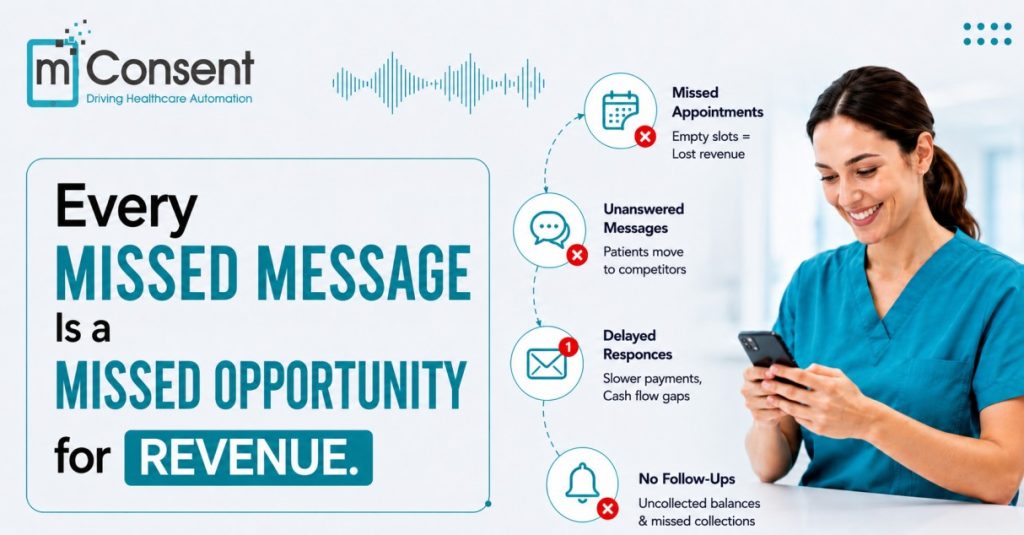
So yeah. Every missed message? That’s a missed opportunity for revenue. Let me show you what I mean.
The Hidden Cost of Doing Nothing Different
I talk to practice owners all the time who say things like, “Our no-show rate isn’t that bad.” Then we actually run the numbers. A 10% no-show rate in a busy practice can eat up $50,000 a year or more. That’s not a bad month. That’s a whole employee’s salary.
But no-shows are just the start.
What about the patient who needed a crown six months ago? You explained it. They nodded. Then they left and never scheduled. Was it because they didn’t trust you? Probably not. More likely, they got busy. They forgot. Nobody followed up. And now that tooth is worse, and they’re going somewhere else.
Or here’s a fun one: the patient who just… disappears. No cancellation, no angry Yelp review, just silence. You call, you leave messages, nothing. That’s attrition. And it usually happens because somewhere along the way, the communication broke down. Maybe a bill was confusing. Maybe a reminder never came. Maybe they just felt like a number.
Poor communication isn’t a soft skill problem. It’s a revenue problem. Full stop.
Where Most Practices Drop the Ball
Let me break down the five places where communication either saves you money or costs you a fortune.
1. Appointment Scheduling & Reminders
This is the big one. You’d be amazed how many practices still rely on manual phone calls for reminders. Staff spends hours calling people, leaving voicemails, and playing phone tag. And even then, show rates are mediocre.
The fix? Automated reminders via text and email. But not just any reminders two-way ones. Patients should be able to reply “CONFIRM” or “RESCHEDULE” without talking to a human. And when someone cancels last minute, you need a system that can fill that spot instantly from a waitlist.
I’ve seen practices cut no-shows from 12% to 3% just by switching to automated SMS reminders. That alone can add $30k–$50k back into your bottom line.
2. Treatment Plan Communication
Here’s where things get tricky. You can be the best dentist in the world, but if your patient doesn’t understand why they need a procedure or what it’s going to cost, they’re not saying yes.
Most practices hand the patient a printed treatment plan with a bunch of codes and numbers. Then they rush off to the next room. The patient stares at it, feels confused, maybe a little overwhelmed, and says “I’ll think about it.” And then you never see them again.
Better approach? Visual treatment plans. Send it to them digitally via text or email with clear explanations, maybe a short video or an image. Then follow up a day or two later with a simple message: “Hi Janice, just checking if you had any questions about the crown we discussed. Happy to go over anything.”
That follow-up alone can double your case acceptance rate. People need permission to ask questions. They need a nudge.
3. Billing and Payments
Nobody likes talking about money. Dentists especially. But avoiding the conversation doesn’t make the problem go away.
If your billing communication is unclear, patients will delay paying. If you only send paper statements, they’ll lose them. If you wait until the patient is in the chair to spring a balance on them, they’re going to be annoyed.
The solution is stupid simple: payment reminders with a link to pay by text. People have their phones in their hand 14 hours a day. Let them click a button, pay their bill, and move on. No logging into portals. No calling the office. No writing checks.
I’ve seen practices cut their accounts receivable days in half just by adding text-to-pay. That’s faster cash flow, less staff time chasing people down, and fewer awkward conversations at the front desk.
4. Post-Treatment Follow-Ups
This one sounds like a “nice to have,” but it’s actually a revenue driver. Why? Because patients who feel cared for come back. And they refer their friends.
After a root canal or an extraction, send an automated follow-up the next day. “How are you feeling? Here are your care instructions again just in case. Reply with any questions.” That takes five seconds to set up, but it builds massive trust.
And trust equals retention. Retention equals recurring revenue. A patient who stays with you for ten years is worth thousands more than one who bounces after two cleanings.
5. Recalls and Reappointments
You know those patients who are “due for a cleaning” but never seem to schedule? Yeah, those are lost dollars walking around.
Automated recall reminders work. But generic ones work less well. A message that says “It’s time for your checkup” gets ignored. One that says “Hi Mike, you’re due for your cleaning, click here to pick a time that works for you” gets action.
Personalization matters. Timing matters. Frequency matters. Too many reminders and people get annoyed. Too few and they forget. The sweet spot is usually three touches: one a month out, one two weeks out, and one a few days before they should schedule.
What Actually Works
I’m going to be honest with you. You cannot do this manually. If you try to have your front desk team send personalized texts to every patient, call everyone who misses an appointment, and follow up on every treatment plan, they will quit. Or you’ll go crazy.
The practices that win are the ones that automate the boring stuff so their team can focus on the human stuff.
Here’s what that looks like in real life:
- Automated appointment reminders via SMS and email, with two-way confirmations.
- Digital forms and treatment plans sent before the visit so patients aren’t filling out clipboards in the waiting room.
- Payment reminders with a text-to-pay link sent automatically after an appointment or on a billing cycle.
- Post-op follow-ups scheduled in advance so nobody forgets.
- Recall campaigns that run in the background without anyone touching them.
And here’s the key: it all has to talk to each other. Your communication system needs to know when a patient confirmed, when they paid, when they last visited, and what they owe. If data is siloed, you’re back to square one.
A Quick Example So You Can See the Difference
Before (the old way):
Sarah books a crown. You hand her a printed estimate. She leaves. Nobody follows up. Two weeks later, you call her. She doesn’t answer. You leave a voicemail. She calls back a week later but you’re busy. You play phone tag for three days. Finally she schedules. Then she forgets about the appointment because nobody reminded her. She no-shows. You lose $800 in chair time. And honestly? She feels a little guilty so she just never comes back.
After (a better way):
Sarah books a crown online. Immediately, she gets a text confirmation. Later that day, she gets a link to her treatment plan with a video explaining the procedure and a clear cost breakdown. The next day, she gets a simple follow-up text: “Any questions about your crown? Reply anytime.” She asks about insurance coverage. You reply in two minutes. She schedules. Two days before her appointment, she gets a reminder text. She confirms with one tap. The morning of, she gets another reminder with a link to pay her copay online. She pays while drinking coffee. She shows up. Treatment happens. Everyone wins.
See the difference? Same patient. Same procedure. Completely different outcome.
Conclusion
Here’s what I want you to walk away with.
Patient communication isn’t some soft skill you can worry about “someday.” It is directly, measurably tied to your revenue. Every time a patient doesn’t understand a treatment plan, that’s lost production. Every time someone forgets an appointment, that’s lost time you can’t get back. Every time a bill goes unpaid because the statement got buried under a pile of mail, that’s cash you’re waiting on for no good reason.
The practices that fix their communication don’t just run smoother. They make more money. Period.
And look, I’m not saying you need to become a marketing expert or a tech wizard. But you do need to stop pretending that phone calls and sticky notes are working. They’re not.
Platforms like mConsent exist for a reason. They handle the reminders, the forms, the payment links, the follow-ups all the stuff that falls through the cracks. They connect communication directly to your workflow so nothing gets missed. And yes, they help practices increase revenue without exhausting their staff.
But even if you don’t use a platform, just start paying attention. Where are the gaps in your communication? When do patients get confused or frustrated or forgetful? Fix those spots, one by one. The money will follow.
FAQs
1. How much can better communication actually increase revenue?
Depends on your starting point. But most practices see a 10-20% bump within six months just from reducing no-shows and improving case acceptance. That’s real money.
2. What’s the single biggest communication mistake dentists make?
Assuming patients remember everything you said. They don’t. They’re nervous, they’re distracted, they’re thinking about work or their kids. Follow up. Every time.
3. Won’t patients get annoyed by too many texts?
If you send junk, yes. If you send useful, timely information confirmations, reminders, payment links, care instructions they appreciate it. Just don’t spam them.
4. Do I really need automated reminders if my front desk calls everyone?
Yes. Because your front desk doesn’t call everyone. Be honest. They get busy. Calls get skipped. Voicemails get ignored. Automation is consistent. Humans aren’t.
5. How fast can I see results?
Within weeks. Switch to automated reminders and you’ll see no-shows drop in the first month. Add text-to-pay and you’ll see faster payments immediately.
“