


Most dentists think revenue recovery starts with billing. You know the drill: patient doesn’t pay, you send a statement, then another statement, then eventually a collections letter. Maybe you call them a few times. It’s awkward. Nobody likes it.
But here’s the thing I’ve learned after talking to hundreds of practice owners: by the time you’re sending that first late notice, you’ve already lost.
Revenue recovery doesn’t start with billing. It starts way earlier. It starts with patient engagement.
Think about it. An unengaged patient is the one who forgets their appointment. Who doesn’t really understand why they need that crown. Who shoves the bill in a drawer and figures they’ll deal with it later. Who cancels at the last minute because they weren’t really sure why they booked in the first place.
You can’t chase those people into paying. You have to engage them before they ever become a problem.
So let’s talk about what actually works. Not theory. Not fluffy “patient experience” nonsense. Real strategies that get people to show up, say yes, and pay on time.
First, What Do I Mean by “Patient Engagement”?
I’m not talking about being friendly at the front desk. Though that helps.
Patient engagement means your patients are actively involved in their own care. They know what’s coming. They understand why it matters. They can communicate with you easily. They get reminders that actually remind them. They can pay without jumping through hoops.
An engaged patient doesn’t accidentally miss an appointment. An engaged patient doesn’t ghost you after a treatment plan. An engaged patient pays their bill because they see the value and the process is simple.
A disengaged patient? They’re a revenue leak waiting to happen.
The Real Cost of Disengaged Patients
Let me give you some numbers that might hurt.
A typical dental practice loses about 10% of its revenue to no-shows and last-minute cancellations. That’s not even counting the patients who accept treatment but never schedule it. Or the ones who schedule but never pay.
I worked with a practice last year that had a 15% no-show rate. Fifteen percent. They thought it was normal. “People are busy,” the office manager said. Yeah, people are busy. But they show up for things they care about and remember.
We dug into their numbers. That 15% no-show rate was costing them about $85,000 a year. Plus another $40,000 in uncollected balances from patients who just… never paid. Plus all the staff time spent calling, rescheduling, sending statements.
That’s not a small problem. That’s a down payment on a house.
And the root cause? You guessed it. Poor engagement. Patients weren’t getting good reminders. They didn’t understand their treatment plans. Billing was confusing. Nobody followed up after appointments. So patients just drifted away.
10 Patient Engagement Strategies That Actually Boost Revenue Recovery
I’m going to give you the strategies that work. Some are simple. Some require a bit of tech. But all of them have one thing in common: they turn passive patients into active, engaged ones.
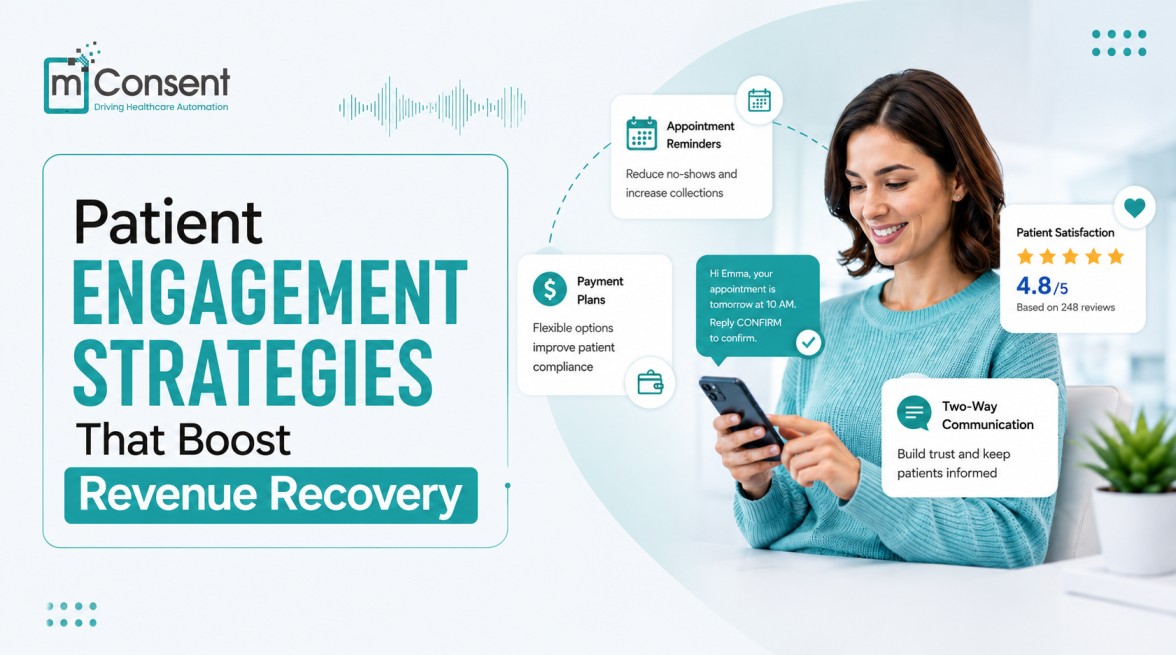
Strategy #1: Automated Appointment Reminders
If you’re still having your front desk call every patient to confirm appointments, stop. Just stop.
Automated reminders via SMS and email reduce no-shows by 30-50%. I’ve seen it happen a hundred times. Patients get a text two days before, another the day before, maybe one the morning of. They tap “CONFIRM.” Done.
No more “I forgot.” No more empty chairs. No more lost production.
Strategy #2: Two-Way Communication
Here’s where most automated systems fail. They send messages but don’t let patients respond. That’s like leaving a voicemail and never checking your messages.
Patients want to reply. “Can I reschedule?” “What’s my copay?” “I’m running five minutes late.” If you don’t give them a way to do that easily, they’ll just… not. And then they might not show up.
Two-way texting changes the game. Patients feel heard. Problems get solved in seconds instead of days. And you capture way more confirmations.
Strategy #3: Personalized Communication
Nobody wants a text that says “This is a reminder for your upcoming dental appointment.” Yawn.
Try this instead: “Hey Sarah, just a heads-up about your cleaning tomorrow at 2pm with Dr. Martinez. Reply CONFIRM to lock it in.”
See the difference? Name, specific time, specific provider, clear action. It takes two seconds to set up personalization fields in your system. But most practices don’t bother. And their patients ignore them.
Strategy #4: Digital Treatment Plans and Education
This one is huge for case acceptance.
When you hand someone a printed treatment plan with a bunch of CDT codes and dollar amounts, their eyes glaze over. They don’t understand it. So they say “I’ll think about it” and leave.
But if you send them a digital treatment plan with a visual explanation—maybe a short video, maybe an image showing the problem—they actually get it. And when they understand, they’re far more likely to say yes.
One practice I know started sending treatment plans via text with a link to a one-minute video explainer. Their case acceptance went from 35% to 68% in three months.
Strategy #5: Automated Payment Reminders
People forget to pay. It’s not malicious. They just have fifteen other things going on.
A simple payment reminder via text or email, polite, clear, with a link to pay works wonders. Send it a few days before the due date, then on the due date, then maybe a week after if it’s still outstanding.
You’re not nagging. You’re helping. And you’ll get paid way faster.
Strategy #6: Text-to-Pay
I can’t believe I still have to say this, but here we are.
If you’re sending paper statements and asking people to mail a check, you are living in 1998. People have their phones in their hands 24/7. Send them a text with a secure payment link. They click it, tap a few buttons, and done.
I’ve seen practices collect more money in three days with text-to-pay than they did in three months with paper statements. It’s not even close.
Strategy #7: Recall and Reappointment Campaigns
You know those patients who are “due for a cleaning” but you never see them? They’re not mad at you. They just forgot.
Automated recall campaigns fix this. Send a reminder when they’re due. Then another a week later. Then another. Make it easy to book with a link.
The practices that do this consistently have retention rates over 85%. The ones that don’t? They’re constantly chasing new patients just to stay afloat.
Strategy #8: Patient Feedback and Reviews
Here’s something most dentists overlook. Asking for feedback engages patients and boosts revenue at the same time.
After a visit, send a quick text: “How was your appointment? Click here to leave a review.” Happy patients leave good reviews. Good reviews bring in new patients. New patients generate revenue.
Plus, when you ask for feedback, patients feel like you care. That builds loyalty. Loyal patients refer their friends.
Strategy #9: Omnichannel Communication
Some patients love text. Some prefer email. A few still want a phone call. (Yes, those people exist.)
Don’t pick one channel. Use them all. Send reminders via SMS and email. Offer a phone option for the old-school crowd. Use app notifications if you have a patient portal.
The goal is to reach patients where they already are.
Strategy #10: Real-Time Engagement Analytics
You can’t improve what you don’t measure.
Track your open rates, response rates, confirmation rates, payment rates. See what’s working and what’s not. Maybe your emails are going to spam. Maybe your texts are going out at 3am. Maybe patients hate your payment link.
Data tells you the truth. Use it.
How Engagement Actually Drives Revenue Recovery (The Short Version)
Let me connect the dots for you.
- Engaged patients show up → fewer no-shows → more production.
- Engaged patients understand treatment → higher case acceptance → more revenue.
- Engaged patients get payment reminders → faster collections → better cash flow.
- Engaged patients come back → higher retention → recurring revenue.
- Engaged patients refer friends → more new patients → growth without crazy marketing spend.
See how that works? It’s not one big thing. It’s a hundred small things that add up.
A Real Example
Let me tell you about a practice in Ohio. Three hygienists, two doctors, about 2,000 active patients.
They were bleeding money on no-shows about 12% of appointments. Case acceptance was around 40% for major work. Their average collection time was 45 days. Staff was burned out from calling people.
They implemented automated reminders first. No-shows dropped to 4% in two months. That alone added about $60,000 a year.
Then they added digital treatment plans with follow-up texts. Case acceptance jumped to 65%. Another $100,000 or so.
Then text-to-pay. Collection time dropped from 45 days to 12 days. Their accounts receivable balance got cut in half.
Total impact? About $200,000 in recovered and new revenue over 12 months. And the staff stopped complaining about chasing patients.
That’s not magic. That’s just engagement done right.
The Big Mistake Most Practices Make
Here it is: they try to do everything manually.
They think, “Oh, I’ll just have Jessica send some texts at the end of the day.” But Jessica is busy. She forgets. She does it inconsistently. She uses her personal phone. It’s a mess.
You cannot scale manual engagement. You need automation. Not because you’re lazy because automation is consistent, trackable, and frees up your team to do things that actually require a human.
The best engagement systems run in the background. Reminders go out automatically. Follow-ups schedule themselves. Payment links generate without anyone thinking about it.
Your job is to be a dentist. Not a part-time text message sender.
What mConsent Does (And Why I Mention It)
Look, I’m not here to give you a sales pitch. But I’ve seen enough practices struggle with this stuff to know that most platforms are either too complicated or too limited.
mConsent connects engagement directly to your revenue workflows. Automated reminders, two-way texting, digital forms, treatment plans, payment reminders, text-to-pay—all in one place. And it all talks to your practice management system so you’re not double-entering data.
But more than the features, it’s the philosophy. Engagement isn’t a “nice to have.” It’s how you stop leaking revenue and start growing.
If you already have a system that works, great. Stick with it. But if you’re still relying on phone calls and sticky notes and hoping people show up… you’re leaving money on the table. A lot of it.
Final Thought
Here’s what I want you to remember.
Revenue recovery isn’t about squeezing money out of patients. It’s about engaging them so well that paying, showing up, and saying yes feel like the easy, natural things to do.
When patients are engaged, you don’t have to chase them. They show up. They accept treatment. They pay. They come back. They tell their friends.
That’s not a billing strategy. That’s a relationship strategy. And it works a whole lot better.
FAQs
1. What exactly is patient engagement in dentistry?
It’s the ongoing communication and interaction between your practice and your patients, reminders, education, billing, follow-ups, feedback. Basically, everything that happens outside the chair.
2. How does engagement actually help me recover revenue?
Engaged patients are more likely to show up for appointments, accept treatment plans, pay on time, and come back for future care. Each of those behaviors directly impacts your bottom line.
3. What’s the single most effective engagement strategy?
If you do nothing else, start with automated appointment reminders. They’re easy, cheap, and reduce no-shows fast. Then add text-to-pay. Those two alone will transform your cash flow.
4. Will patients get annoyed if I send too many messages?
Yes, if you’re sending junk. No, if you’re sending useful, timely information. A reminder before an appointment, a follow-up after treatment, a payment link when a bill is due, that’s helpful, not annoying.
5. How quickly can I see results from better engagement?
Within weeks. Switch to automated reminders and you’ll see no-shows drop in your first month. Add text-to-pay and you’ll see payments come in the same day. This isn’t a long-term project. It’s a quick win.
"![HIPAA Release Form – All you Need to Know [Instant Download]](https://mconsent.net/blog/wp-content/uploads/2021/09/HIPAA-Release-Form-All-you-Need-to-Know-Free-Release-Form.jpg)