


That’s the reality for most dental practices. Revenue doesn’t disappear in one big, obvious loss. Instead, it leaks slowly, through missed follow-ups, delayed payments, billing confusion, and inefficient systems.
The hidden cost of inefficient payment recovery isn’t just financial. It shows up as:
- Growing accounts receivable (A/R)
- Overworked front desk staff
- Frustrated patients
- Lost growth opportunities
Even high-production practices struggle with collections. Why? Because production doesn’t equal collection. And in today’s landscape, where patients carry higher deductibles and co-pays, payment responsibility has shifted significantly to the patient.
This is where many practices get stuck. Not because they’re doing everything wrong, but because they’re relying on outdated processes.
The real issue isn’t effort. It’s system gaps.
Modern platforms like mConsent are designed to fill in these gaps by automating processes, improving communication, and speeding up collections without putting more stress on your team.
In this blog post, we’ll talk about the most common mistakes people make when trying to get dental payments back, why they happen, and how to fix them so that more money comes in and less money goes out.
Understanding Payment Recovery in Dentistry
What is Payment Recovery?
In a dental office, “payment recovery” means getting the money that is still owed after the work is done.
It’s important to know the difference between:
- Sending claims or bills to billing
- From collections to getting payments
- Recovery to check on unpaid bills
Why It’s More Complex Today
It has become harder to get paid back because of:
- More problems with dental insurance billing
- More financial responsibility for patients
- Too much work for the front desk staff
- Broken systems
The True Cost of Inefficiency
When systems break down, practices face:
- Delayed cash flow
- Higher write-offs
- Staff burnout
- Poor patient experience
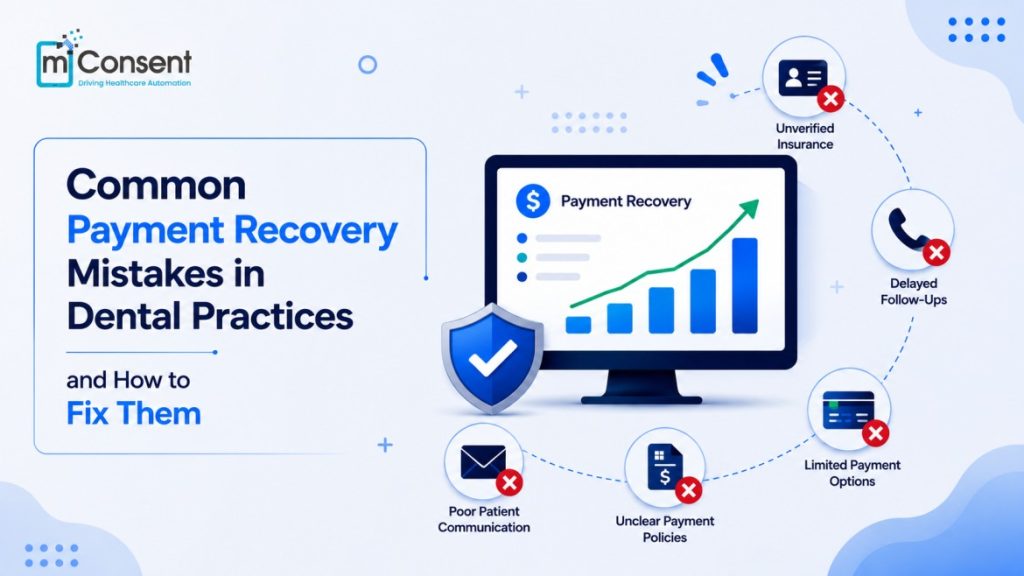
What are the Common Mistakes
Relying on Manual Follow-Ups
What Happens
- Staff repeatedly call patients
- Voicemails go unanswered
- Follow-ups are inconsistent
Why It’s a Problem
Manual processes are:
- Time-consuming
- Inefficient
- Low in response rates
How to Avoid It
- Use automated payment reminders in dental workflows
- Set scheduled follow-up sequences
How mConsent Fixes It
- Automated SMS and email reminders
- Smart workflows based on balance timing
- Reduced staff workload
Not Collecting Payments at the Right Time
What Happens
- Patients leave without paying
- “We’ll send a bill” becomes standard
Why It’s a Problem
The probability of payment drops significantly after the visit.
How to Avoid It
- Collect upfront or same-day
- Offer payment options during treatment
How mPayr Helps
- Instant text to pay dental links
- Mobile-first payments
- Faster transaction completion
Poor Financial Communication
What Happens
- Patients don’t understand their balance
- Insurance coverage confusion
Why It’s a Problem
- Disputes increase
- Reviews suffer
- Payments get delayed
How to Avoid It
- Provide clear estimates before treatment
- Maintain transparent billing
How mConsent Helps
- Digital treatment plans
- Real-time communication
- Clear cost breakdowns
Disconnected Insurance and Billing Systems
What Happens
- Calculating by hand after insurance
- A lot of mistakes in dental billing
Why It’s a Problem
- More days in A/R
- Holds and mistakes
How to Avoid It
- Integrate systems
- Automate reconciliation
How mConsent Solves It
- Insurance coordination tools
- Automatic balance updates
- Reduced errors
Ignoring Small Balances
What Happens
- Small balances get written off
- No follow-up
Why It’s a Problem
Revenue leakage adds up over time.
How to Avoid It
- Make collections automatic for all balances.
- Make it easy to pay.
How mPayr Helps
- Quick micro-payments via text
- Frictionless payment experience
No Structured Follow-Up Strategy
What Happens
- Random reminders
- No timeline
Why It’s a Problem
- Patients forget
- Results are inconsistent
How to Avoid It
Create a cadence:
- Day 1
- Day 3
- Day 7
- Day 14
How mConsent Helps
- Pre-built automation workflows
- Customizable follow-up schedules
Lack of Payment Options
What Happens
- Limited payment methods
- Patients delay payments
Why It’s a Problem
- Lower conversion rates
- Frustrated patients
How to Avoid It
- Offer flexible payment options
- Enable mobile payments
How mPayr Solves It
- Multiple payment methods
- Secure, fast transactions
- Saved payment methods
Not Tracking Key Metrics
What Happens
No visibility into performance.
Why It’s a Problem
Decisions are based on guesswork.
How to Avoid It
Track key KPIs:
- Days in A/R
- Collection rate
- Same-day collections
- Payment turnaround time
How mConsent Helps
- Real-time analytics dashboard
- Actionable performance insights
Delayed Insurance Verification
What Happens
- Incorrect patient responsibility
- Billing surprises
Why It’s a Problem
- Patient dissatisfaction
- Payment delays
How to Avoid It
- Verify insurance before appointments
How mConsent Helps
- Insurance concierge features
- Accurate pre-treatment estimates
Ignoring Patient Experience
What Happens
- Billing feels transactional
- Patients feel pressured
Why It’s a Problem
- Lower trust
- Poor retention
How to Avoid It
- Focus on convenience and clarity
How mConsent Improves Experience
- Mobile-first design
- Friendly communication
- Seamless payment journey
Manual vs Automated Payment Recovery
| Manual | Automated (mConsent + mPayr) |
|---|---|
| Time-consuming | Time-saving |
| High error rate | Accurate |
| Low response rate | High engagement |
| Delayed payments | Faster collections |
| Poor visibility | Real-time insights |
Step-by-Step Plan to Fix Payment Recovery
Week 1 – Audit
- Review A/R
- Identify workflow gaps
Week 2 – Implement Automation
- Start automated payment reminders dental
- Enable digital payments
Week 3 – Optimize Communication
- Improve billing clarity
- Send estimates upfront
Week 4 – Measure & Improve
- Track KPIs
- Adjust workflows
Why mConsent is the Ideal Solution
End-to-End Workflow
Everything, from intake to payment, was connected on one platform.
Automation + Personalization
Smart workflows with human-like communication.
mPayr Advantage
- Text-to-pay
- Faster collections
- Improved patient experience
Proven Results
- Reduced A/R
- Increased same-day collections
- Lower staff workload
Conclusion
The truth is that mistakes in recovering dental payments happen all the time, but they can be avoided. Most businesses don’t have a problem with people; they have a problem with the system. Everything changes when you automate tasks, improve communication, and give people modern, flexible ways to pay.
You can get patients to pay faster, fix billing problems, and make your collections much better. mConsent and mPayr not only fix payments, but they also improve the way your front desk works and help you make money. Better systems mean more money and better care for patients. To get started, set up a demo with mConsent, use mPayr to speed up collections, and download the free checklist for getting payments back.
FAQs
1. What is the biggest mistake in dental payment recovery?
Relying on manual follow-ups instead of automation.
2. How can I reduce A/R in my dental practice?
Use automation, improve communication, and collect payments upfront.
3. Why do patients delay payments?
Lack of clarity, convenience, or reminders.
4. How does text-to-pay improve collections?
It enables faster, easier, mobile-first payments.
5. Is it safe to use mConsent for payments?
Yes, it protects patient data by using payment software and systems that meet HIPAA standards.
“