


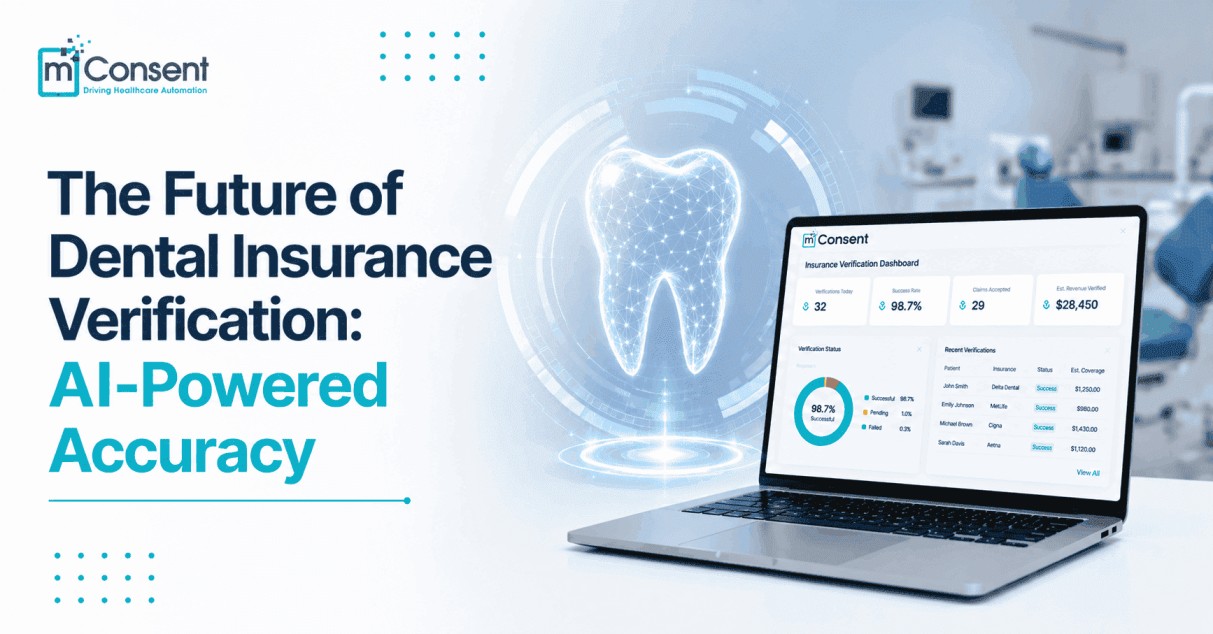
It's a $5 million problem hiding in plain sight
A patient sits in your chair. Treatment goes perfectly. The team submits the claim with confidence.
Three weeks later, the denial letter arrives. Wrong subscriber ID. Coverage lapsed last month. Frequency limit already hit. The revenue you already earned? Gone, at least until someone spends another two hours fixing it.
This isn’t an unusual story. It’s the daily reality for most dental practices.
Here’s What the Numbers Say
- Roughly 20% of dental insurance claims are denied on first submission, costing the industry an estimated $5 million annually.
- 78% of dental offices have seen an uptick in claim denials or payer scrutiny over the past 12 months.
- 40%+ of denied claims trace back to missing or inaccurate eligibility information collected before treatment.
- Verification calls take 15-20 minutes per patient, and hold times can exceed 30 minutes.
The good news? Most of these losses are preventable, and a new generation of AI dental insurance verification tools is already proving it. Practices using automated, real-time eligibility checks are cutting eligibility-related denials by up to 70% and recovering $2,000-$3,000 per month per 100 claims processed.
This is the future of dental revenue protection. Here’s how it works, why it matters, and how platforms like mConsent help practices get there without overhauling their entire stack.
Why Insurance Verification Is the Financial Foundation of Every Dental Practice
Insurance verification looks like a front-desk task. It’s actually the first domino in your entire revenue cycle.
What Verification Actually Confirms
A real verification isn’t a yes/no on active coverage. It’s a deep check on:
- Eligibility and effective dates
- Deductibles and how much has been met
- Co-pays and coinsurance percentages
- Annual maximums and remaining balance
- Covered vs. excluded procedures
- Frequency limitations (how often a cleaning, X-ray, or crown is covered)
- Waiting periods and missing-tooth clauses
- Coordination of benefits with secondary insurance
Miss any one of these, and you’re either eating the cost or chasing the patient for a balance they weren’t expecting.
Why It Matters More in 2026 Than Ever
Three forces have made verification mission-critical:
- Insurance complexity is rising. Plans change mid-year. Networks shift. Frequency rules tighten quietly.
- Patient financial responsibility is growing. High-deductible plans push more cost onto patients, making accurate estimates non-negotiable.
- Patient expectations have shifted. People expect their dental office to handle insurance the way Amazon handles checkout: instantly, transparently, correctly.
When verification is wrong, every downstream system breaks: scheduling, treatment acceptance, billing, collections, cash flow, and patient trust.
The Hidden Cost of Manual Verification
Most practices know that manual verification is painful. Few realize how expensive it actually is.
It’s Slow
Staff spend 15-20 minutes per call, often on hold longer than they spend talking. Multiply that across a 30-patient day and you’ve burned 7+ hours on a single administrative task.
It’s Error-Prone
A misspelled name, a transposed birthdate digit, or an outdated policy detail is enough to trigger a denial. Patient demographic and ID errors alone account for nearly a quarter of all dental claim denials.
It’s Inconsistent
Without a standardized workflow, every team member verifies a little differently. One person checks frequency. Another forgets the missing-tooth clause. The result is unpredictable claim outcomes.
It Damages the Patient Experience
When verification happens at check-in (or worse, after treatment), patients get blindsided by costs no one warned them about. That’s how 5-star reviews become 1-star complaints.
It’s Burning Out Your Front Desk
Repetitive phone calls and data entry are a leading driver of administrative burnout. Skilled team members end up doing low-value work instead of caring for patients.
The Financial Damage Stacks Quickly
| Issue | Downstream Impact |
|---|---|
| Demographic data errors | Denied claims, rework |
| Outdated eligibility info | Lost reimbursement, write-offs |
| Missed frequency limits | Patient disputes, refunds |
| Delayed verification | Same-day cancellations, schedule gaps |
| Inaccurate estimates | Damaged trust, lost referrals |
A practice running 100 claims a month at a 15% denial rate is leaving thousands of dollars on the table every single month. Over a year, that’s a six-figure problem disguised as paperwork.
How AI Is Rewriting the Insurance Verification Playbook
AI dental insurance verification isn’t a fancier phone tree. It’s a fundamentally different model, one that replaces reactive correction with proactive accuracy.
What Changes With AI
| Traditional Verification | AI-Powered Verification |
|---|---|
| Manual phone calls | Automated electronic checks |
| 15–20 minutes per patient | Seconds per patient |
| Human-dependent accuracy | Predictive validation |
| Inconsistent workflows | Standardized data capture |
| Reactive corrections | Proactive error detection |
| Reachable only in business hours | Continuous, 24/7 monitoring |
Core Capabilities of a Modern AI Verification System
- Real-time eligibility checks. Coverage status, deductible balance, and benefit details are available in seconds before the patient ever walks in.
- Automated data validation. Missing subscriber IDs, mismatched birthdates, and outdated group numbers are automatically flagged.
- Predictive error detection. The system identifies high-risk claims before submission, when fixes are still cheap.
- Smart workflow automation. Verifications trigger themselves based on the schedule, no one has to remember to run them.
- Continuous data refresh. Insurance details are updated as policies change, so day-of surprises become rare exceptions rather than weekly events.
The result is what every practice manager wants but rarely sees: clean claims, faster reimbursement, and predictable cash flow.
The Revenue Recovery Math: What AI Verification Actually Returns
Most AI verification platforms deliver ROI within 60–90 days. Here’s what drives it:
Fewer Claim Denials
Real-time eligibility checks reduce eligibility-related denials by up to 70%. That alone shifts thousands of dollars per month from “lost” to “collected.”
Faster Reimbursements
Cleaner claims move through payer systems without manual review. Practices with strong verification workflows typically maintain AR days in the 30-40 range, while gaps push them past 60.
Lower Administrative Costs
Teams save an average of 12-15 staff hours per week previously spent on phone calls and data entry. That’s the equivalent of recovering one part-time role’s worth of capacity for patient care, treatment plan presentations, or schedule optimization.
More Accurate Patient Estimates
When estimates are right the first time, treatment acceptance climbs. Patients trust numbers they don’t have to question.
Reduced Revenue Leakage
The small errors that compound silently, a missed deductible here, an expired plan there, get caught at the point of entry instead of at the point of pain.
The Patient Experience Side of the Equation
Verification isn’t just a back-office issue. It’s a brand issue.
Patients today expect three things from every healthcare interaction:
- Speed. They don’t want to sit at the front desk while someone calls Delta Dental.
- Transparency. They want to know what they’ll owe before the chair reclines.
- No surprises. A bill that doesn’t match the estimate is a guaranteed complaint.
AI-powered verification delivers all three. Patients arrive at a check-in process that already knows their plan, their balance, and their financial responsibility. That clarity is what builds loyalty, referrals, and the kind of online reviews that fill chairs.
How mConsent Supports a Smarter Verification Workflow
mConsent isn’t a standalone verification engine, it’s the patient engagement and workflow automation layer that makes verification actually work. Bad data in, bad verification out. The biggest leak in most practices isn’t the verification call itself; it’s the inaccurate, handwritten, half-completed intake form that feeds it.
Here’s where mConsent strengthens the chain:
Digital Patient Intake Forms
Patients complete forms on their own device, with required fields enforced, insurance card images captured, and data flowing cleanly into the practice management system. No transcription errors. No illegible handwriting.
Automated Patient Communication
Pre-appointment reminders, eligibility confirmations, and benefit summaries reach patients without staff lifting a finger. Front-desk teams stop chasing and start focusing.
Real-Time Engagement
Two-way messaging keeps the loop tight among the practice, the patient, and the verification process, so missing details are resolved before the appointment, not during it.
Digital Treatment Plans
Treatment estimates with insurance breakdowns presented clearly in the patient’s hand, increasing case acceptance and reducing billing disputes.
Integrated Billing & Payment Communication
Once treatment is complete, payment requests, balance reminders, and statements flow through the same engagement system, closing the revenue cycle with fewer manual touches.
HIPAA-Compliant by Design
Every workflow respects patient privacy and healthcare data standards, so practices can automate without compromising compliance.
The combination of clean intake data, smart communication, and verification readiness turns a slow, error-prone process into a streamlined revenue engine.
Before vs. After: What an AI-Enabled Verification Workflow Looks Like
| Before Modern Automation | After AI-Powered Verification |
|---|---|
| Hours on hold with payers | Eligibility confirmed in seconds |
| Frequent eligibility errors | Predictive error detection |
| Patient surprises at checkout | Accurate estimates up front |
| Inconsistent front-desk workflows | Standardized, repeatable process |
| Revenue leaks no one tracks | Visible, actionable revenue data |
| Staff burnout from busywork | Team focused on patient care |
10 Best Practices for a Future-Ready Verification System
- Verify insurance before every appointment, not just new patients.
- Use digital intake forms to eliminate handwriting and transcription errors.
- Standardize the verification process across every team member.
- Reduce manual data entry wherever the PMS allows write-back.
- Automate communication workflows for reminders, confirmations, and follow-ups.
- Improve financial transparency by presenting estimates digitally.
- Track denial trends monthly to surface root causes.
- Integrate verification with billing to ensure data flows end to end.
- Train your team on digital workflows, not just legacy phone scripts.
- Invest in scalable automation, solutions that grow with patient volume.
What’s Next: The Future of AI in Dental Operations
Verification is the leading edge. The same intelligence is now reshaping the entire dental operations stack:
- Predictive patient communication that anticipates questions before they’re asked
- AI-powered financial forecasting based on real claim history
- Intelligent scheduling automation that fills gaps proactively
- Real-time revenue intelligence dashboards that surface leaks instantly
- Fully connected digital ecosystems where intake, verification, treatment plans, and billing speak the same language
Practices that adopt now will set the operational standard for the next decade. Those that wait will be playing catch-up against competitors with cleaner books, faster collections, and happier patients.
Conclusion
Insurance verification used to be a phone call. It’s becoming an intelligence layer, one that protects revenue, sharpens patient experience, and frees skilled team members to do the work that actually matters.
The shift is already underway. Practices using AI-powered verification combined with digital engagement platforms like mConsent are seeing fewer denials, faster reimbursements, and stronger patient trust.
The question isn’t whether your practice will modernize verification. It’s whether you’ll lead the curve or chase it.
FAQ's
1. What is AI-powered dental insurance verification?
AI-powered dental insurance verification uses intelligent automation, real-time payer connections, and predictive validation to confirm patient eligibility, benefits, deductibles, and coverage details automatically and in seconds rather than through manual phone calls.
2. Why is insurance verification so important in dentistry?
Verification is the foundation of the entire revenue cycle. Errors at this stage cause claim denials, billing disputes, delayed reimbursements, patient frustration, and revenue leakage. Roughly 40% of denied claims trace back to missing or inaccurate eligibility information.
3. How does AI improve verification accuracy?
AI reduces manual errors by automatically validating data, pulling current benefit details directly from payer systems, flagging high-risk claims before submission, and continuously updating as policies change, replacing reactive corrections with proactive accuracy.
4. How does mConsent support smarter dental workflows?
mConsent strengthens the front end of the revenue cycle with digital patient intake, automated communication, digital treatment plans, and integrated billing workflows, ensuring the data flowing into verification and claims is clean, complete, and HIPAA-compliant.
5. Can AI verification really reduce claim denials?
Yes. Practices using real-time AI verification typically see eligibility-related denials drop by up to 70%, faster reimbursement cycles, and 12-15 hours of staff time saved per week. Most practices reach ROI within 60-90 days.
6. Is AI dental insurance verification HIPAA-compliant?
Reputable platforms, including mConsent, are built to HIPAA standards, with encrypted data handling, secure patient communication, and audit trails. Always confirm compliance certifications with any vendor before implementation.
7. How long does it take to implement AI-powered verification?
Most modern platforms integrate with leading practice management systems and can be operational within days to a few weeks, depending on practice size and existing tech stack. White-glove onboarding shortens the curve significantly.
"
![HIPAA Release Form – All you Need to Know [Instant Download]](https://mconsent.net/blog/wp-content/uploads/2021/09/HIPAA-Release-Form-All-you-Need-to-Know-Free-Release-Form.jpg)