

dental practice protection quadrant

Access Controls:

Safeguarding patient data is paramount for dental practices. Despite it being a legal and ethical imperative, many practices expose themselves to significant risks by overlooking appropriate security measures.

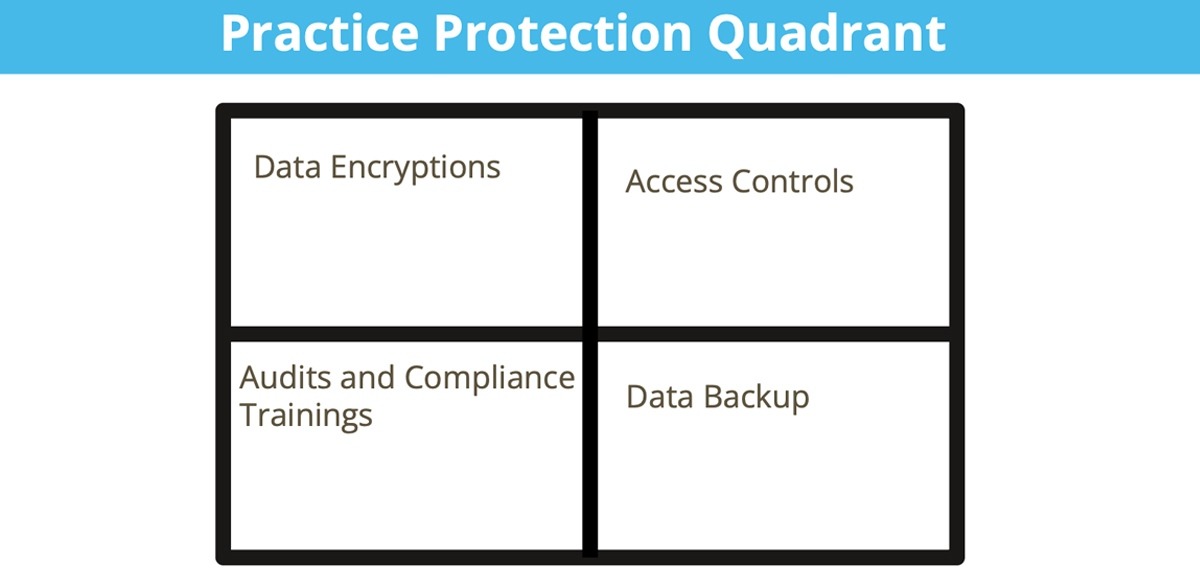
In this article we will explore the quadrant of dental practice protection in detail in order to help you understand the four essential components of protecting your practice against data and compliance breaches.

Data Encryption:

Data encryption stands out amongst all four components of the practice protection quadrant as the frontline defense against data breaches. Encrypting your data safeguards your practice and ensures that even if unauthorized access occurs, your information is still unreadable and unusable.

Data encryption is the foundation of protecting dental practices from unauthorized access and interception of sensitive patient information. Despite its significance, some practices overlook encryption of patient data collected through online forms which increases the likelihood of data exploitation.

Most of the times such vulnerabilities arise when dental practices entrust their digital management activities such as web development tasks to individuals who lack knowledge about HIPAA compliance.

For example, some practices may outsource their web development services to offshore developers. If the developer lacks knowledge about compliance laws and regulations, he may build a web page to collect patient information and attach it directly to the doctor’s website, without necessary encryption protocols in place.

In such cases, the form becomes an easy target for hackers who can access the doctor’s account and compromise patient data. The result is a series of events that can lead to losing sensitive data. Therefore, it is imperative for dental practices to avoid hiring someone who does not have knowledge of HIPAA compliance, PHI (Protected Health Information), or the BAA (Business Associate Agreement).

Such errors can be avoided by implementing robust data encryption protocols as well as diligently vetting any external partners to ensure they are well equipped with the knowledge of HIPAA regulations. Simple steps can have a huge impact on minimizing security breaches and upholding patient data confidentiality.

One of the most common causes of data breaches is lack of care taken with regards to setting up access control for all users. Many times passwords are shared across all staff members leading to unauthorized access and data breaches.

In order to avoid falling victim to such traps, role based access controls must be adopted that are customized to the responsibilities of each staff member.

For example, oftentimes the same passwords are shared by everyone within one practice. The doctor may use it to log in to their EHR, and the server access may be available to front office staff.

This lack of proper roles and responsibilities, and a centralized access control system poses a threat to data security. Therefore, it is crucial that access controls are assigned based on roles and responsibilities so that the office manager, front office staff, hygienist and practice owner, each have their own access controls.

Moreover, two factor authentication also adds an additional layer of security for strengthening practice protection against unauthorized access attempts.

Audits and Compliance Training:

Two of the most indispensable components of robust security for dental practices are:

1- Regular practice audits.

2- Compliance training for staff.

It is recommended to collaborate with HIPAA compliance experts who act as an invaluable source of guidance and support for navigating regulatory requirements.

Through proactive planning and continuous staff training, your team can respond effectively to security incidents, reducing the risk of potential data breaches.

If you run a small practice, investing in compliance training for your staff is not just recommended, it is essential for safeguarding practice reputation and viability in the increasingly regulated environment.

Data Backup:

One of the most proactive approaches for safeguarding the integrity of patient data is to schedule off site or cloud based data backups with daily frequency.

Any threats of data breaches can compromise the availability of patient information and risk the continuation of practice operations. Through investing in robust data backup solutions, the impact of data breaches due to unforeseen events can be significantly reduced.

It also helps with swift restoration of operations in case any breaches occur.

If you don’t have daily backups running on auto you are facing a big risk to your practice. Protecting your practice is not difficult or expensive anymore. With a minimum investment you can easily get daily updates and be better prepared against any data breaches.

The easiest and most effective way to ensure maximum data security is through assigning clear roles and responsibilities for data management related activities. These guarantee accountability and facilitate a coordinated response to security threats.

Conclusion:

Securing patient data is more than just a compliance requirement, it is pivotal to protecting patient privacy and building trust. The quadrant of dental practice data protection which includes data encryption, access controls, audits, compliance training and data backup, offers a complete guideline for practices to secure themselves from any security threats.

Dental practices that prioritize patient security, gain a reputation for being trustworthy in the increasingly interconnected world of today. Dental practice owners can confidently navigate the complexities of data security by taking proactive measures and showcasing a commitment to continued vigilance.

Important disclosures

The information in this article is for general informational and educational purposes only. Individual results vary by practice. Pricing and program terms are governed by the MSA at activation. mConsent operates as a Business Associate under HIPAA and executes a BAA with client practices.

General information. The information provided in this article is for general informational and educational purposes only and does not constitute legal, financial, compliance, or professional practice advice. mConsent makes no representations or warranties regarding the accuracy, completeness, or suitability of this content for any particular practice or circumstance. Individual results vary based on practice size, payer mix, patient demographics, geographic location, and other factors outside mConsent's control.

Performance benchmarks. Performance benchmarks and industry metrics cited in this article are derived from published third-party research and do not represent guaranteed outcomes for any individual practice. All commercial claims are subject to the terms of your Master Services Agreement (MSA). See mconsent.net/terms-and-conditions/ for details.

HIPAA compliance. mConsent operates as a Business Associate under HIPAA and executes a Business Associate Agreement (BAA) with each customer. Nothing in this article constitutes a representation of HIPAA compliance for any specific workflow, configuration, or use case. Customers are responsible for their own HIPAA compliance program and for ensuring their use of mConsent aligns with applicable regulatory requirements.

TCPA and text messaging. SMS and text-to-pay features referenced in this article require prior express written consent from each patient in compliance with the Telephone Consumer Protection Act (TCPA). Standard message and data rates may apply. Reply STOP to opt out. It is the customer's sole responsibility to obtain and document required consents and to comply with all applicable federal and state telecommunications regulations.

Trademarks. Dentrix® is a registered trademark of Henry Schein One, LLC. Eaglesoft® is a registered trademark of Patterson Companies, Inc. Open Dental® is a registered trademark of Open Dental Software, Inc. These trademark holders are not affiliated with mConsent and do not endorse, sponsor, or certify any mConsent product or service.

Forward-looking statements. This article may contain forward-looking statements about product features described as “designed to” achieve certain outcomes. Actual feature performance, availability, and results may differ. mConsent reserves the right to modify or discontinue features at any time. For current product capabilities, refer to official product documentation at mconsent.net.

Schedule A Demo →