


I had a conversation with a dentist in Scottsdale a few weeks ago that I can’t stop thinking about. He was frustrated. Production was up. The schedule was full. But the bank account wasn’t reflecting the busy-ness.
We pulled the numbers. His production-to-collection ratio was slipping. Claims were trickling in late. Patients were leaving without paying because the front desk couldn’t give them an accurate number. He was doing the work, but the money was stuck in a pipeline clogged by delayed information.
I asked him when his team typically verified insurance. He shrugged. “Whenever they have time. Day before, morning of, sometimes after.”
That “sometimes after” is a leak you can’t afford in 2026.
We’ve entered an era where timing isn’t just a matter of convenience- it’s the difference between getting paid and fighting for every dollar. Same-day insurance verification dental practices aren’t just running a tighter ship. They’re building a financial buffer that protects them from the chaos of modern insurance.
The Definition Has Shifted
Let’s be clear on what we’re talking about. Same-day insurance verification means confirming eligibility, deductibles, annual maximums, frequency limits, and waiting periods on the exact day the appointment is scheduled—or at the very least, before the patient sits in the chair.
It sounds basic. It sounds like something every practice should already do. But walk into any busy office on a Monday morning, and you’ll see the reality. The front desk is juggling walk-ins, phone calls, and check-outs. The verification gets pushed to the bottom of the pile. By the time someone gets to it, the patient is already in the room, and the hygienist is waiting for a green light.
That delay has a cost. A hidden one, but a heavy one.
The Risk You Don’t See Coming
When you delay verification, you’re gambling. You’re betting that the insurance card in the patient’s hand is accurate, that the coverage hasn’t changed since last year, that the deductible hasn’t been met by a procedure last week.
Here’s what actually happens when you lose that bet.
The claim gets denied. Not because the treatment wasn’t necessary, but because the eligibility lapsed. Or the frequency limit on that fluoride varnish was already used. Or the patient switched to a high-deductible plan you didn’t know about, and now they owe $1,500 they weren’t expecting.
That denial becomes a dispute. The dispute becomes a negative review. The review costs you future patients. And it all started because someone didn’t have time to make a five-minute phone call or better yet, let software do it in five seconds.
This is why real-time dental insurance verification has moved from a nice-to-have to the core of financial sanity. It catches the errors when they’re still fixable. It identifies the lapsed policy before you lay a hand on the patient. It flags the frequency limitation before you schedule a recall that isn’t covered.
The year 2026
Why does this matter more this year than last? A few reasons.
First, insurance plans have become maddeningly complex. Tiered networks, annual maximum adjustments mid-cycle, coordination of benefits that requires a spreadsheet to untangle. You cannot eyeball this stuff anymore.
Second, patients have changed. They walk in with their phones and their expectations. They’ve already googled the cost of a crown. They want transparency, and they want it now. If you can’t tell them what they owe, they lose confidence. And if you tell them wrong, they leave a one-star review.
Third, staffing. You don’t have extra bodies to throw at the problem. The front desk is already stretched thin. The only way to scale is through dental eligibility verification automation. You have to let the technology do the heavy lifting so the humans can do the connecting.
The Revenue Chain Reaction
Here’s the mechanical truth of a dental practice. Every delay in verification creates a ripple effect.
You verify late, you miss a coverage detail. You miss a coverage detail, you submit a claim wrong. You submit a claim wrong, it denies. It denies, you resubmit. While you’re resubmitting, the patient is getting a bill they didn’t expect. They don’t pay it. You spend hours chasing it. The AR days stack up. The cash flow tightens.
Now flip it.
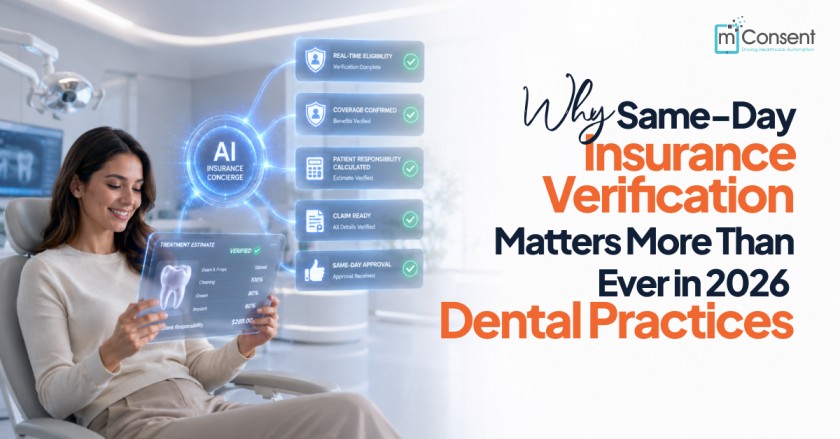
You verify same-day. The system confirms active coverage, remaining annual max, and the exact patient portion. You generate an accurate estimate on the spot and send it securely to their phone. They know the cost before treatment starts. They pay their portion before they leave. The claim goes out clean. It pays in 14 days instead of 45.
This is why insurance verification software for dentists isn’t just an administrative tool. It’s a cash flow engine.
The Front Desk Transformation
I’ve watched practices implement same-day verification, and the change in the team is immediate. The front desk coordinator isn’t walking on eggshells anymore. When a patient asks, “How much is this going to cost me?” they don’t have to say, “I’ll call you later.” They can pull up a verified, structured benefit summary right there.
The confidence that comes with that is palpable. It changes the entire energy of the front office. The phone calls to payers drop by 80%. The hold music stops playing. The sticky notes disappear.
And the disputes? The dreaded “you told me it was covered” conversations? They vanish too. Because you have a digital, signed acknowledgment of the estimate. You documented the conversation. You prevent dental billing disputes before they start.
A Real-World Before and After
Let me give you a concrete example. A practice in Ohio I’ve been working with had an 18% claim denial rate last year. Eighteen percent. That’s nearly one in five claims rejected. Most of them were eligibility and frequency denials—entirely preventable.
Their AR was hovering around 45 days. The front desk was in constant firefighting mode.
They switched to a same-day verification model. Within 90 days, the denial rate dropped to under 10%. AR dipped below 30 days. The office manager told me the biggest change wasn’t the money—it was the mood. The team stopped dreading the front desk. They started enjoying it again.
Conclusion
Look, I understand the hesitation. You’re busy. Adding “one more thing” feels impossible. But same-day verification isn’t another task. It’s a replacement for a dozen broken tasks.
It replaces the phone calls. The guesswork. The rework. The arguments. The write-offs.
In 2026, timing is everything. Patients expect instant answers. Insurance companies expect perfect submissions. And your team deserves a workflow that doesn’t burn them out.
Same-day verification isn’t a luxury anymore. It’s the baseline for a practice that wants to stay profitable, keep its staff sane, and actually enjoy the work of dentistry again.