


Patients don’t choose a dental practice based on clinical skill alone. They also judge a practice by whether they understood what they’d owe before they sat in the chair.
When insurance information is incomplete, outdated, or verified too late, patients can end up with a bill that doesn’t match what they expected. That gap between “what I thought I’d pay” and “what I actually paid” is one of the fastest ways a practice loses a patient’s confidence, even when the clinical care was excellent.
Unclear insurance information creates the same chain of problems in every practice: confusion about treatment costs, unexpected balances, delayed treatment decisions, awkward conversations at checkout, frustration with the practice, and lower confidence going forward. None of that is about the quality of the dentistry. It’s about the quality of the information patients received beforehand.
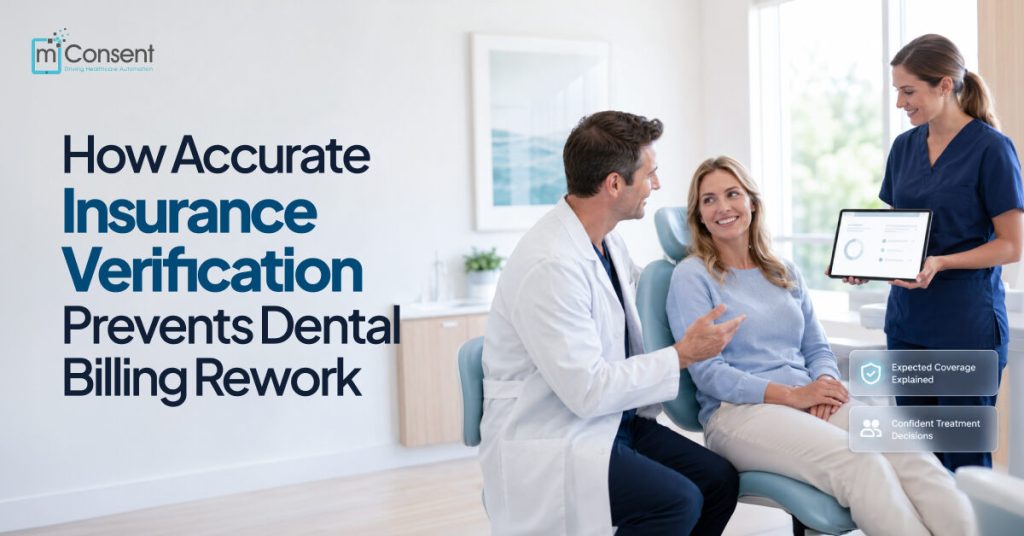
Accurate insurance benefits information solves this at the root. It gives dental teams what they need to communicate financial expectations earlier and more clearly before treatment, not after. That’s where dental insurance verification becomes a trust-building tool, not a back-office task.
This is also the idea behind mConsent’s Insurance Concierge, which helps practices obtain insurance eligibility and benefits information before the appointment. Instead of scrambling to verify coverage the morning of a visit, teams can review benefits ahead of time and walk into the appointment ready to have a clear financial conversation.
Why Insurance Accuracy Matters to Patient Trust
Trust in a dental practice extends well beyond the clinical exam room. Patients also quietly evaluate whether financial information is clear, whether staff can answer insurance questions with confidence, whether estimates are communicated consistently across visits, whether the final bill matches what they were told, and whether treatment costs are explained before care begins rather than after.
Patients Expect Financial Transparency
Dental patients increasingly want to know their expected financial responsibility before treatment starts, not after the drill has stopped. This isn’t unreasonable; it’s the same expectation people bring to nearly every other purchase they make. When a practice can answer “what will this cost me” with a real number instead of a vague estimate, patients feel respected rather than managed.
Incorrect Information Can Damage Confidence
When the estimate a patient receives doesn’t match the bill they get, it doesn’t read as a minor accounting error; it reads as a reliability problem. Patients start to wonder what else the practice might have gotten wrong, and that doubt can bleed into how they feel about their treatment plan, their next appointment, and whether they recommend the practice to others.
Accurate Benefits Information Creates Confidence
When staff have reliable, current insurance data in front of them, financial conversations change entirely. Instead of hedging with “it depends,” staff can speak with specifics. That confidence is contagious; patients pick up on it immediately, and it reduces the anxiety that often surrounds dental costs.
7 Ways Accurate Insurance Benefits Information Builds Patient Trust
1. Gives Patients Clearer Cost Expectations
This is the core of the solution. When a practice completes insurance verification before an appointment, staff can walk into that visit already knowing the expected insurance coverage, deductible information, copay information, coinsurance, annual maximums, remaining benefits, and the patient’s estimated responsibility.
Key takeaway: When patients understand their expected costs before treatment, they are far less likely to feel blindsided by the bill later.
This is exactly where Insurance Concierge fits in. By helping practices obtain insurance information earlier, before the patient arrives or before treatment begins, it gives teams the runway they need to review coverage and prepare an estimate that actually holds up.
2. Reduces Surprise Bills and Financial Frustration
The pattern is predictable: unclear benefits lead to an unexpected balance, which leads to patient frustration, which leads to reduced trust. Flip the inputs, and the outcome flips too: accurate verification leads to a better estimate, which leads to clear communication, which leads to greater confidence. The insurance data itself is what determines which path a practice ends up on.
3. Helps Staff Have More Confident Insurance Conversations
Front-desk teams are often put in an impossible position: patients ask direct financial questions, but staff only have partial benefits information to work with. Accurate, verified information changes that dynamic. It helps staff answer questions more confidently, explain expected coverage clearly, discuss patient responsibility without guesswork, prepare patients for possible out-of-pocket costs, and reduce uncertainty on both sides of the desk.
4. Supports Better Treatment Decisions
Unclear financial information doesn’t just cause frustration; it causes delay. Patients who don’t know what a procedure will cost often postpone treatment to avoid the unknown. When patients understand their expected financial responsibility earlier, they can make more informed decisions about treatment timing, financing options, payment arrangements, how to use their insurance benefits, and what out-of-pocket expenses to plan for.
Does insurance verification affect treatment acceptance? Yes. Patients who understand their expected costs in advance are generally more comfortable moving forward with treatment, because the financial uncertainty that often causes hesitation has already been addressed. When patients are left guessing about cost, that uncertainty often leads them to delay the decision rather than accept the treatment plan.
5. Creates a More Transparent Patient Experience
Transparency shouldn’t start at the checkout desk; by then, it’s too late to shape the patient’s expectations. It needs to run through every touchpoint: appointment scheduling, pre-visit communication, treatment planning, insurance discussions, check-in, and checkout. A practice that only becomes transparent about cost at the very end of the visit has already missed most of the opportunity to build trust.
6. Reduces Conflicting Financial Information
Manual verification and fragmented records often mean different staff members tell patients different things. Without accurate data, a conversation might sound like: “Your insurance should cover most of this.” With verified benefits information, that same conversation becomes: “Based on your current benefits, your estimated insurance coverage is X and your expected responsibility is approximately Y.” The second version is specific, consistent, and repeatable, no matter which team member the patient talks to. That consistency builds confidence over time.
7. Shows Patients That the Practice Respects Their Time and Money
Insurance verification is ultimately part of the broader patient experience, not a separate administrative function. Patients are more likely to trust practices that proactively help them understand what their insurance covers, what they may owe, what treatment may cost, and what financial options are available.
What Happens When Insurance Benefits Are Not Verified Accurately?
The consequences of poor verification tend to show up in predictable, connected ways. Patients receive unexpected costs. Treatment discussions become more difficult because staff can’t answer basic financial questions. Staff spend more time resolving insurance issues after the fact instead of preventing them. Billing disputes increase. Patient satisfaction can decline. And over time, the practice may experience real revenue leakage from underpayments, denials, and unpaid balances.
The pattern usually follows this path: incomplete verification leads to an unclear estimate, which leads to patient confusion, which leads to treatment delay, which leads to billing friction, which leads to lower trust.
Manual Insurance Verification vs. Automated Benefits Verification
| Factor | Manual Verification | Automated Benefits Verification |
| Staff involvement | High | Lower |
| Verification speed | Can be slow | Faster |
| Data entry | Repetitive | Reduced |
| Consistency | Depends on staff/process | More standardized |
| Pre-visit preparation | Difficult at scale | Easier |
| Cost communication | Can be delayed | Can happen earlier |
| Patient experience | More uncertainty | Greater transparency |
Automation doesn’t replace staff; it gives them better information and more time to focus on patients instead of insurance portals. Automated dental insurance verification can reduce repetitive manual phone calls, portal checks, and data entry, helping practices obtain insurance information more efficiently and with fewer bottlenecks.
How Insurance Concierge Helps Dental Practices Give Patients Clearer Cost Expectations
Get Insurance Information Before the Appointment
Obtaining benefits information earlier gives the team more time to review coverage, catch discrepancies, and prepare an estimate before the patient ever walks in.
Reduce Manual Verification Work
Automation can reduce repetitive phone calls, portal checks, manual data entry, and reverification tasks that otherwise eat into staff time every day.
Give Staff Better Information for Patient Conversations
Verified information connects directly to better financial communication; staff aren’t guessing, they’re referencing real data.
Prepare Patients Before They Arrive
Pre-visit insurance information helps staff prepare patients for expected costs ahead of the appointment, rather than delivering that information for the first time at checkout.
Create a More Consistent Financial Experience
Standardized insurance workflows help ensure that, no matter which staff member a patient speaks with, the financial information they hear is the same.
Dental insurance verification software plays a key role here. It can help practices streamline eligibility and benefits verification, reduce repetitive administrative work, and give staff access to insurance information earlier in the patient journey.
How to Use Accurate Benefits Information to Improve Patient Communication
Getting the data is only half the job; using it well matters as much. Practices that communicate cost effectively tend to verify benefits before the appointment, review key benefit details rather than skimming them, identify potential patient responsibility early, communicate estimates as soon as they’re known, explain clearly that estimates are not guarantees, document insurance information consistently, and update it whenever it changes.
What Insurance Benefits Should Dental Practices Verify?
A thorough verification should cover patient eligibility, effective coverage dates, deductible amount, deductible remaining, annual maximum, annual maximum remaining, preventive coverage, basic procedure coverage, major procedure coverage, orthodontic benefits when applicable, waiting periods, frequency limitations, exclusions, copayments, coinsurance, and overall patient responsibility.
Important note: Benefits and estimates can change, and final claim adjudication is what ultimately determines actual payment. Verified information gives practices a reliable estimate, not a guarantee.
The Connection Between Cost Transparency and Patient Trust
The relationship is straightforward and cumulative: financial transparency leads to better patient understanding, which leads to fewer cost surprises, which leads to more confident treatment decisions, which leads to a better patient experience, which leads to greater trust.
Insurance verification isn’t simply an administrative task tucked away in the back office. It’s part of the patient experience strategy, arguably one of the most influential parts, since it shapes how patients feel about the practice before treatment even begins.
How Accurate Insurance Information Supports the Entire Dental Practice
The benefits of accurate verification extend well past the patient. For patients, it means better cost expectations, less financial uncertainty, and more confidence in the practice. For front-desk teams, it means fewer repetitive insurance questions, better preparation, and more confident conversations. For billing teams, it means better information, fewer avoidable errors, and less rework. For dentists, it means fewer financial distractions, smoother treatment conversations, and better patient communication overall. And for practice owners, it means a better patient experience, improved operational efficiency, and reduced revenue leakage.
Signs Your Practice Needs Better Insurance Verification
Your practice may need a better verification process if staff manually check multiple insurance portals, patients frequently ask about their coverage, insurance information is verified only shortly before treatment, patients frequently receive unexpected balances, staff spend significant time on insurance phone calls, benefits information is entered manually, claims require frequent rework, treatment is delayed because costs are unclear, different staff members provide different insurance information, or your team struggles to keep benefits information current.
If several of these sound familiar, the verification process, not the staff, is the bottleneck.
Conclusion: Accurate Information Creates Stronger Patient Relationships
Patient trust is built not only through excellent clinical care but also through transparency about cost. When dental practices obtain insurance information before appointments, staff can communicate expected coverage and patient responsibility earlier, before it becomes a source of tension.
Accurate benefits information can help practices reduce financial surprises, improve communication, support better treatment decisions, reduce staff workload, create a more transparent patient experience, and ultimately build stronger patient trust.
Give Patients Clearer Cost Expectations With Insurance Concierge
Explore how Insurance Concierge can help your practice automate insurance verification and give your team earlier access to benefits information.
[See How Insurance Concierge Works]
Frequently Asked Questions
1. What is dental billing rework?
Dental billing rework is the additional administrative work required to correct, investigate, or resubmit claims because of errors or incomplete information.
2. How does accurate insurance verification prevent billing rework?
Accurate verification helps identify eligibility, patient information, and benefit issues before they flow into treatment, claims, and billing, reducing the need for downstream corrections.
3. What insurance errors commonly cause dental billing rework?
Common problems include incorrect member IDs, outdated eligibility, incorrect subscriber information, missing benefit details, coordination-of-benefits issues, and misunderstood coverage limitations.
4. Can insurance verification reduce dental claim errors?
Accurate insurance verification can help reduce certain preventable claim errors by providing more reliable eligibility and benefit information before claim submission.
5. What is the difference between insurance verification and benefits verification?
Eligibility verification determines whether coverage is active. Benefits verification examines relevant plan details such as deductibles, annual maximums, coverage, waiting periods, and limitations.
6. How does an Insurance Concierge improve verification accuracy?
An Insurance Concierge can streamline verification workflows, reduce repetitive manual work, standardize processes, and help staff identify potential insurance issues earlier.
7. Can Insurance Concierge eliminate claim denials?
No. Insurance Concierge can help reduce certain preventable insurance-related errors, but no verification solution can eliminate all claim denials.