



Every endodontic practice runs on accurate insurance information. It’s what lets your team have a clear treatment conversation, set the right financial expectations, and get paid for the care you deliver. So it’s easy to treat dental insurance verification as a routine box to check, a few calls, a portal login, a quick benefit lookup.
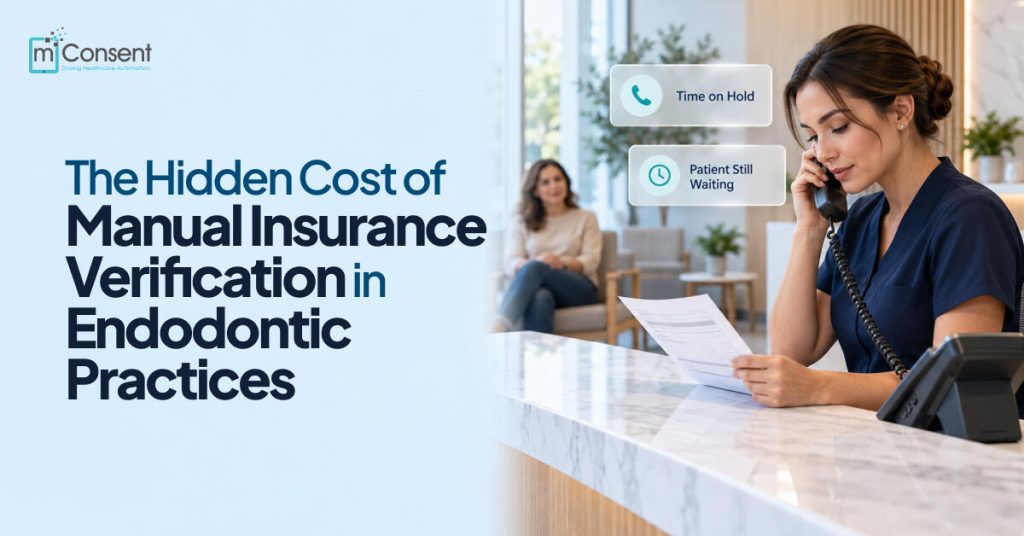
But when you do that work by hand, the real cost rarely shows up on any invoice. It hides in the minutes your front desk spends on hold, in the emergency patient waiting for coverage answers, in the claim that comes back short, and in the revenue that quietly slips away when the information arrives late or incomplete.
This is the hidden cost of manual insurance verification and in a practice built around urgent, high-value treatment, it adds up faster than most teams realize.
What Manual Dental Insurance Verification Actually Involves
Before you can measure the cost, it helps to see the full process. Manual dental insurance verification usually means a staff member works through the same sequence for every patient:
- Collect the patient’s insurance information.
- Call the payer or log into its portal.
- Confirm eligibility.
- Search for the relevant benefit information.
- Review deductibles and remaining benefits.
- Check coverage details for the planned procedure.
- Document everything in the system.
- Explain the financial picture to the patient.
- Start over whenever something is missing or unclear.
One patient, handled cleanly, feels manageable. The problem is that this sequence repeats across many patients, many payers, many procedures, multiple providers, and for growing groups, multiple locations. Layer in emergency and same-day appointments, and the “quick” task becomes a constant, unpredictable drain on your team.
Why Manual Verification Is Especially Costly for Endodontists
For a general practice, a verification delay is an inconvenience. For an endodontic practice, it can hold up care.
Endodontists frequently see emergency referrals and patients in real pain who need a decision quickly. Root canal treatment, retreatment, and treatment planning all hinge on knowing what a plan covers. When someone is sitting in your chair hurting, and the front desk is stuck navigating a phone tree or hunting through a payer portal, the administrative lag becomes something the patient actually feels.
That’s the core tension: the moments when patients most need timely endodontic care are exactly the moments your team has the least room to chase insurance information by hand. This is why dental insurance verification for endodontists deserves a closer look than it usually gets.
The 7 Hidden Costs of Manual Insurance Verification
1. Staff time lost to repetitive work
Manual verification asks employees to repeat the same low-value tasks: dialling carriers, navigating automated menus, waiting on hold, checking portals, searching for benefits, documenting results, and circling back on anything missing. None of it requires clinical skill, but it still consumes hours your team could spend elsewhere.
2. Front-desk productivity you can’t see on a timesheet
The cost isn’t only the minutes spent verifying. It’s everything that doesn’t happen while a team member is tied up. A staffer stuck on hold isn’t checking patients in, answering the phone, coordinating the schedule, walking a patient through treatment, or collecting a balance. Verification quietly crowds out the work that keeps your front office and your revenue moving.
3. Delays for emergency and urgent patients
When an emergency patient arrives, your team may need to reach a payer, wait for a representative, dig through a portal, confirm coverage, and pull together the numbers before anyone can talk treatment with confidence. Each step can add delay, and delays hit hardest on the urgent cases endodontists see most. This is where emergency dental insurance verification becomes a treatment-readiness issue, not just an admin one.
4. Verification errors and incomplete information
Manual processes leave more room for information to be entered incorrectly, misread, missed, documented incompletely, or gathered too late. And a small error early on tends to grow, into incorrect financial expectations, repeated verification, billing rework, claim headaches, and still more staff time spent cleaning it up.
5. Billing rework and endless follow-up
When the information you started with is incomplete or inaccurate, someone has to revisit the case: recheck eligibility, review benefits again, call the payer again, correct the patient record, clarify patient responsibility, and resolve the billing questions that follow. Rework is some of the most expensive time in the practice, precisely because it’s work you already did once.
6. Revenue leakage from delayed or incomplete information
This is where the hidden cost becomes a real financial cost. When insurance information is incomplete or arrives late, it’s harder to understand available coverage, communicate patient responsibility clearly, collect appropriately, identify financial expectations early, and reduce avoidable follow-up. Each gap is a small opening for revenue to leak out, through a missed collection, a delayed conversation, or a claim that never gets fully resolved. Poor or missing verification is a well-known driver of claim denials across dentistry, and endodontic practices are not exempt.
7. Patient trust and financial uncertainty
Patients want to know what their treatment is likely to cost. When your team can’t clearly explain coverage, deductibles, remaining benefits, and potential patient responsibility, that uncertainty sits with the patient, right at the moment they’re deciding whether to move forward with care. Clarity builds trust; guesswork erodes it.
How to Estimate What Manual Verification Really Costs You
Rather than relying on a one-size-fits-all figure, it’s more useful to build your own estimate. Here’s a simple framework:
- Step 1: Staff time. Multiply your number of verifications by the average minutes each one takes.
- Step 2: Labor cost. Multiply those verification hours by your loaded hourly staff cost.
- Step 3: Rework. Add the time spent on reverification, corrections, payer follow-up, and billing questions.
- Step 4: Opportunity cost. Ask what else that time could have gone toward: patient interactions, scheduling, collections and how much of it is being delayed.
- Step 5: Revenue impact. Consider whether incomplete or delayed information is contributing to missed collections, postponed financial conversations, billing rework, or unresolved insurance issues.
Run those five steps and the “small” administrative task usually looks a lot bigger and a lot more expensive than it did before.
How Better Verification Protects Your Revenue
Improving dental insurance verification isn’t about removing every human step. It’s to get the right information, earlier, with less friction. When verification works well, a practice can identify coverage sooner, understand deductibles and remaining benefits, communicate potential patient responsibility with confidence, close information gaps, reduce rework, and tighten the front-desk financial workflow. That’s how you keep revenue from leaking out through timing and paperwork.
How mConsent Insurance Concierge Helps
This is exactly the gap mConsent Insurance Concierge is built to close for endodontic practices and it’s worth being clear about what it is. It isn’t just another piece of dental insurance verification software that hands exceptions back to your front desk. It’s a managed workflow, backed by a dedicated team, that works the case for you and delivers detailed benefit breakdowns directly into your PMS.
In practice, that means Insurance Concierge helps your team:
- Reduce repetitive verification work, so staff spend less time on the same low-value tasks.
- Cut down on manual payer calls and the hold time that comes with them.
- Spend less time in insurance portals hunting for answers.
- Simplify benefit lookups, making key coverage details easier to access.
- See insurance information earlier in the patient workflow, often 24-48 hours before scheduled appointments.
- Lighten the front-desk load so your team can focus on patients and the rest of the practice.
- Communicate finances more clearly, with the coverage, deductible, and patient-responsibility details needed for a confident conversation.
The benefit breakdowns cover the details endodontists actually rely on: eligibility and effective dates, deductibles and remaining benefits, annual maximums, coverage percentages, root canal and retreatment specifics, procedure-level limitations, frequency limits, waiting periods, and secondary insurance coordination worked ahead of time and documented into your system, not left for your front desk to rekey.
This is what automated dental insurance verification should feel like in an endodontic setting: less repetitive dental insurance verification automation busywork, and more time for the patients in front of you.
The Real Cost of Manual Insurance Verification
On paper, manual insurance verification looks routine. In reality, it can cost staff time, cause delays, create errors, drive rework, increase patient uncertainty, and leak revenue.
The goal isn’t to eliminate every manual step. It’s to create a more efficient dental insurance verification workflow that gets your endodontic team the information it needs earlier while reducing repetitive work.
With mConsent Insurance Concierge, your practice can reduce payer calls, portal checks, and manual benefit lookups while accessing eligibility, coverage, deductibles, remaining benefits, and patient-responsibility information more efficiently.
Reduce the hidden cost of manual insurance verification.
FAQ
What is the hidden cost of manual dental insurance verification?
It goes well beyond staff time. Hidden costs can include lost front-desk productivity, verification delays, errors, billing rework, patient financial uncertainty, and revenue leakage from incomplete or delayed insurance information.
Why is manual insurance verification expensive for endodontic practices?
Because it pulls staff away from patients and everything else the front desk needs to do. Payer calls, portal checks, benefit lookups, and documentation all take time and in an endodontic practice full of urgent and same-day cases, that time is in short supply.
How does manual insurance verification affect endodontists?
It increases front-desk workload, creates delays for emergency patients, opens the door to verification errors, and makes it harder to have clear treatment and financial conversations before care begins.
Can manual insurance verification cause revenue leakage?
It can contribute to it. Incomplete or delayed insurance information can lead to missed collections, financial-communication gaps, and billing rework. Verification is one part of a broader revenue-cycle workflow.
What is dental insurance verification automation?
It’s the use of technology to streamline repetitive eligibility and benefits verification, reducing manual work like payer calls, portal checks, and repetitive benefit lookups. This frees your team to focus on more complex cases.
How can dental insurance verification software reduce staff workload?
By taking on repetitive eligibility checks, benefit lookups, payer calls, portal searches, and manual data entry, so that staff can focus on patients and the rest of the practice. mConsent Insurance Concierge goes a step further, pairing that efficiency with a dedicated team that works the case and delivers breakdowns into your PMS.