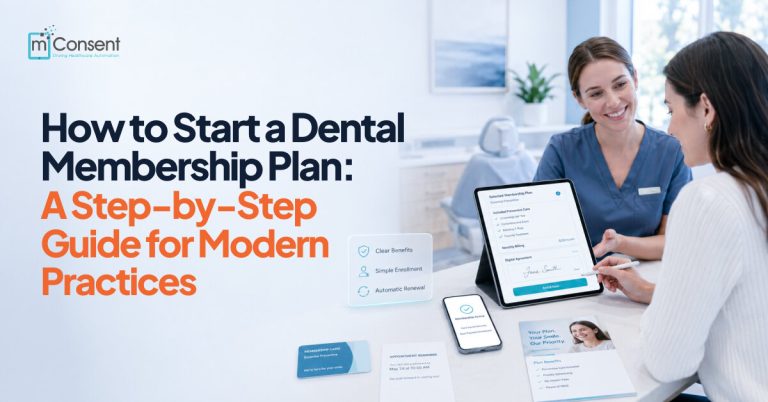





A dental membership plan looks simple on paper: patients pay a recurring fee, they get included care and a discount, your practice gets predictable revenue. In practice, plenty of well-intentioned membership programs quietly underperform not because the concept is flawed, but because of a handful of avoidable setup mistakes.
Here are the seven that come up most often, and how to fix each one before it costs you.
Mistake 1: Pricing the Plan Without Checking the Math First
It’s tempting to set your membership price based on what sounds attractive to patients – $20 a month has a nice ring to it without first confirming that $20 a month actually covers what you’re including.
If two included cleanings cost your practice more to deliver than the plan collects in a year, you’re not building recurring revenue. You’re subsidizing preventive care out of your own margin, and the discount you’re extending on additional treatment only makes that gap wider.
The fix: Add up your actual cost to deliver the included services before you land on a number. The price needs to clear that cost with room left over; otherwise, every enrolled patient is a net loss, not a win.
Mistake 2: Skipping the Down Payment
Without some kind of upfront payment at enrollment, you’ll eventually run into patients who sign up right before a cleaning, get the visit, and cancel shortly after collecting the included care without ever becoming a genuinely recurring member.
The fix: Build in a down payment at signup, even a modest one. It doesn’t need to be large enough to feel like a barrier to enrollment; it just needs to be large enough that signing up purely to get one free-feeling visit isn’t worth the hassle.
Mistake 3: No Cancellation or Reactivation Policy
If a patient can cancel anytime with zero consequence and re-enrol later with zero consequence, the plan effectively becomes “pay only in months I’m using it”, which defeats the purpose of a recurring model.
The fix: Set clear terms upfront: what happens to unused benefits on cancellation, and a small reactivation fee if someone wants to re-enrol after canceling. This isn’t about penalizing patients; it’s about making sure the plan behaves like the recurring commitment it’s designed to be, not an à la carte menu.
Mistake 4: Selling the Mechanism Instead of the Outcome
This is a messaging mistake, not an operational one, but it’s just as costly. It’s easy to describe a membership plan by explaining how it works: “We’re fee-for-service, so you pay us directly instead of through insurance” and assume that’s the pitch.
It isn’t. That’s a description of the mechanism, not the outcome the patient actually cares about. Nobody enrols in a membership because they want to understand your billing structure. They enrol because it’s a predictable, affordable way to keep up with their oral health without navigating an insurance company.
The fix: Lead with what the patient gets: Predictable cost, no surprise bills, discounts on care they’ll eventually need, and only explain the fee-for-service mechanics if they ask. Save the “how it works” explanation for the fine print, not the headline.
Mistake 5: Running Recurring Billing Manually
A spreadsheet works fine for five members. It falls apart at fifty. Manually tracking who’s due for a charge, whose card expired, and who missed a payment is exactly the kind of task that quietly leaks revenue, not because anyone’s careless, but because manual processes don’t scale with volume.
The fix: Use a system built to handle recurring billing automatically: saving a card on file at enrollment, charging it on schedule without manual intervention, and surfacing failed charges instead of letting them go unnoticed. This is the operational core mConsent’s Membership module is built to handle plan setup, automated recurring billing, and card-on-file management, so growth in membership numbers doesn’t mean a proportional growth in administrative hours.
Mistake 6: Not Monitoring Failed Payments Regularly
Even with automated billing, cards expire, get replaced, or get declined. If nobody’s actively checking for failed or overdue payments on a regular basis, memberships quietly lapse without anyone noticing and the patient often doesn’t realize it either, until they show up assuming they’re still covered.
The fix: Make checking for failed or overdue payments a standing weekly task for your front desk, not an occasional one. Catching a declined card within a week is a quick conversation. Catching it three months later is an awkward one, and by then you’ve likely lost several billing cycles of revenue from that member.
Mistake 7: Launching Without a Signed Agreement
A membership is a recurring financial commitment, which means it needs the same rigor as any other agreement your patients sign: clear terms on billing frequency, what’s included, and cancellation policy, all captured in writing at enrollment.
Skipping this because it feels like “just a subscription” creates real exposure: if a billing dispute comes up later, there’s nothing on file establishing what the patient actually agreed to.
The fix: Get the agreement signed at the same time as enrollment, whether that’s in person, on a tablet, or sent digitally to the patient’s phone. Don’t treat the signature as a formality to circle back to later; bake it into the enrollment moment itself.
The Pattern Behind All Seven
Look closely at these seven mistakes and a pattern emerges. Almost all of them come from treating a membership plan like a one-time setup task instead of an ongoing system. Pricing needs revisiting as costs change. Billing needs active monitoring, not just automation. Policies need to be clear from day one, not clarified after the first dispute.
The practices that get the most out of membership plans are the ones that build the operational discipline in from the start: clear pricing logic, a real cancellation policy, signed agreements, and a billing system that surfaces problems before they become lost revenue.
Building or troubleshooting a membership program and want to see how the billing side can run on autopilot? Book a demo with mConsent and we’ll show you what’s possible.