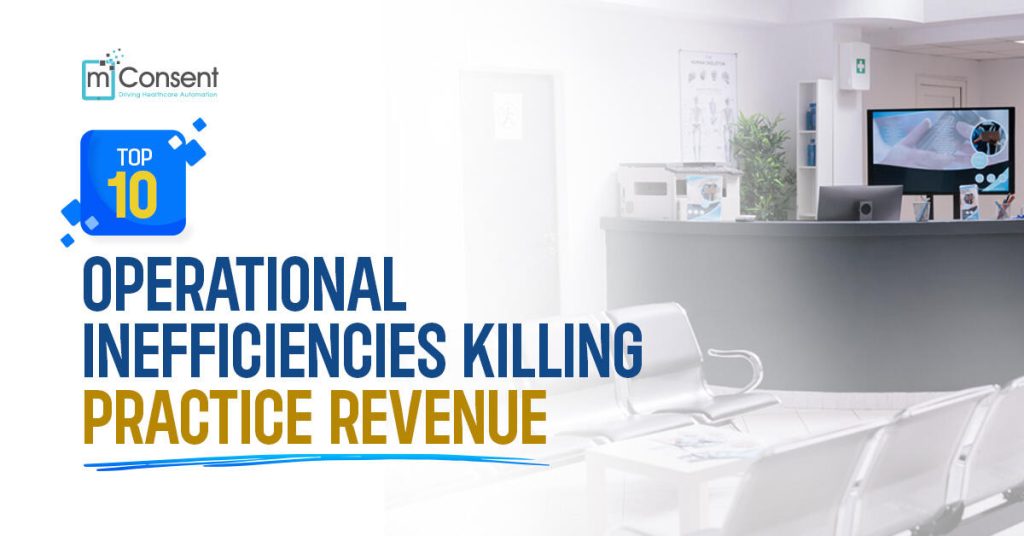




Revenue Loss Doesn’t Always Come From Low Case Volume
Increasing marketing expenditures is frequently the natural reaction of dental practices experiencing stagnant or declining revenue. More advertisements, promotions, and new patients. Patient acquisition is important, but many practices ignore operational leakage, a more subtle but far more serious issue.
Every day, operational inefficiencies steal money. Although they are not readily apparent on a profit-and-loss statement, they can be seen in underutilized chairs, overworked employees, delayed schedules, and incomplete paperwork. It is not possible to bill for any additional time spent pursuing forms, re-entering data, or awaiting consent.
Paperwork, consent delays, and administrative bottlenecks rarely feel like revenue issues. They feel like “just how the office runs.” Yet these inefficiencies compound across hundreds of patient visits, quietly suppressing production, cash flow, and scalability.
In today’s environment, operational efficiency is no longer an internal cleanup task. It is a growth strategy. Practices that streamline workflows outperform those that rely on manual processes, even with the same patient volume.
This is where platforms like mConsent shift the conversation. Digital consent is not just a compliance tool it becomes an automation engine that connects intake, treatment, billing, and payments into a single, efficient workflow.
How Operational Inefficiency Impacts Revenue in Dental Practices
The Direct Link Between Time, Flow, and Production
Time is the most important factor in dental income. Time spent in a productive chair makes money. Chair time that is interrupted, delayed, or not used does not. When administrative delays, missing consents, or paperwork problems mess up clinical schedules, practices lose money every hour.
One missed appointment might not seem like a big deal, but the loss adds up over days, weeks, and months. High-performing practices keep chair time by getting rid of tasks that don’t add value to the clinical workflow.
Why Manual Consent Is a Revenue Bottleneck
Consent is a gatekeeper. No treatment, billing, or claim can move forward without it. When consent is handled manually, that gate becomes fragile and slow.
Paper consents are often unsigned, incomplete, misplaced, or discovered too late. Each issue introduces friction that delays care and revenue recognition.
The Compounding Effect of Small Delays
One delayed consent doesn’t just affect one appointment. It creates a ripple effect:
- Schedules back up
- Waiting rooms fill
- Staff scramble
- Patients become frustrated
Over time, these small inefficiencies compound into lost appointments, reduced production, and staff burnout.
Inefficiency 1: Manual Patient Check-In That Disrupts Schedule Flow
What Happens in Paper-Based Practices
Check-in in paper-driven offices starts with clipboards, filling out forms repeatedly, and front desk employees balancing phones and paperwork. Due to incomplete forms, patients frequently arrive early but still postpone the start of their appointments.
Operational Breakdown
- Late appointment starts
- Crowded waiting rooms
- Peak-hour bottlenecks
Revenue Impact
- Fewer patients seen per day
- Reduced daily production
How mConsent Solves It
Patients can fill out pre-visit digital intake and consent forms before they arrive. Chair time is safeguarded, schedules become predictable, and check-ins speed up.
Inefficiency 2: Employee Hours Lost to Form Corrections and Data Entry
Undiscovered Time Drain in Administration
Handwritten forms require manual re-entry into practice management systems, forcing staff to correct errors, chase missing information, and decipher unclear or illegible responses.
Why This Kills Productivity
Administrative work replaces patient-facing tasks, increasing overtime costs. Skilled team members spend hours on low-value work.
Revenue Impact
- Higher labor costs
- Lower return on investment per staff member
Automation Advantage
Smart digital forms do away with the need to re-key information, automatically gather patient data, and must be filled out before they can be sent.
Inefficiency 3: Delayed or Missing Consent Signatures
Why Paper Consents Slow Everything
People often find unsigned forms just before procedures. This means that treatments are put on hold, appointments are moved, or explanations are rushed.
Workflow Disruptions
- Clinical interruptions
- Wasted chair time
Revenue Loss
- Missed procedures
- Underutilized schedules
How mConsent Fixes It
Digital consents are sent before appointments, tracked in real time, and completed prior to arrival ensuring treatment can begin on time.
Inefficiency 4: Paper-Based Treatment Plan Reviews
Problems with Traditional Treatment Paperwork
Paper treatment plans are often hard to read, inconsistent, and lack visual clarity.
Operational Consequences
- Longer explanation times
- Repeated conversations
Revenue Impact
- Lower case acceptance
- Delayed decisions
Solution
Clear digital treatment plans provide structured, consistent presentations that help patients understand and approve of care more quickly.
Inefficiency 5: Front-Desk Overload and Task Switching
Daily Reality for Front-Desk Teams
People who work at the front desk answer phones, take payments, fill out paperwork, and answer patient questions all at the same time. Switching tasks all the time makes mistakes more likely and adds stress.
Operational Cost
- Burnout
- High turnover
Revenue Impact
- Hiring and training expenses
- Slower patient throughput
How mConsent Makes It Easier
Self-service digital workflows cut down on interruptions in person and let staff focus on the patient experience instead of paperwork.
Inefficiency 6: Poor Patient Flow Between Care Stages
Where Paper Breaks the Flow
Waiting for finished forms and manual handoffs slows down the process of going from intake to treatment to checkout.
Bottlenecks Created
- Patients waiting between steps
- Delayed procedures
Revenue Impact
- Reduced chair utilization
- Longer visit times
Streamlined Flow
Automated consent connects intake, treatment, and billing with clear next steps and no delays.
Inefficiency 7: Delayed Billing and Payment Processing
Impact of Paperwork on Billing Delays
Missing documentation often delays billing until after the visit, requiring follow-up and increasing accounts receivable.
Revenue Impact
- Slower cash flow
- Higher A/R balances
mConsent Advantage
Real-time documentation completion ensures same-day billing readiness and faster collections.
Inefficiency 8: Paper Storage, Printing, and Waste Costs
The Hidden Cost of Paper
Printing, storing, and throwing away things cost money that doesn’t help with patient care.
Environmental and Financial Impact
- Increased supply costs
- Inefficient use of office space
Digital Alternative
Fully paperless workflows help the environment and cut down on supply costs.
Inefficiency 9: Compliance and Audit Inefficiencies
Risks of Paper Records
Paper documents can be lost, damaged, or difficult to retrieve during audits.
Revenue Risk
- Fines
- Legal exposure
Compliance Automation
Secure digital storage, audit-ready logs, and instant retrieval reduce risk and save time.
Inefficiency 10: Inability to Scale Operations Efficiently
Why Paper Limits Growth
It’s hard to make paper processes the same for everyone and hard to train people on them in different places or teams.
The Revenue Ceiling Created
As complexity increases, each additional patient requires greater manual coordination, more staff time, and more error correction, leading to disproportionate overhead growth. Without automation, practices hit a revenue ceiling where costs rise faster than production, compressing margins despite higher volume.
How mConsent Enables Scale
Centralized templates and consistent workflows allow practices to grow without operational chaos.
Quantifying the ROI of Automated Digital Consent
When digital consent is used, practices usually see:
- A lot of administrative time is saved each week
- More use of chairs
- Lowered costs for paper and supplies
- Faster collections and better cash flow
Conclusion
Digital consent isn’t just a feature; it’s the operational foundation that ties intake, treatment, billing, and payments into a single, seamless workflow, closing the gaps that slow teams down and quietly drain revenue. Practices that consistently use mConsent see measurable benefits, such as faster patient flow, lower administrative costs, and higher daily production without adding more patients.
By 2026, patients will increasingly expect digital-first experiences, and practices that invest in automation and efficiency will gain a distinct competitive edge through smoother operations and improved patient satisfaction. True revenue growth begins within the practice, and by eliminating operational inefficiencies, dental offices unlock hidden capacity and profitability, elevating consent from a compliance task into a strategic driver of productivity, scalability, and long-term growth.
“