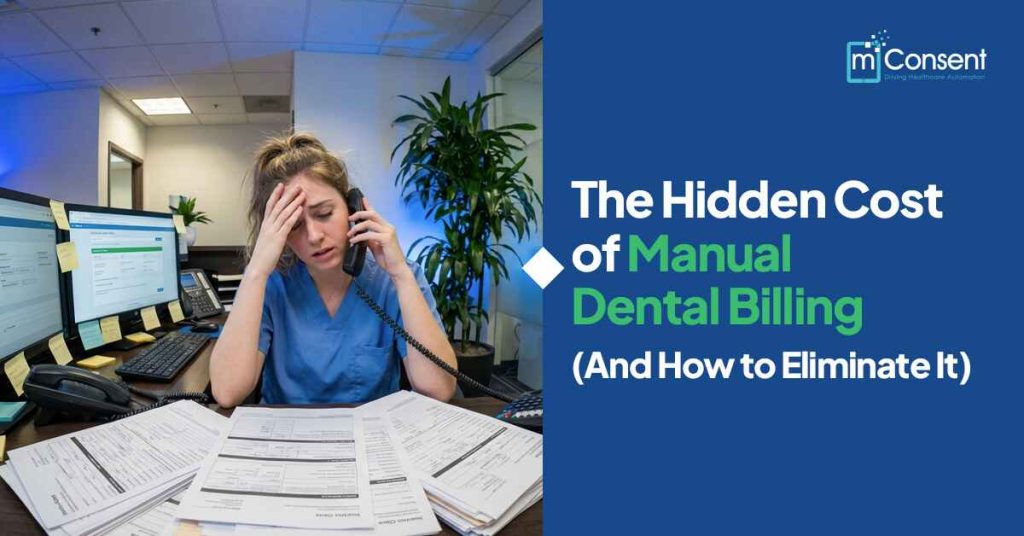



If you’ve ever stood at the front desk at 5:45 PM, phone pressed to your ear, listening to hold music while a room full of patients waits and your front desk coordinator shoots you a desperate look, you know the scene. The insurance company is taking its sweet time, you’re trying to verify benefits for a new patient tomorrow, and you still have three claims to resubmit before you can close out the day. It’s chaos. And it feels strangely normal.
We spend so much time blaming insurance companies for slow payments and denials, and sure, they deserve their share of the blame. But there’s a quieter, more insidious culprit draining the profitability of dental practices everywhere: the manual billing workflow itself. It’s the clipboards, the sticky notes, the spreadsheets, and the endless tabs open in your browser.
The true cost of manual dental billing isn’t just the hourly wage of the person doing the work. It’s the revenue you never capture, the staff you burn out, and the patient trust you quietly erode. And the best part? It’s entirely preventable.
What “Manual Billing” Really Looks Like Today
When we say “manual dental billing,” we aren’t just talking about printing paper statements and licking stamps (though that still happens). In 2026, manual billing is a hybrid of old habits and disconnected technology. It looks like this:
- Insurance Verification by Phone: A staff member calls an insurance provider, waits on hold for 10 to 20 minutes, and jots down benefits on a notepad.
- Spreadsheet Chaos: You have an Excel file tracking outstanding claims, but three people update it, and no one is sure if the data from last Tuesday is accurate.
- Reactive Follow Ups: You only call about a claim because you happen to notice it’s 60 days old while looking for something else.
- Manual Payment Posting: Paper EOBs (Explanation of Benefits) arrive in the mail, and a team member manually enters data line by line.
- Guesswork Estimates: You give a patient a rough idea of what their crown might cost, crossing your fingers that the insurance pays as expected.
Many practices cling to these methods because of the “if it isn’t broken, don’t fix it” mentality. There’s a fear that switching to automation will be expensive or that the learning curve will shut down the practice for a week. But the reality is that the perceived safety of manual work is an illusion. It’s costing you far more than you realize.
The Hidden Costs of Manual Dental Billing
Let’s pull back the curtain on what these workflows actually cost your practice. It goes far deeper than just the line item for payroll.
1. The Staff Time Drain (Your Most Expensive Resource)
We see it all the time: a highly skilled treatment coordinator spending two hours on insurance calls instead of presenting a treatment plan. A front desk person staying late to post payments manually when they should be confirming next week’s appointments.
Manual billing is a black hole for time. Every time you have to re-enter data, make a call to check on a claim status, or chase down a missing signature, you’re burning dollars. That time isn’t just lost; it’s misallocated. Your team’s energy should be going toward patient care and production, not acting as unpaid insurance clerks.
2. Revenue Leakage (The Money You Never See)
This is the silent killer. Revenue leakage isn’t always a dramatic $5,000 denial. It’s the slow drip of small, uncaptured dollars.
- Missed Secondary Insurance: You bill the primary, but forget to send it to the secondary, and the $300 balance sits there until it’s written off.
- Forgotten Small Balances: You tell a patient, “Don’t worry about the $20 today, we’ll bill you.” That bill gets lost in the shuffle, and chasing a $20 balance costs more in labor than it’s worth.
- Under-Collection at Checkout: Without a verified, real-time benefit check, you collect the wrong co-pay. You might collect $200 when you should have collected $350.
These small leaks add up to thousands of dollars a year—money that is earned but never realized.
3. Increased Claim Denials and Delays
Manual data entry is prone to human error. A mistyped ID number, an old policy date, or a missing tooth number can kick a claim back, adding 30 days to your payment cycle. Even worse is the “missing documentation” denial. You submit a claim, but because you didn’t have the latest x-ray attached (because you forgot to scan it manually), it gets denied.
The worst part? You often don’t know it’s denied until weeks later when you finally have time to check. By then, the appeal window is closing, and the patient is frustrated.
4. Accounts Receivable (AR) Growth
When your follow-up is inconsistent, your AR ages. Balances that sit at 60, 90, or 120+ days become exponentially harder to collect. The patient forgets why they owe the money, or they assume the insurance already paid it. Manual billing creates a “set it and forget it” environment for receivables, which is the fastest way to starve your practice of cash flow.
5. Staff Burnout and Turnover
Let’s talk about the human cost. Front desk teams are on the front lines of financial conflict. They have to tell a patient, “Actually, your insurance didn’t cover that,” and then deal with the resulting frustration. They spend their days on the phone with unhelpful insurance representatives and their evenings reconciling spreadsheets.
This constant stress leads to burnout. And when a good front office coordinator quits, you’re not just losing a person; you’re losing institutional knowledge. The cost of hiring, training, and the productivity dip during the gap is massive.
6. Poor Patient Experience
Patients don’t understand insurance. They just know that when they sat in your chair, you said it would be “mostly covered.” So when they get a surprise bill three weeks later, they don’t blame the insurance company; they blame you. They leave negative reviews citing “bait and switch” tactics or “hidden fees.” In the era of online reputation, a few billing disputes can significantly damage the trust you’ve worked so hard to build.
Why Most Practices Don’t Notice the Problem
If manual billing is so bad, why do so many practices live with it? Because it’s normalized. It’s the “background radiation” of the dental office. You’re so busy putting out fires that you don’t realize the arsonist is your own workflow.
Practice owners often look at the profit and loss statement and see a good month. They don’t see the $2,000 they left on the table because of missed secondary claims. They don’t calculate the “opportunity cost” of the time wasted on hold. The pain is real, but it’s diffuse. It feels like just part of the job. It doesn’t have to be.
How to Eliminate These Costs: The Path to Automation
The Manual Reality:
Sarah at the front desk calls to verify insurance. She writes the benefits down. She enters them into the PMS. She prints an estimate. The patient leaves. The claim is submitted. 45 days later, Sarah realizes it wasn’t paid, so she calls the insurance. She finds out the patient’s coverage changed. She has to rebill the patient. The patient is annoyed. Sarah is exhausted.
The Automated Reality:
A new patient checks in via a tablet or their phone. Their insurance card is scanned, and real-time eligibility is run instantly. The system calculates the exact patient portion based on current benefits. The patient signs the estimate digitally right there. The claim is submitted electronically with all necessary attachments. If there’s a delay, the system flags it, and a reminder pops up for a quick resolution. The patient gets a text link to pay their balance before they even leave the parking lot.
Step 1: Automate Insurance Verification
Stop playing phone tag. Integrated verification tools run checks in seconds, not minutes. They provide a clear, structured breakdown of benefits that you can share with the patient immediately. This eliminates the “guess” from treatment estimates and drastically reduces denials based on expired coverage.
Step 2: Standardize Patient Estimates
Surprise bills are the number one cause of patient frustration. By using digital forms and treatment plans, you can provide a clear, itemized cost summary before treatment begins. When the patient signs that document via email or text, you have proof they understood the financial responsibility. It shifts the conversation from “You owe me money” to “Here is what we agreed upon.”
Step 3: Automate Claim Tracking
You shouldn’t have to remember to check on a claim. Your software should. Automated systems track the lifecycle of every claim. They alert you when a claim is aging, when a denial is received, and when a follow-up is due. This takes the mental load off your team and ensures nothing falls through the cracks.
Step 4: Integrate Embedded Payments
This is where cash flow accelerates. Instead of printing a statement and waiting for a check in the mail, convert your treatment plan into a payment link. Send it via SMS. The patient can click, pay with a credit card or HSA/FSA card, and be done. It’s instant. It’s easy. It reduces your AR days from 45 to under 30.
Step 5: Centralize Communication
Keep all financial conversations, estimates, and signed consents in one auditable log. If a patient disputes a charge, you have the digital proof of what they signed and when they signed it. This protects your practice legally and reduces the anxiety of “your word against theirs” conflicts.
A Soft Introduction to the Solution
This isn’t just a theory. Platforms like mConsent are designed specifically to bridge this gap. They take the manual, sticky-note workflows and digitize them.
Imagine your front desk never having to pick up the phone for a verification call again because mConsent’s automated insurance workflows handle it in real time. Imagine patients filling out their own insurance info through digital intake forms, eliminating data entry typos.
Then, picture using mPayr to send that treatment plan as a click-to-pay text message right after the consult. The patient pays their share before they leave, and the money hits your account in days, not weeks. The system logs everything, creates a clear estimate, and even tracks your AR so you can see exactly where your bottlenecks are. It transforms billing from a source of stress into a seamless part of the patient experience.
The Future of Dental Billing
We are moving toward a world where manual verification will look as outdated as paper charts. The future includes AI that predicts which claims are likely to be denied before you even submit them. It includes smart payment reminders that send a gentle text to a patient based on their typical payment behavior. It includes revenue forecasting dashboards that show you your financial future based on current scheduled treatment.
The practices that adopt these tools now aren’t just saving time; they are building a competitive advantage. They are the practices with happier staff, healthier cash flow, and patients who trust them.
Conclusion
Manual dental billing is a hidden tax on your practice. It doesn’t just cost you a little time; it costs you revenue through leakage and denials, it costs you staff morale through burnout, and it costs you patient trust through surprise bills and confusion.
By embracing automation, you aren’t just “upgrading software.” You are fundamentally changing how your practice operates. You are building a system that reduces denials, accelerates payments, prevents disputes, and protects your team from the exhausting cycle of manual follow up.
It’s time to stop working in the billing chaos and start managing your practice’s financial health with clarity and control. Discover how mConsent can help you eliminate the hidden costs of manual billing and move toward intelligent revenue management.
Book a demo today and see the difference automation can make.
FAQ’s
1: What are the biggest hidden costs of manual dental billing?
A: The biggest hidden costs include the excessive staff time spent on repetitive tasks, the slow bleed of revenue from missed secondary claims and under collections, increased claim denials due to human error, the growth of aging accounts receivable, and the high cost of staff burnout and turnover.
2: How does automation reduce dental billing errors?
A: Automation reduces errors by removing manual data entry. It verifies insurance eligibility in real time directly from the source, uses standardized digital forms for estimates, and automatically tracks claims to ensure they are complete and submitted correctly, catching issues before they become denials.
3: Can small, solo practices really eliminate manual billing?
A: Absolutely. In fact, automation is often even more impactful for smaller teams. With fewer hands to handle the workload, automation tools handle the heavy lifting of verification and follow up, allowing the small team to focus on patient care and production without getting buried in paperwork.
4: Does automation actually reduce staff workload, or just add another task?
A: When implemented correctly, automation drastically reduces workload. It eliminates the need for manual data entry, hold times with insurance companies, and manual claim tracking. It frees your team up to focus on higher value tasks like patient relationship building and treatment acceptance.
5: How quickly can a practice expect to see a return on investment?
A: Many practices see measurable improvements within the first 30 to 60 days. The most immediate changes are often seen in accounts receivable as payments are collected faster at the time of service via payment links, and in staff morale as the burden of manual work decreases.
“