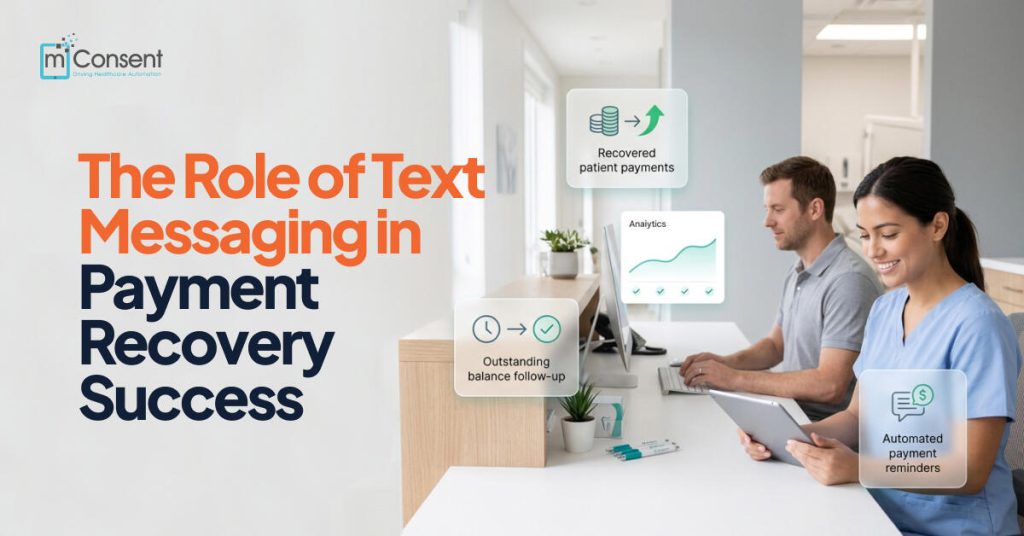




What if one simple text message could recover thousands in unpaid dental bills?
In today’s fast-paced, mobile-first world, patients aren’t ignoring their payments; they’re ignoring outdated communication methods. Phone calls go unanswered. Paper statements get lost. Emails sit unopened.
Meanwhile, your accounts receivable quietly grows.
People are willing to pay, so that’s not the problem.
It’s the way you’re asking for money.
Text messaging is now the fastest, most direct, and most effective way to get in touch with patients and get paid.
Platforms like mConsent are changing the way dental offices get paid by putting automated SMS reminders, text-to-pay, and real-time patient communication into one smooth workflow.
Understanding Payment Recovery in Dentistry
What is Payment Recovery?
Payment recovery is the process of getting patients to pay off their bills after they have been treated. It is very important for dental practices to keep their cash flow steady and their finances stable.
Why Payment Recovery is Challenging
Dental offices have to deal with a lot of problems, such as:
- Costs for patients are going up.
- Late or unclear communication
- Not having organized follow-ups
Traditional Payment Recovery Methods
Most practices still depend on:
- Calls on the phone
- Statements sent in the mail
- Reminders in person
Limitations of Traditional Methods
These approaches are no longer effective:
- Low response rates
- Time-consuming for staff
- High operational costs
Why Text Messaging is a Game-Changer
SMS is the best way to get in touch with patients because it gets to them where they are: on their phones. Text messages are much more likely to be read than emails or voicemails because they have an open rate of about 98%. They also make things easier right away, letting patients read, respond, and even make payments in seconds, with no problems or delays. SMS is less intrusive than phone calls because it doesn’t interrupt the patient’s day, but it still gets their attention and makes them act, which makes it very effective.
How Text Messaging Impacts Payment Behavior
- Less likely to forget: Timely reminders make sure payments don’t get lost.
- Makes things urgent: A text message needs to be read right away.
- Makes Payments Easier: Patients can pay with just one click when they use text-to-pay.
- Builds Trust with Patients: Clear, open communication makes things less confusing and boosts confidence.
Key SMS Strategies for Payment Recovery Success
Automated payment reminders help you stay on track without making your team do more work. You don’t have to do follow-ups by hand anymore. Make a simple plan: send the bill on Day 1, a reminder on Day 3, and a follow-up on Day 7. This helps things move along faster and keeps patients up to date on their payments.
Adding links to text-to-pay in every message makes things even easier. Patients can pay right away by clicking a button, without having to log in or call the office. Messages that include the patient’s name and balance information are more likely to get a response because they seem more relevant.
A follow-up plan with steps that are in order also works better. Send a friendly reminder first, then a follow-up, and if you need to, a more urgent message. Two-way messaging lets patients respond, ask questions, or ask for payment plans, which makes the whole process easier and more patient-friendly.
Types of SMS Messages for Payment Recovery
- Invoice Notification: “Your bill is ready”
- Payment Reminder: Soft nudges to pay
- Messages to Follow Up: Make it more urgent
- Confirmation of payment: builds trust
- Offers for Payment Plans: Gives more options
Timing & Frequency Strategy
Best Times to Send SMS
- Morning (before work)
- Evening (after work hours)
Optimal Frequency
2-3 reminders per billing cycle is ideal. Avoid over-messaging.
Trigger-Based Messaging
Send messages based on what people do:
- After the appointments
- After the invoice is made
Escalation Strategy
Increase urgency gradually without overwhelming the patient.
SMS Workflow for Payment Recovery
Stage 1: Post-Treatment
Send invoice via SMS immediately
Stage 2: Reminder Sequence
- Day 2: Reminder
- Day 5: Follow-up
Stage 3: Escalation
Final reminder with urgency
Stage 4: Resolution
Payment completed or payment plan initiated
High-Converting SMS Templates
Invoice SMS
“Hi [Name], your invoice is ready. Pay securely here: [link]”
Reminder SMS
“Friendly reminder: your balance of $X is due. Pay here: [link]”
Follow-Up SMS
“We’re here to help! Let us know if you need assistance.”
Urgent Reminder
“Final reminder: please complete your payment today.”
Payment Plan Offer
“Need flexibility? Ask us about payment plans.”
Benefits of SMS for Revenue Recovery
- Faster Payments: Get paid faster and keep your cash flow steady.
- Higher Collection Rates: More people who are involved pay more.
- Less Work for Admin: Follow-ups are automated.
- Better Patient Experience: Simple, fast, and stress-free.
- Cost-Effective: Less expensive than phone calls and mailed statements.
Common Mistakes to Avoid
Don’t make common mistakes that make SMS payment recovery less effective. Sending too many texts can annoy patients, while generic messages without personalization often get ignored. Not including a payment link adds extra steps, which makes it less likely that patients will finish the payment. If you don’t have a clear plan for following up, you could miss messages because of bad timing. This could mean you miss out on chances to collect unpaid bills.
Measuring SMS Effectiveness (KPIs)
Keep track of performance with:
- Rates of opening
- Rates of clicks
- Rates of payment conversion
- Time it takes to process payments
- Less time spent on accounts receivable (AR days)
How mConsent Maximizes SMS Payment Recovery
mConsent is more than just a messaging app; it also includes a full payment recovery system:
- Automated SMS Workflows: Reminders that are set up ahead of time make sure things stay the same.
- Integration of Text-to-Pay: Patients can pay right away from their phones.
- Two-way messaging: Talking to each other in real time helps build trust.
- Smart Automation: Messaging that starts when the patient does something
- Analytics Dashboard: Watch how things are going and make changes as needed.
The Future of SMS in Payment Recovery
The future of payment recovery is becoming simpler and smarter with better communication. AI-powered personalization helps practices send messages that feel more relevant by using each patient’s history and preferences, instead of sending the same message to everyone. Predictive messaging takes it a step further by identifying the best time to send reminders, so patients are more likely to respond and pay on time.
Omnichannel communication also lets patients talk to each other through SMS, email, or apps, whichever they want, which makes things go more smoothly. Chat-based payments make it even easier because patients can ask questions, look at their options, and make payments all in one conversation. All of these changes make payment recovery faster and more efficient, which leads to more collections and happier patients.
Conclusion
It’s not just about billing when it comes to getting paid; it’s also about how well you talk to your patients. Today, SMS is the best way to get through the noise of missed calls and ignored emails. It’s quick, easy, and made to fit how patients already interact. With the right system in place, practices can turn simple reminders into steady income by reducing wait times and making it easy for patients to pay.
With mConsent, dental offices can automate the whole process of getting paid back, from smart reminders to easy text-to-pay, without making the front desk do any extra work. The end result is quicker collections, fewer follow-ups, and a better experience for patients.
Make money from every message. With mConsent, you can start using SMS-driven payment recovery to get paid faster and with less work.
FAQs
1. What makes SMS a good way to get money back?
Because it gets to patients right away and has very high open rates.
2. What does “text-to-pay” mean?
A feature that lets patients pay directly through a secure link sent by text message.
3. How often should reminders to pay be sent?
Usually, there are two or three reminders over the course of a week.
4. Can SMS help speed up payments?
Yes, a lot, by speeding up communication and getting more people to respond.
5. Is it safe to pay with SMS?
Yes, as long as you use secure, HIPAA-compliant platforms like mConsent.