

A patient’s plan shows “active” on Monday. The crown is seated on Thursday. Three weeks later, the claim comes back denied for a waiting period nobody saw. Your team now has to call the patient about a bill they never expected.
That scenario is getting more common. In a 2026 industry survey of more than 160 dental revenue cycle professionals, 71% named insurance verification as their top daily operational challenge, and 78% said claim denials and payer scrutiny had increased over the previous 12 months. And 2027 adds new code sets, benefit cuts, and coverage rules on top of that workload.
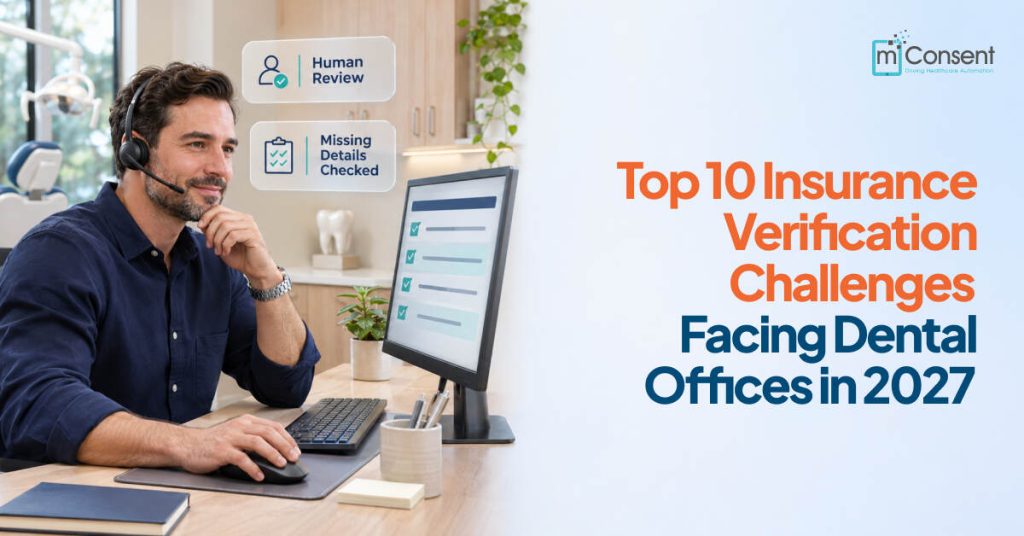
This article covers the 10 biggest dental insurance verification challenges your office will face in 2027 and a practical fix for each one.
What Are the Biggest Dental Insurance Verification Challenges in 2027?
The top challenges are:
- “Active coverage” that hides benefit limits
- Incomplete electronic eligibility data
- Payer portal logins, MFA, and downtime
- Rising claim denials and payer scrutiny
- CDT 2027 code changes
- Medicare Advantage dental benefit cuts
- Medicaid coverage churn from new work requirements
- January plan resets and mid-year plan changes
- Coordination of benefits with secondary and family plans
- Front desk capacity and staff turnover
Why Dental Insurance Verification Is Harder in 2027
Verification is already the most expensive administrative task in a dental office. According to the CAQH Index, dental practices spent $2.1 billion on eligibility and benefit verification in 2023. That was the largest share of dental administrative spending, and CAQH estimates $580 million a year could be saved by moving manual and portal checks to fully electronic transactions.
In 2027, payers are changing plan designs, new codes take effect on January 1, and Medicaid eligibility rules tighten. Each change creates more chances for a verification to be incomplete or out of date.
Prevent Denials with Automated Verification
The Top 10 Insurance Verification Challenges for Dental Offices
1. “Active Coverage” That Hides Benefit Limits
Dental insurance eligibility verification confirms that a policy exists. It does not confirm that a specific procedure will be paid. A patient can be active but have no annual maximum left, a missing-tooth clause on a planned bridge, or a frequency limit on the fluoride your hygienist is about to apply.
How to Fix: Treat eligibility as step one. Full dental benefits verification should cover coverage percentages by category, deductibles, remaining maximums, waiting periods, frequency and age limits, downgrades, and the missing tooth clause.
2. Incomplete Electronic Eligibility Data
Standard electronic eligibility responses often leave out the dental details your team needs, so most offices still rely on payer portals and phone calls. The ADA has noted that this data gap keeps practices dependent on portals. A newer CAQH CORE operating rule requires dental responses to include frequency limits, waiting periods, age limits, and remaining benefits, but adoption across payers will take time.
How to Fix: Don’t assume an automated response is complete. Build a checklist of required fields, and fill any gaps with a portal lookup or a payer call before the appointment.
3. Payer Portal Logins, MFA, and Downtime
Most payers now require multi-factor authentication (MFA) on provider portals. When a session expires, a code goes to a former employee’s phone, or a portal goes down, verifications stall until someone notices, often at check-in.
How to Fix: Keep a shared, secure credential and MFA ownership list, and flag any failed verification as open work, not a completed check. If you use dental insurance verification automation, ask the vendor how it handles expired sessions and failed lookups.
4. Rising Claim Denials and Payer Scrutiny
Payers are tightening how they apply medical necessity rules and frequency limits. Many of those denials trace back to the verification step, such as missed frequency limits, undocumented waiting periods, or the wrong benefit applied to a procedure.
How to Fix: Log every denial with its reason code and trace it back to where it started. If frequency limits and waiting periods are among your top denial reasons, the fix belongs in your dental insurance verification process, not in billing.
5. CDT 2027 Code Changes
The ADA approved 67 changes to the CDT Code for 2027, including 28 new codes and 33 revisions, all effective January 1, 2027. The new codes cover implant healing caps, orofacial pain injections, and interim fixed dentures, and D2390 can now be reported on any tooth. Payers will not all update their coverage rules for these codes on the same timeline.
How to Fix: Verify eligibility by CDT code for any new or revised procedure in Q1 2027, and confirm the payer recognizes the code before treatment.
6. Medicare Advantage Dental Benefit Cuts
Many Medicare Advantage plans are cutting dental benefits for 2027. An analysis of 2027 plan data reported by Healthcare Dive found dental cuts affecting about 70% of UnitedHealthcare’s Medicare Advantage members, with reductions at several other large carriers. Patients who had generous dental allowances in 2026 may have far less in January.
How to Fix: Re-verify every Medicare Advantage patient after January 1. Explain plan changes to patients before treatment so the new balances don’t surprise them at checkout.
7. Medicaid Coverage Churn From New Work Requirements
Federal Medicaid changes include work requirements for many adults, set to be enforced by January 1, 2027, along with stricter eligibility documentation. More patients will show up believing they’re covered when their coverage has lapsed.
How to Fix: Verify Medicaid eligibility close to every appointment, not just at the first visit. Know your state’s rules, which can differ across state lines.
8. January Resets and Mid-Year Plan Changes
Most plans reset deductibles and maximums on January 1, and employer plan switches happen year-round. Verifying too early, or relying on a breakdown from six months ago, puts outdated benefits into your patient estimates.
How to Fix: Time verification to the schedule. Collect missing insurance details 3-7 days out, run the full benefits check 24 to 48 hours before the visit, and re-verify after any reported plan change.
9. Coordination of Benefits With Secondary and Family Plans
Patients with two plans add real complexity. Billing the wrong primary carrier, a missing primary EOB, or a miscalculated secondary payment can hold a claim for weeks and inflate your AR.
How to Fix: Ask about other coverage at every visit, verify all policies (not just the primary), and document which plan pays first.
10. Front Desk Capacity and Staff Turnover
Your front desk answers phones, schedules, confirms appointments, presents treatment, collects payments, and verifies insurance. Under that pressure, shortcuts happen and documentation becomes inconsistent. When an experienced coordinator leaves, much of what they knew about each payer leaves with them.
How to Fix: Standardize documentation with timestamps, reference numbers, and consistent terms in the PMS. Dental front desk automation and outside verification support can take this task off a stretched team.
Dental Insurance Verification Software vs. Services: Which Fixes These Challenges?
Dental insurance verification software confirms eligibility quickly, but it depends on what the payer’s electronic feed or portal returns. When a lookup fails or returns partial results, the exception goes back to your front desk.
Dental insurance verification services use trained people to work every case through portals, payer calls, and fax-backs. That matters in 2027, when many of the challenges above (benefit cuts, new codes, Medicaid churn) require judgment and follow-up, not just a status check.
The most reliable option combines both. Automated dental insurance verification handles the routine checks, and human verifiers complete the breakdown and resolve exceptions before the patient arrives.
How mConsent Insurance Verification Helps
mConsent Insurance Verification gives your practice a dedicated team of experienced verification agents, led by a US-based Director of Insurance Verification, with a named account manager who handles onboarding.
- Verified 24 to 48 hours before each appointment using insurer portals, phone calls, and fax-backs
- 99%+ completion rate† compared with partial results from software-only tools
- Full breakdowns: maximums, deductibles, waiting periods, frequency and age limits, missing tooth clauses, downgrades, coordination of benefits, and eligibility by CDT code
- Secondary and family insurance verified, with re-verification when plans change
- Uploaded directly to your PMS, including Dentrix, Eaglesoft, Open Dental, Dolphin, and others, with no rekeying
- Patient Messaging tool schedule and send reminders by email, text, or both, with a booking link so patients can use their remaining benefits before insurance resets at year-end.
Your front desk starts each day with the schedule already verified, and patients get clearer cost estimates before treatment.
Prepare Your Dental Insurance Verification for 2027
The 2027 challenges are predictable: new CDT codes, January plan resets, Medicare Advantage cuts, and Medicaid churn all hit in the first weeks of the year. Offices that verify full benefits before every appointment will have fewer denials, more accurate estimates, and fewer surprised patients.
Ready to take dental insurance verification off your front desk before January?
Request Pricing to see how mConsent Insurance Verification fits your practice.
Frequently Asked Questions
1. What is dental insurance verification?
Dental insurance verification is the process of confirming a patient’s coverage and benefits before treatment. It includes eligibility, coverage percentages, deductibles, remaining maximums, waiting periods, frequency limits, and plan exclusions.
2. How far in advance should dental offices verify insurance?
Run the full benefits check 24 to 48 hours before the appointment, and collect missing insurance details 3 to 7 days out. Re-verify on the day of the visit for major treatment or recent plan changes.
3. What is the difference between eligibility verification and benefits verification?
Eligibility verification confirms that a plan is active. Dental benefits verification confirms what the plan will actually pay for a specific procedure, including limits and waiting periods.
4. Can automation replace manual dental insurance verification?
Automation speeds up routine eligibility checks, but payer data is often incomplete. Most practices get the best results by combining dental insurance verification automation with human review of complex or failed cases.