



Your front desk sends hundreds of messages a week. Appointment reminders. Treatment plans. Insurance updates. Balance follow-ups. Most of them touch protected health information, and most dental practices are still sending them through tools that were never built to protect it.
In 2026, that’s not just a compliance problem. It’s a revenue problem.
A non-compliant text thread isn’t only a HIPAA risk. It’s a missed reactivation, a slow recall, a payment that didn’t get collected, a patient who quietly chose the practice down the street because the messaging felt clunky and cold. Communication is now the front door to your practice and it has to be both secure and convenient.
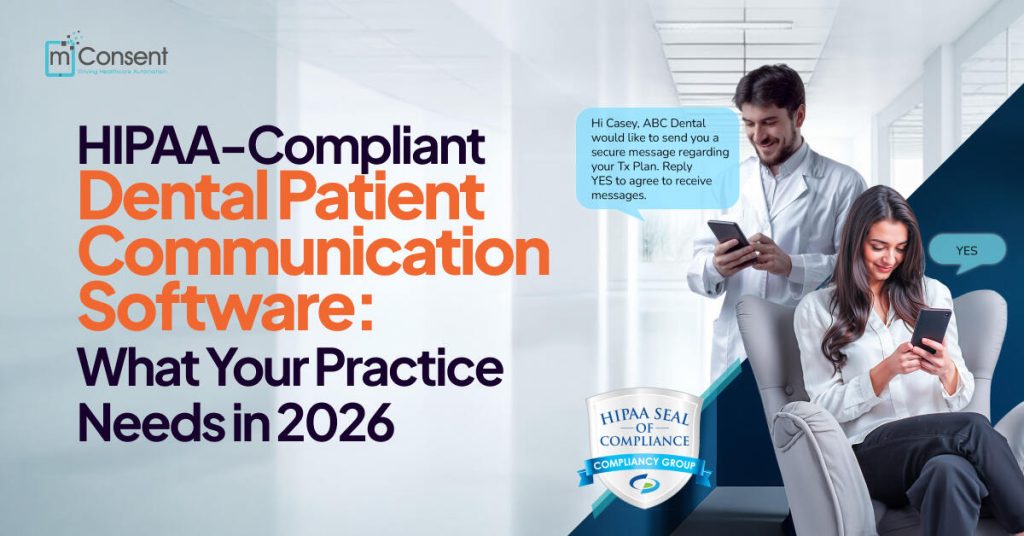
This guide breaks down exactly what HIPAA-compliant dental communication software must do in 2026, where most practices are getting it wrong, and how mConsent helps dental teams turn secure patient communication into measurable revenue recovery.
The shift: HIPAA-compliant communication isn’t a checkbox anymore. It’s the operating system of a modern front desk.
Why HIPAA-Compliant Dental Communication Matters More Than Ever
Patient communication used to mean a phone call and a postcard. Today, it spans text, email, mobile forms, online scheduling, after-hours AI, payment links, and recall sequences. The volume of PHI moving through a typical practice every day has multiplied and so has the attack surface.
Five forces are pushing HIPAA-compliant dental communication to the top of the operations agenda:
- Dentistry has gone fully digital. Intake forms, imaging, treatment plans, billing, and reminders all move through connected systems. Every channel is now a compliance surface.
- Patients expect instant communication. Texting, mobile forms, and one-click scheduling are the new baseline. Practices that still rely on phone tag quietly lose patients.
- Healthcare is the No.1 target for data breaches. Dental practices, especially smaller ones, are increasingly attractive targets because they hold rich PHI and often run on legacy systems.
- Patient trust is built on privacy. A single breach notification letter can undo a decade of word-of-mouth referrals.
- HIPAA penalties are not theoretical. Civil monetary penalties, OCR investigations, breach notification costs, and reputational damage routinely run into six and seven-figure amounts.
The takeaway is simple. Convenience without security is a liability. Security without convenience is obsolete. In 2026, your software has to deliver both and turn that combination into operational ROI.
What HIPAA Compliance Actually Means for Dental Communication
HIPAA compliance isn’t a logo on a website. It’s a specific set of safeguards your communication software has to enforce every time a message moves through it.
- Protection of PHI. Any identifiable patient health information names tied to appointments, balances, insurance, treatment, or clinical notes must be safeguarded in transit and at rest.
- Encrypted data transmission. Messages, forms, and attachments must travel through encrypted channels, not standard SMS or unsecured email.
- Controlled access. Only authorized team members should see specific patient information, and only for legitimate operational reasons.
- Audit trails. Every communication touch sent, received, opened, and accessed should be logged and reviewable.
- Business Associate Agreements (BAAs). Any vendor handling PHI on your behalf must be willing and able to sign a BAA. If they won’t sign, they can’t legally hold your PHI.
These aren’t aspirational. They’re on the floor. Anything below this isn’t HIPAA-compliant dental communication; it’s exposure waiting to be discovered.
Why Traditional Communication Methods No Longer Work
Most front desks are still patching together tools that were never built for healthcare. Each one looks harmless on its own. Stacked together, they create the compliance gap that the OCR keeps fining practices for.
- Standard SMS travels through carrier networks with no encryption, no audit trail, and no BAA.
- Personal devices mix PHI with personal photos, third-party apps, and unmanaged passwords.
- Generic email (Gmail, Outlook, Yahoo) is rarely configured with the controls HIPAA requires unless paired with a BAA-eligible enterprise tier.
- Paper intake leads to duplicate data entry, lost forms, and stacks of PHI left in unlocked drawers.
- Manual workflows rely on human memory, leading to inconsistencies, missed steps, and accidental disclosures.
These methods don’t just break compliance. They break the operational tempo of the front desk. Every minute lost chasing forms, retyping data, or hunting for a phone number is a minute not spent recovering revenue from the five places it leaks: unscheduled treatment, broken appointments, hygiene, insurance, and aging AR.
The Biggest HIPAA Communication Mistakes Dental Practices Still Make
Most violations don’t come from bad intent. They come from familiar habits that quietly drift out of compliance as the practice scales.
- Texting from non-compliant platforms. If it doesn’t encrypt, log, and operate under a BAA, it doesn’t belong in patient communication.
- Sending PHI through an unsecured email. Appointment confirmations with full names plus procedures. Balance statements. Insurance details. All are routinely sent through inboxes that have no business holding them.
- Personal phones for patient texting. Convenient, until the staff member leaves, the phone is lost, or the messages get screenshot.
- Weak password and access management. Shared logins, no role separation, no MFA.
- Untrained teams. New hires get clinical training but no formal HIPAA communication training.
- Workflow drift. Different staff members follow different processes, none of which are documented.
- No centralized communication platform. Five tools, five logins, zero visibility.
Each of these is fixable. None of them gets fixed by trying harder. They get fixed by replacing the system underneath.
What Modern HIPAA-Compliant Dental Software Must Do in 2026
If you’re evaluating dental patient communication software this year, these seven capabilities are the non-negotiables. Anything missing from this list isn’t ready for the way patients communicate or for how regulators audit in 2026.
Secure Two-Way Patient Messaging
Why it matters. Patients expect conversational texting. Phone calls go unanswered. Emails sit unread for days.
The risk. Unsecured texting exposes PHI through carrier networks and personal devices, with no audit trail and no way to revoke access.
What software must be provided? Encrypted two-way messaging, role-based access, full audit logging, and message-level visibility for managers.
How mConsent helps. mConsent’s Communication module gives every team member secure, two-way patient messaging from a single platform with the conversation tied directly to the patient record in Dentrix, Eaglesoft, Open Dental, or Dolphin. No personal phones. No lost threads.
Automated Appointment Reminders
Why it matters. Manual reminders are inconsistent and labor-intensive. A single missed reminder costs the practice the full value of a broken appointment slot.
The risk. Even automated reminders contain the patient’s PHI: name, provider, procedure, and location. If the delivery channel isn’t compliant, the automation just scales the violation.
Must-haves. Encrypted reminder delivery, configurable cadences, two-way confirmations, and complete tracking of every send.
How mConsent helps. Automated appointment reminders run on a compliant infrastructure, integrate directly with your PMS, and tie into the broader workflow that closes broken-appointment and recall leaks.
Secure Digital Patient Forms
Why it matters. Paper intake is slow, error-prone, and a daily source of PHI leaks. Patients arrive 15 minutes early just to fill out forms at the front desk, then re-key.
The risk. Forms emailed as PDFs or filled out on shared tablets without proper safeguards expose more PHI than almost any other workflow.
Must-haves. Mobile-first digital forms, encrypted transmission, identity verification, and direct write-back into the PMS.
How mConsent helps. Paperless Intake, one of mConsent’s five core modules, lets patients complete fully HIPAA-compliant forms on their own device before they arrive. Data flows straight into the chart. No re-keying. No paper. No exposure.
Centralized Communication Management
Why it matters. Fragmented systems mean fragmented oversight. If three team members are messaging patients through three different tools, no one has a full picture and HIPAA compliance is impossible to enforce.
The risk. Unified visibility is what turns “we think we’re compliant” into “we can prove it.”
Must-haves. Single dashboard for all patient communication, team-level coordination, workflow visibility, and complete audit trail.
How mConsent helps. Every patient touch text, form, payment, recall, and after-hours AI call flows through one centralized platform. One source of truth for the front desk, one source of truth for compliance.
Role-Based Access Controls
Why it matters. Not every team member needs to see every patient’s details. HIPAA’s “minimum necessary” standard requires you to limit access by role.
The risk. Shared logins and over-permissioned accounts are how internal HIPAA violations happen and they’re disproportionately what OCR audits flag.
Must-haves. Granular role-based permissions, MFA, user-level audit logs, and easy offboarding when staff leave.
Secure Payment Communication
Why it matters. Balance reminders and payment links almost always combine PHI with financial data. That combination is exactly what attackers target.
The risk. Most practices send payment requests through tools that aren’t HIPAA-or PCI-compliant.
Must-haves. Encrypted payment links, tokenized card-on-file, secure receipts, and full audit logging.
How mConsent helps. mPayr Payments integrates compliant payment communication directly into the messaging workflow, the same secure channel, the same audit trail, the same patient record. Aging AR drops. Collections rise.
Automated Workflow Documentation
Why it matters. Compliance is what you can prove, not what you remember. If an OCR auditor asks for the last 30 days of patient communication activity, you should be able to export it in minutes.
Must-haves. Immutable audit logs, communication tracking, workflow records, and exportable reports.
How mConsent helps. Automation does the documentation work for you. Every send, open, response, and exception is logged automatically, turning compliance from a manual burden into a background utility.
How HIPAA-Compliant Communication Improves the Patient Experience
Compliance is the floor. Patient experience is the ceiling. The practices winning in 2026 are the ones using compliance as a starting point, not a finish line.
When secure communication is done right, patients feel it before they can name it:
- Faster communication. Two-way texting beats phone tag every time.
- Mobile-first convenience. Forms, scheduling, and payments happen from the couch.
- Visible trust. A polished, secure portal signals a serious practice.
- Cleaner scheduling. Fewer no-shows, fewer broken appointments, faster recalls.
- Stronger engagement. Treatment acceptance climbs when communication is timely and clear.
- Less confusion. Centralized messaging means patients aren’t bouncing between three reps with three different answers.
- A more professional experience. The kind that drives reviews, referrals, and lifetime value.
Security and convenience aren’t trade-offs anymore. In 2026, they’re the same product.
The Connection Between Secure Communication and Revenue
Here’s the part most “HIPAA compliance” content misses. Secure communication isn’t a cost center. It’s a revenue lever.
Every front desk in dentistry leaks 6-12% of practice revenue across five categories: unscheduled treatment, broken appointments, hygiene, insurance, and aging AR. Communication is the connective tissue across all five. When it’s secure, automated, and centralized, the leaks close.
- Retention. Patients who feel communicated with stay. The average new-patient lifetime value in dentistry sits around $900, and every retained patient compounds it.
- Scheduling. Faster response times convert more inbound interest into booked chairs.
- Cost reduction. Automation replaces manual reminder calls, paper forms, and re-keying.
- Collections. Secure, integrated payment messaging leads to faster payments than paper statements.
- Scalability. Centralized communication is the only way to grow without proportionally growing your front desk.
- Loyalty. Trust is a moat. Privacy builds it.
Compliance protects what you have. Modern communication grows what you have. The right platform does both at once.
Why Dental Practices Need Communication Automation in 2026
A few realities are converging that make this the year to move:
- Patient expectations keep rising. Healthcare is being judged against Amazon, Uber, and DoorDash, not the practice next door.
- Manual workflows can’t scale. The front desk is already overloaded. Adding more humans isn’t the answer; better systems are.
- Front-desk staffing is harder. Turnover is high. Software has to capture institutional knowledge so the practice doesn’t lose it whenever someone leaves.
- Cyber risk is climbing. Healthcare ransomware attacks are at an all-time high.
- Competitors are modernizing faster. Every month spent on legacy systems is a month of compounding disadvantage.
How mConsent Helps Practices Modernize HIPAA-Compliant Communication
mConsent is built as a Front Desk Revenue Control System for dental practices. The Communication module sits at the center, but it works because it’s wired into everything else.
- HIPAA-compliant messaging with full audit trails and BAA coverage.
- Automated appointment reminders tied directly to your PMS schedule.
- Digital patient intake forms that write straight into the chart.
- Two-way patient engagement across text, email, and after-hours AI.
- Centralized communication dashboards with role-based access.
- Integrated payment communication through mPayr.
- Zaha AI is the after-hours voice agent that answers new-patient calls when the front desk has gone home.
- PMS integrations with Dentrix, Eaglesoft, Open Dental, and Dolphin.
- Trusted by 5,000+ practices since 2017.
The result isn’t a “communication tool.” It’s a front-desk operating system that protects PHI, automates workflows, and recovers revenue from leaks that most practices don’t even measure.
Before vs. After: Modernizing Patient Communication
| Before mConsent | After mConsent |
| Unsecured texting from personal phones | Encrypted two-way messaging with audit logs |
| Paper intake stacked at the front desk | Mobile-first forms that flow into the PMS |
| Manual reminders, inconsistent cadence | Automated reminders tied to the schedule |
| Five tools, no unified visibility | One centralized communication dashboard |
| Compliance you hope holds up | Compliance you can prove on demand |
| Front desk overloaded, revenue leaking | Front desk freed, revenue recovered |
10 Best Practices for HIPAA-Compliant Patient Communication
- Use a dedicated, BAA-backed secure messaging platform, never standard SMS.
- Keep PHI off personal devices, full stop.
- Encrypt everything in transit and at rest.
- Automate the workflows humans keep forgetting.
- Move to secure digital intake forms.
- Train every team member on HIPAA communication standards and re-train annually.
- Centralize all patient communication onto one platform.
- Enforce role-based access and MFA.
- Maintain immutable audit logs and review them regularly.
- Pick software that’s built for dental, not retrofitted from generic healthcare.
The Future of HIPAA-Compliant Dental Communication
The next wave is already here:
- AI-powered secure communication. After-hours voice agents, intelligent triage, draft replies, all running inside the compliance envelope.
- Predictive engagement. Software that flags the patient most likely to drop a recall before they drop it.
- Fully digital patient journeys. From the first Google search to the final payment, with no paper, no re-keying, no compliance gaps.
- Embedded cybersecurity. Continuous monitoring, automated breach detection, zero-trust access.
mConsent is built for this curve, not against it. Smart automation, secure infrastructure, dental-specific workflow design, and patient engagement that scales, all in one place.
Conclusion
HIPAA-compliant communication isn’t a defensive posture anymore. It’s how modern dental practices grow.
The shift is from outdated, fragmented communication systems → secure, automated, patient engagement ecosystems that protect PHI and recover the revenue leaking past the front desk.
With mConsent, you don’t have to choose between compliance and convenience, or between security and growth. You get the system that delivers all four.
See where your front desk is leaking and how to close it.
In 20 minutes, we’ll show you exactly where your communication workflow is exposing PHI, where it’s costing you revenue, and how a Front Desk Revenue Control System closes both gaps at once.
FAQ
1. Why is HIPAA-compliant communication important for dental practices?
HIPAA-compliant communication protects patient privacy, prevents costly violations and breach notifications, builds patient trust, and provides your practice with an auditable record of every communication touchpoint. In 2026, it’s also the foundation for revenue-recovery workflows like automated recalls, payment reminders, and treatment follow-ups.
2. Are regular texting platforms HIPAA compliant?
No. Standard SMS, iMessage, WhatsApp, and most consumer messaging apps don’t encrypt PHI, don’t provide audit trails, and don’t operate under Business Associate Agreements. They’re not designed for protected health information and shouldn’t be used for any patient communication that includes PHI.
3. What features should HIPAA-compliant dental communication software include?
At minimum: encrypted two-way messaging, automated appointment reminders, secure digital intake forms, centralized communication dashboards, role-based access controls, secure payment communication, automated audit logging, and PMS integration with systems like Dentrix, Eaglesoft, Open Dental, and Dolphin.
4. How does mConsent support HIPAA-compliant communication?
mConsent provides secure patient messaging, automated workflows, digital intake forms, integrated payments through mPayr, after-hours AI through Zaha, and a centralized communication dashboard, all backed by HIPAA-compliant infrastructure and BAA coverage. The platform is built specifically for dental practices and integrates directly with the major PMSs.
5. Why is automation important for HIPAA-compliant workflows?
Automation improves consistency, eliminates human errors that cause most HIPAA violations, ensures every communication touchpoint is logged for audit purposes, scales the front desk without adding headcount, and frees the team to focus on revenue recovery work instead of manual reminders and re-keying.
6. Can mConsent replace tools like Weave or NexHealth?
Yes. mConsent goes beyond communication-only tools by combining HIPAA-compliant messaging with paperless intake, insurance concierge, integrated payments, and after-hours AI, all within a single Front Desk Revenue Control System. Practices switching to mConsent typically consolidate three to five separate tools into one.