


Why Dental Front Desks Are Overloaded
Ask any dental front-desk coordinator what their day looks like, and “answering phones and checking patients in” won’t even crack the top five stressors. The real job is much bigger.
On any given day, your front-office team may be handling:
- Insurance eligibility checks
- Benefits verification
- Patient insurance updates
- Payer portal research
- Phone calls to insurance companies
- Data entry
- Treatment estimates
- Patient financial questions
- Appointment scheduling
- Patient communication
- Billing coordination
Dental insurance verification alone can consume a disproportionate share of that time because it involves repetitive steps across multiple payers, multiple portals, and multiple systems for every patient, every day.
Here’s the problem in one sentence: every minute spent manually checking insurance is a minute your front desk isn’t spending with a patient.
A typical manual verification process looks something like this:
Find insurance information – Log into payer portal – Search patient – Check eligibility – Review benefits – Record information – Repeat.
For every patient. Every day.
An Insurance Concierge changes that equation. By automating and streamlining eligibility and benefits verification, it removes repetitive manual work. It gives front-office teams room to focus on higher-value patient interactions the work that actually grows your practice.
Why Manual Insurance Verification Takes So Much Staff Time
Before looking at the solution, it helps to understand why this task is such a time sink in the first place.
1. Multiple payer portals. Different insurance carriers require different websites, login credentials, and workflows, and none of them stalks to each other.
2. Phone calls. Some information isn’t available online, which means staff have to call insurance companies and wait on hold.
3. Repetitive searches. The same patient-lookup, coverage-check routine happens dozens of times a day, with almost no variation.
4. Manual data entry. Once verification is complete, someone still has to copy the results into the practice management system.
5. Benefits research. Staff often have to dig through multiple benefit categories, deductibles, maximums, and waiting periods to answer one patient’s question.
6. Follow-up. Missing or unclear information means staff have to circle back and dig further.
7. Reverification. Coverage often needs to be checked again whenever an appointment or treatment plan changes.
Multiply all of this by dozens of patients a week, and it’s easy to see how insurance verification quietly eats an entire employee’s schedule.
The Hidden Cost of Front-Desk Insurance Verification
The cost isn’t just staff time, although that alone adds up fast. Manual insurance verification can contribute to a chain of downstream problems:
Staff workload: More repetitive administrative tasks pile onto an already full plate.
Patient wait times: Staff attention gets divided between verification tasks and the patients standing in front of them.
Reduced productivity: Skilled employees spend hours on low-value, repetitive work instead of tasks that actually require judgment.
Verification errors: More manual steps mean more opportunities for mistakes.
Claim problems: Incorrect insurance information collected at check-in can create billing issues weeks later.
Patient frustration: Patients notice when staff are stretched thin, especially during check-in and checkout.
Staff burnout: Constant repetitive administrative work makes front-office roles harder to sustain and harder to hire for.
This is where an Insurance Concierge for dental practices earns its place in the workflow.
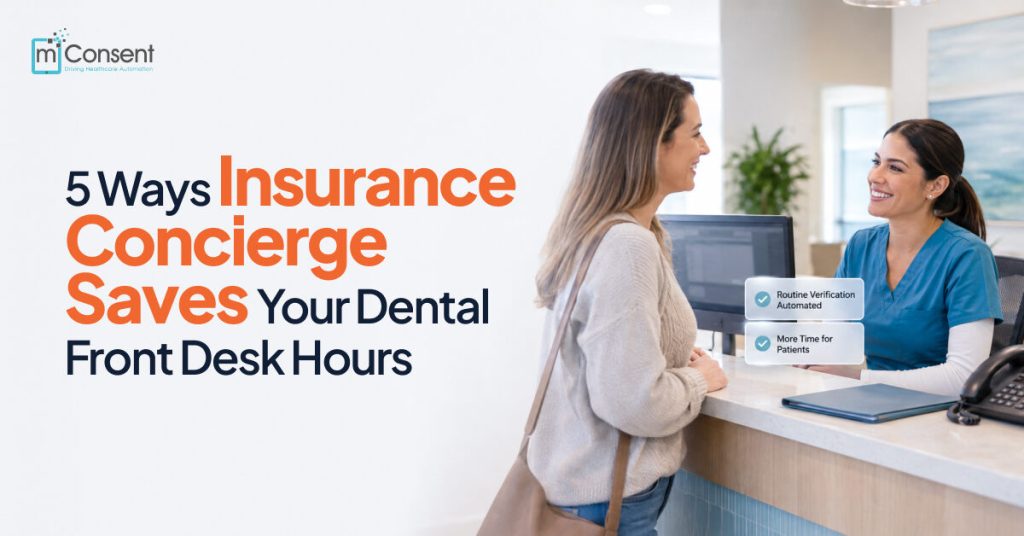
The 5 Ways an Insurance Concierge Saves Dental Front Desk Hours
Way 1: Automates Insurance Eligibility Verification
Checking whether a patient’s insurance is active is one of the most repetitive front-desk tasks. Without automation, staff typically have to find the patient’s insurance information, locate the right payer portal, log in, search for the patient, review eligibility, and record the results, then start over for the next patient.
Before: Patient – Staff – Payer Portal – Search – Verify – Record
With Insurance Concierge: Patient – Insurance Concierge – Verification – Staff Reviews
The time-saving benefit is straightforward: staff spend far less time performing repetitive eligibility checks and far more time on patient-facing responsibilities.
Way 2: Automates Benefits Verification
Eligibility is only half the story. Front-office staff also need to investigate deductibles, annual maximums, coverage details, waiting periods, frequency limitations, and other benefit restrictions and manually reviewing all of that takes real time.
Insurance Concierge helps automate and organize benefits verification, turning a “search – click – review – record – repeat” cycle into a simpler process: automated verification, review of the relevant information, and staff attention only where exceptions arise.
The result: staff spend less time researching routine benefits information and more time acting on it.
Way 3: Reduces Repetitive Insurance Calls and Portal Checks
Manual verification often means bouncing between insurance websites, payer portals, phone systems, patient records, and the practice management system. Each transition adds friction and friction adds up over a full patient schedule.
By automating routine work, an Insurance Concierge reduces repetitive portal checks, routine payer calls, manual searches, and repeated verification tasks. The core message is simple: automate the repetitive work so staff can focus on exceptions and patients.
Way 4: Reduces Manual Data Entry and Verification Errors
Insurance verification isn’t just time-consuming; it’s also vulnerable to human error. Common mistakes include an incorrect member ID, wrong subscriber information, missing benefit details, an inaccurate eligibility status, general data-entry slips, and incomplete documentation.
The more times staff manually re-enter the same information, the more opportunities there are for errors. A better workflow looks like this: automated verification, organized information, staff review, and exception handling in that order.
This structure reduces repetitive data-entry work while supporting more consistent dental insurance verification you can rely on.
Way 5: Frees Staff to Focus on Patients and Higher-Value Work
Here’s the part that matters most: the value of Insurance Concierge isn’t just the minutes it saves; it’s what your team does with those minutes.
Instead of getting tied up in repetitive insurance tasks, staff can focus on greeting patients, answering phones promptly, scheduling appointments thoughtfully, coordinating treatment, communicating with patients, having financial conversations, following up on care, resolving exceptions, and improving the patient experience.
That’s the real transformation: administrative work shifts to patient-facing work. It’s the core business value behind dental insurance verification automation.
How Much Time Can Insurance Concierge Save?
It wouldn’t be accurate to claim that Insurance Concierge saves every practice the same number of hours each week; the real opportunity depends on your verification volume and how many manual steps are currently involved.
Here’s a simple way to estimate it. Suppose a practice manually verifies 30 patients per day, and each verification takes about 10 minutes. That’s 300 minutes per day, or roughly 5 hours daily. Over a five-day week, that adds up to around 25 hours nearly a full-time role spent entirely on verification.
If automation eliminates a significant portion of that repetitive work, a practice can redirect a meaningful chunk of those hours toward patient-facing and higher-value activities.
Of course, actual results will vary based on patient volume, payer mix, verification complexity, existing workflows, staff processes, and how much of the process is automated. Run the math for your own practice to see where you stand.
Insurance Concierge Helps Improve Verification Accuracy
Time savings are only part of the story. An Insurance Concierge also improves the quality and consistency of the verification process itself.
Accurate, automated verification can help identify inactive coverage, detect incorrect insurance information, surface benefit limitations before treatment begins, reduce manual entry, standardize workflows across the team, give staff more reliable information, and reduce downstream claim errors.
In short: better verification accuracy reduces claim errors. Getting accurate information at the start of the revenue cycle is one of the most effective ways to prevent billing rework later on.
What Can Front-Desk Staff Do With the Time They Save?
This question really demonstrates ROI. When dental insurance verification software takes routine checks off your team’s plate, staff can:
Spend more time with patients, giving each visit more direct attention.
Answer calls faster with more capacity for incoming calls instead of a growing hold queue.
Improve scheduling, focusing on appointment coordination instead of catching up on backlog.
Support treatment acceptance by spending more time clearly explaining financial information.
Follow up with patients, dedicating time to reactivation and recall outreach.
Handle complex insurance cases, focusing on genuine exceptions instead of checking every patient manually.
Improve the overall patient experience: less time behind a screen means more time actually interacting with the people in the chair.
Conclusion
Dental front desks carry the dual responsibility of creating a great patient experience while managing a constantly growing pile of administrative work. Manual insurance verification, payer calls, portal checks, benefits research, eligibility checks, data entry, reverification, and error correction are among the biggest drains on that time.
Insurance Concierge changes the workflow. Instead of having front-desk employees manually complete every verification task, automation handles routine eligibility and benefits verification while staff focus on exceptions and patients.
The five ways it saves your team hours every week:
- Automates eligibility verification
- Automates benefits verification
- Reduces payer calls and portal checks
- Reduces manual data entry and verification errors
- Gives front-desk staff more time to focus on patients
The broader impact compounds: automated verification lowers staff workload, improves verification accuracy, reduces claim errors, cuts billing rework, and makes the practice more efficient overall.
Automate Insurance Verification and Reduce Staff Workload
Insurance Concierge helps dental practices reduce repetitive manual calls, portal checks, and data entry so front-desk teams can spend more time where it matters most: with patients.
FAQ
1. How does Insurance Concierge save dental front-desk time?
Insurance Concierge automates routine eligibility and benefits verification, reducing repetitive payer calls, portal checks, manual research, and data entry.
2. What insurance tasks can be automated?
Depending on the workflow, automation can support eligibility verification, benefits verification, information gathering, and routine verification processes.
3. How much time can a dental practice save with Insurance Concierge?
Time savings vary based on patient volume, payer mix, verification complexity, and the practice’s existing workflow. Practices can estimate their opportunity by multiplying daily verification volume by average manual verification time.
4. Does Insurance Concierge reduce manual data entry?
Yes. Automating verification workflows can reduce repetitive data entry and the need for staff to record routine insurance information manually.
5. Can Insurance Concierge reduce dental claim errors?
It can help reduce certain preventable insurance-related claim errors by improving verification accuracy and reducing manual information-entry problems.