



Enrolling a patient into your membership plan takes two minutes. Keeping that membership alive for the next 12 months takes a system, and most practices don’t have one.
If you’re running your in-house dental membership plan on spreadsheets, sticky notes, or calendar reminders, someone on your team is quietly doing a job they were never hired for: tracking renewals, chasing failed payments, and hoping nobody falls through the cracks.
That’s the real cost of choosing membership software based on how easy sign-up looks. Sign-up is the easy part.
Before comparing vendors, it helps to know what a membership plan actually requires to run well, and where most in-house programs quietly break down.
What Is a Dental Membership Plan, and Why Are Practices Building Them?
A dental membership plan is a subscription a practice runs directly with patients, usually billed monthly or annually, bundling preventive care, cleanings, exams, and X-rays with a discount on other treatment. Practices build these because a large share of patients have no dental insurance, and even insured patients are often underinsured. For the patient, it’s predictable, affordable care with no insurance company in the middle. For the practice, it’s recurring revenue the practice controls directly. The catch: it’s a 12-month-plus commitment that has to be billed, tracked, and maintained without your front desk thinking about it daily.
The Hidden Operational Work Behind Every Membership Plan
Running a plan well means getting a few things right every cycle, for every member: knowing whose payment is due and whether it actually went through, catching a declined card immediately, seeing which memberships are active, overdue, or need a call, and keeping a signed record whenever terms change.
On a spreadsheet, that’s a subscription business with no subscription infrastructure someone has to remember, run the charge, and update a row every cycle. A missed cycle is silent; by the time it’s caught, you’re chasing several missed payments for treatment you’ve already delivered.
What to Look for in Dental Membership Plan Software
Before comparing vendors, look for: automatic recurring billing, built-in failed-payment retries, one dashboard for every membership’s status, a signed agreement for every plan change, and easy pause/cancel. Sign-up is the two-minute part every vendor demos well; the following 12 months determine whether a program becomes reliable revenue or an administrative burden.
How mPayr Dental Payment Platform Simplifies Membership Management
mPayr is built to do more than help you enroll patients. It automates the ongoing work of running an in-house dental membership program, from recurring billing and payment tracking to renewals and membership reporting.
Instead of relying on spreadsheets or manual reminders, your team manages every membership from a single dashboard. Patient agreements, payment schedules, cards on file, billing status, and membership activity are all centralized, giving your front desk complete visibility without extra administrative work.
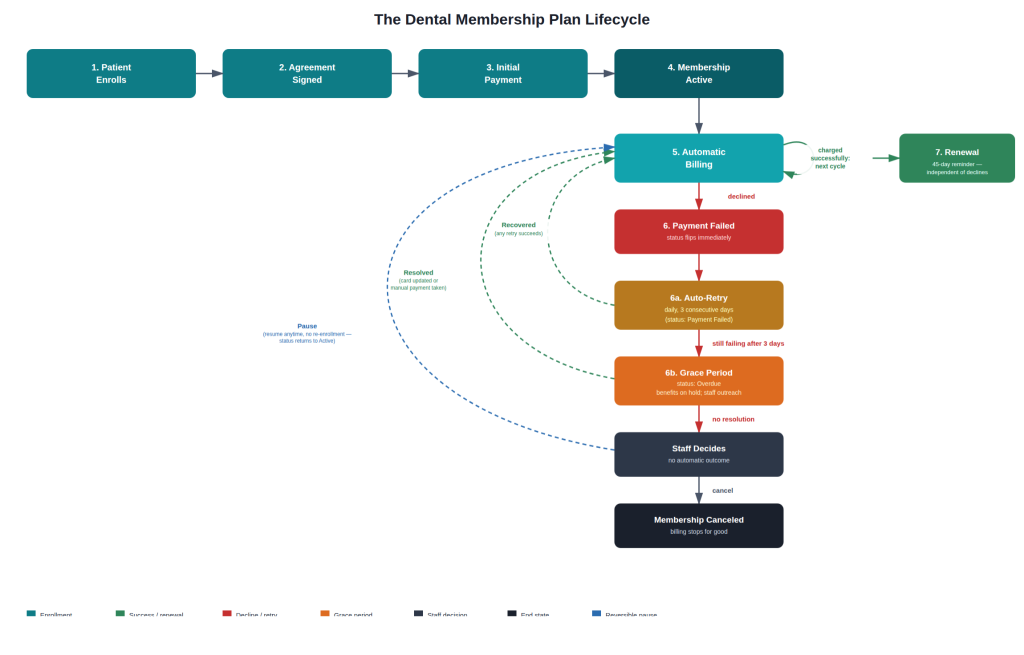
Here’s the full lifecycle at a glance, and then we’ll walk through each stage below:
How mPayr Automates the Billing Cycle
This is the stage where a spreadsheet has no answer: the card charges itself, every cycle, without anyone opening a file.
With mPayr, once your in-house membership plan is active:
- The card on file is charged automatically on each due date
- A successful charge is recorded and the next payment date rolls forward on its own
- The membership shows up in one dashboard alongside every other active plan, so status is visible without digging through records
No one has to remember. The system does.
What Happens When a Membership Payment Fails?
This is where manual tracking really shows its limits and where most practices lose revenue without realizing it.
Here’s what happens automatically inside mPayr when a payment is declined:
- The status flips immediately to Payment Failed, visible in the dashboard.
- The system retries automatically once a day, for three consecutive days.
- If the charge succeeds on any retry, the membership goes right back to active. No one has to intervene.
- If it’s still failing after three days, the membership enters a grace period. Benefits are paused, but the plan isn’t canceled, your team reaches out, and the patient can update their card or pay manually.
- After the grace period, it’s your call. There’s no automatic cancellation. The patient can still resolve it by updating their card or paying manually; otherwise, staff can pause billing or cancel; the practice stays in control of the outcome.
Run this same scenario on a spreadsheet: a declined charge is silent unless someone happens to check. By the time it’s caught, you’re not chasing one missed payment, you’re chasing more.
Managing an Active Membership
Memberships aren’t locked in once they’re active. At any point, your team can:
- Change the fee, which voids the current agreement and requires a new signature before the next charge, so pricing changes are always documented
- Update the card on file
- Pause billing: Recurring charges stop, but the membership doesn’t need to be re-enrolled when it resumes; picking back up is a single click
- Cancel: billing stops for good, and the status updates across the dashboard immediately
Every one of these actions is a status change your team can see, not a note buried in a spreadsheet tab.
Conclusion
A dental membership plan is only as good as what happens after the patient signs the agreement. Enrollment is the easy part. Twelve months of billing, retries, renewals, and reconciliation are where a spreadsheet turns into a liability and where dedicated membership plan software pays for itself.
With mPayr, every stage of the membership plan is managed in one place. Your team spends less time tracking payments and more time caring for patients, while your practice benefits from predictable recurring revenue and complete visibility into every active membership.
See exactly how mPayr handles your full in-house membership plan from enrollment through renewal in a personalized 15-minute demo. Discover how automation can simplify operations, reduce administrative work, and help your practice scale its membership program with confidence.