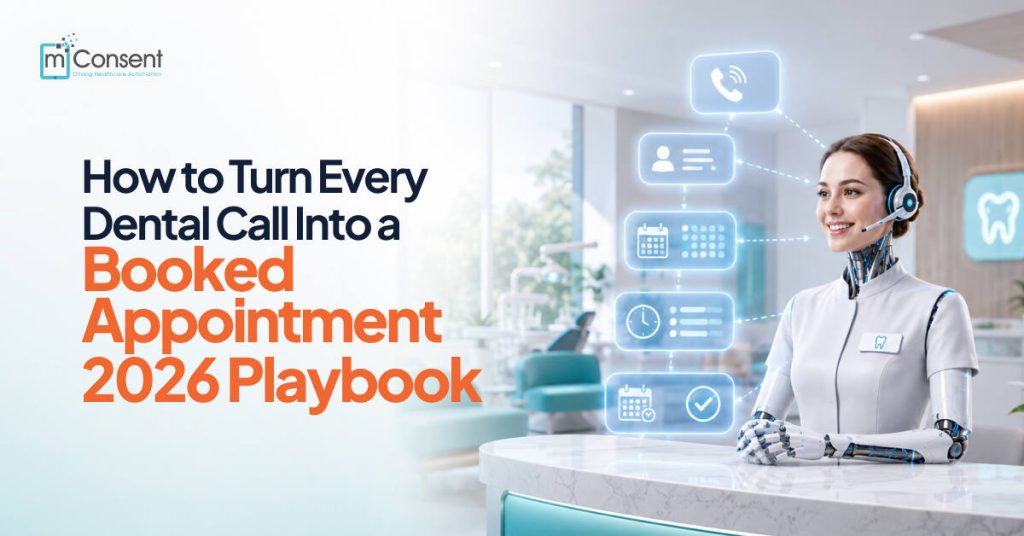




A potential new patient picks up the phone. They have a toothache. They’ve already Googled three practices near them. Yours is the first they call.
The phone rings four times. Five. Voicemail.
They hang up and call the next dentist on the list.
That single missed call just cost you roughly $850 in first-year revenue and somewhere between $4,500 and $22,000 in lifetime value. And it wasn’t a one-off. Industry data shows that the average dental practice misses 20% to 38% of incoming calls, with peak-hour miss rates climbing to 35% or more in many offices.
That’s not a phone problem. That’s a revenue leak.
The good news: every step in that leak is fixable. You don’t need a bigger marketing budget you need a better conversion system at the exact moment patients are ready to book. This guide walks through the seven shifts that high-performing practices use to turn more calls into kept appointments, along with the communication infrastructure, such as mConsent, that makes it scalable.
Why Phone Calls Are Still the No.1 Dental Conversion Point
Online scheduling is growing. AI assistants are flashy. But the data is unambiguous: roughly 71% of dental appointments are still booked by phone. Patients use the phone for the same reason they always have: they want reassurance before they commit.
That makes every inbound call a high-intent moment. Consider what’s actually happening on the other end of the line:
- The caller has chosen to dial your number, not a competitor’s
- They’ve already decided they need care
- They’re emotionally primed, usually anxious, sometimes in pain
- They’re seconds away from either booking or moving on
Miss the moment and you don’t just lose one appointment. You lose the cleanings, the crowns, the family referrals, and the five-star review that would have come twelve months later.
What Missed and Mishandled Calls Actually Cost
| Metric | Industry Range |
| Calls missed per practice | 20%-38% |
| Immediate revenue lost per missed new patient | $850 |
| Lifetime value lost per missed new patient | $4,500-$22,000 |
| Callers who hang up at voicemail and call a competitor | 62%-75% |
| Daily revenue lost from missed calls (avg practice) | $2,800-$6,300 |
The numbers compound. A practice missing just ten new-patient calls a month is leaving roughly $100,000 a year on the table, before factoring in the referrals those patients would have generated.
Why Callers Don’t Book Even When They Want To
Most “lost” callers aren’t lost because of price or location. They’re lost in the conversation. The seven most common failure points:
The call goes unanswered. Voicemail kills more bookings than any other single factor.
The greeting feels rushed. Patients hear “Smith Dental, please hold” in 2 seconds and feel interrupted.
The staff member sounds distracted. Background noise, multitasking, flat tone.
Insurance questions get a vague answer. Patients hear hesitation and assume hidden costs.
Scheduling feels complicated. Too many qualifying questions are asked before an appointment is even offered.
There’s no emotional reassurance. No acknowledgement of the patient’s nervousness, pain, or anxiety.
No follow-up after the call. The patient was “thinking about it”, and nobody ever called back.
Patients don’t choose the best dentist. They choose the best experience, and it starts in the first 90 seconds of the call.
The Psychology of a High-Converting Dental Call
Before any script or tool, understand what’s actually happening in the caller’s head. They’re balancing four anxieties:
- Fear of pain, they want to hear “we’ll take care of you”
- Fear of cost, they want a clear, honest answer about money
- Fear of judgment, they want to feel safe admitting they haven’t been in years
- Fear of inconvenience, they want a fast, simple booking process
Every word your front desk says either reduces one of those anxieties or amplifies it. There is no neutral. A “We can fit you in three weeks from Tuesday” answer doesn’t just fail to book; it actively raises the fear of inconvenience.
The shift that changes everything: stop treating the call as a transaction. Start treating it as the first appointment.
The 7-Step Framework to Convert More Calls Into Booked Appointments
Step 1: Answer Within Three Rings, Every Time
Speed isn’t a nicety. It’s the single biggest variable.
Internet-led research shows that response time within the first five minutes increases conversion by up to 9x compared to a thirty-minute delay. For phone calls, the window is even tighter: if you don’t pick up, 62-67% of callers hang up at voicemail and dial the next practice.
What to fix this week:
- Set a “three-ring rule”, no call rings more than three times before being answered or routed.
- Audit your peak-hour coverage (typically 10 a.m. to noon and 2-4 p.m.)
- Route overflow calls to a second-line team member or a digital channel, never to voicemail
- Track answer rate weekly, the same way you track production
How mConsent helps: When a call is missed, mConsent’s two-way SMS automation can instantly text the caller back from your practice number, catching them while their phone is still in their hand and offering to book by text.
Step 2: Lead With Connection, Not Information
The fastest way to lose an anxious patient is to open with policy. The fastest way to keep them is to open with empathy.
Don’t say: “Smith Dental, can I help you?”
Do say: “Thanks for calling Smith Dental, this is Sarah, how can I help you today?”
The difference is two seconds and one warm name. It signals: a human is here, you have their attention, you are safe.
Once they describe the reason for the call, acknowledge before you respond:
- “I’m so glad you called. That sounds uncomfortable, and we can definitely help.”
- “Totally understand. Many patients feel the same way before their first visit. We’ll make it easy.”
Patients commit when they feel seen. They hesitate when they feel pressured.
Step 3: Simplify the Scheduling Conversation
The most common mistake: asking five qualifying questions before offering a single appointment slot.
Patients want to hear an option fast. Once they hear one, their brain shifts from “should I book?” to “which day works?”, and you’ve already won.
The two-choice close: “I can get you in on Thursday at 10:15 or Monday at 2:30, which works better?”
Two options reduce decision fatigue. It also assumes the booking. Compare that to “When would you like to come in?”, which forces the patient to do the work and gives them an easy exit.
How mConsent helps: Mobile-friendly scheduling links can be texted to the caller mid-conversation, letting them confirm a time without juggling their calendar over the phone.
Step 4: Handle Insurance and Cost Questions Cleanly
The moment money comes up, conversion drops, unless you handle it with confidence.
Common front-desk mistakes:
- Reading the insurance policy back word-for-word (“Your plan covers 80% of basic restorative after the deductible…”)
- Saying “I’m not sure, let me check and call you back” (you just lost them)
- Overpromising coverage to keep the call going
- Going silent when asked, “How much will it cost?”
Better approach: Be specific, then bridge:
“We accept most major plans, and for a new patient cleaning and exam, you’re typically looking at $X out of pocket. We’ll verify your exact benefits before your visit, so there are no surprises. Want me to lock in a time?”
Note what just happened: a specific number, a reassurance, and an immediate close.
How mConsent helps: Digital treatment plans and consent forms can be sent before the visit, so patients see costs in writing, sign, and arrive ready, eliminating financial surprises that lead to no-shows.
Step 5: Always Ask for the Appointment
The single biggest difference between average and top-performing front desks isn’t tone, knowledge, or even speed. It’s whether they actually ask for the appointment at the end of the call.
Most calls die with “Okay, well, let us know what you decide.” That sentence converts almost nobody.
Closing language that works:
- “Would you prefer morning or afternoon?”
- “I have Thursday at 10 or Friday at 3, which is better?”
- “Let’s get you on the books right now so you don’t have to think about it again.”
Train every front-desk team member to close every call. Track close rate as a KPI alongside production.
Step 6: Follow Up Within Minutes, Not Days
Roughly 30% of callers who don’t book on the first call would have booked with a same-day follow-up. But most practices either forget or wait two days, by which point the patient has scheduled with someone else.
The 5-touch follow-up sequence that converts:
Minute 5: SMS: “Hi [Name], this is Sarah from Smith Dental. Wanted to follow up on your call. Want me to hold Thursday at 10?”
Hour 2: Personalized email with scheduling link and FAQ
Day 1: A second SMS check-in
Day 3: A short, friendly voice follow-up
Day 7: Final SMS with a soft offer or new-patient incentive
Doing this manually is unrealistic for most front desks, as they’re answering live calls. This is where automation does the heavy lifting.
How mConsent helps: Automated, HIPAA-compliant follow-up workflows trigger SMS and email sequences the moment a call ends without a booking, so no caller falls through the cracks.
Step 7: Stop Relying on Phone-Only Communication
Here’s the truth most practices haven’t fully accepted yet: the modern dental patient doesn’t want to be called back.
- 98% SMS open rate vs. 20% email open rate
- 62% of patients prefer texting for appointment communication
- 28% of appointment requests come outside business hours
Patients want to text. They want to book on their phone at 9 p.m. while putting their kid to bed. They want to confirm by tapping a link, not by calling back during their lunch break.
A phone-only practice is invisible to a meaningful share of its market.
The multi-channel stack that converts:
- Two-way SMS for live conversation
- Digital intake and consent forms (mobile-first)
- Automated appointment reminders and confirmations
- Online review requests after the visit
- Recall and reactivation sequences for dormant patients
How mConsent helps: mConsent unifies all of the above into one HIPAA-compliant platform, text messaging, digital forms, automated workflows, and patient engagement, so your front desk runs lean while your conversion rate climbs.
What High-Performing Practices Do Differently
The top quartile of dental practices isn’t doing anything magical. They’re doing seven boring things consistently:
- They answer 90%+ of calls live
- They train front-desk scripts every quarter, not every five years
- They track call conversion rate as a weekly KPI
- They automate every follow-up that doesn’t require a human
- They offer two appointment options on every call
- They send digital forms before the visit, not at the visit
- They communicate by text by default, not by phone
None of this is theoretical. All of it is measurable. And all of it compounds.
Phone Scripts That Quietly Kill Conversion
Pull a call recording from this week and listen for any of these. Every one of them is a leak.
- “Can you hold?” was said before the caller had even spoken.
- “We’re booked solid until next month.”, instant exit signal.
- “Let me transfer you,” followed by twenty seconds of silence.
- “You’d have to talk to insurance about that.” abdicates the close
- “Just give us a call back if you decide,” abandons the lead entirely.
- “Our policy is…” kills the human moment.
Replace each with a warmer, more committed alternative. Then have every team member practice them out loud.
Before and After: What Modern Patient Communication Looks Like
| Before (phone-only practice) | After (mConsent-enabled practice) | |
| Missed calls | 25-35% | Under 10%, with automated SMS catch |
| New-patient follow-up | Manual, inconsistent | Automated, 5-touch sequence |
| Forms completion | On clipboard at the visit | Digital, done before arrival |
| Patient preferred channel | Phone (assumed) | SMS, email, and mobile (actual) |
| Front-desk workload | Reactive, overwhelmed | Streamlined, proactive |
| New-patient conversion rate | 35-50% | 65-80% |
| No-show rate | 12-18% | Under 6% with automated reminders |
| After-hours bookings | Zero | 25-30% of weekly bookings |
The 10 Best Practices, in One List You Can Hand Your Front Desk
- Answer within three rings
- Greet warmly and by name
- Lead with empathy before information
- Offer two appointment times, never an open-ended question
- Quote a specific cost range when asked, then bridge to booking
- Ask for the appointment on every single call
- Send digital forms and consent before the visit
- Trigger automated follow-up within five minutes of any unbooked call
- Default to SMS for confirmations, reminders, and questions
- Track call conversion rate weekly and review with the team monthly
Print it. Tape it next to the phone.
Where This Is Headed: The 2026 Dental Front Desk
The practices that win the next five years won’t be the ones with the prettiest waiting room. They’ll be the ones with the smoothest digital front door.
That means:
- AI-assisted call coverage that handles overflow and after-hours
- Predictive engagement that reactivates dormant patients automatically
- Unified messaging across phone, SMS, email, and web
- Fully digital intake, consent, and treatment-plan acceptance
- Real-time analytics on every call, every form, every follow-up
mConsent is built for exactly that: a modern, HIPAA-compliant communication and workflow platform designed to turn every patient touchpoint into a booked appointment.
Conclusion
Phone calls are still the single most valuable conversion point in dentistry. Most practices treat them like an inconvenience. The top ones treat them like the start of the patient relationship.
The shift isn’t a script. It’s a system: faster response times, warmer conversations, simpler scheduling, clear financial answers, confident closing, automated follow-up, and multi-channel communication that meet patients where they actually are.
That’s the difference between a practice that grows on referrals, which can’t predict and one that grows on a conversion engine, it can.
Ready to Plug the Leak?
See exactly how much revenue your practice is losing to missed and mishandled calls and how mConsent can recover it.
20 minutes, no pressure, custom to your practice.
Frequently Asked Questions
1. Why do dental practices lose patients after phone calls?
The most common reasons are unanswered calls, rushed greetings, vague answers to insurance questions, complicated scheduling, weak closing, and zero follow-up. Industry data shows 20-38% of calls go unanswered entirely, and 62-75% of callers who hit voicemail call a competitor instead of leaving a message.
2. How can dental practices improve appointment conversion rates?
Answer within three rings, lead with empathy, offer two specific appointment times instead of open-ended questions, quote clear cost ranges, always ask for the appointment, and automate follow-up within five minutes of any unbooked call.
3. What is the average value of a missed dental call?
Roughly $850 in immediate first-year revenue per missed new-patient call, with lifetime value estimates ranging from $4,500 to $22,000 depending on practice mix.
4. How does mConsent improve dental call conversion?
mConsent unifies two-way SMS, automated follow-up workflows, digital intake and consent forms, mobile-friendly scheduling, and HIPAA-compliant messaging so missed calls trigger instant text-backs, follow-up happens automatically, and patients can book and complete paperwork without ever picking up the phone.
5. Why should dental practices move beyond phone-only communication?
98% of texts are opened, compared with 20% for emails. 62% of patients prefer SMS for appointment communication. And 28% of appointment requests now come outside business hours, when no one is at the phone. A phone-only practice is invisible to a large and growing share of its market.
6. How fast should I follow up on an unbooked call?
Within five minutes. Follow-up within five minutes converts dramatically better than follow-up at thirty minutes or longer. Same-day follow-up converts roughly 30% of callers who didn’t book on the first call, but only if the practice actually does it. Automation is the only realistic way to make this happen consistently.