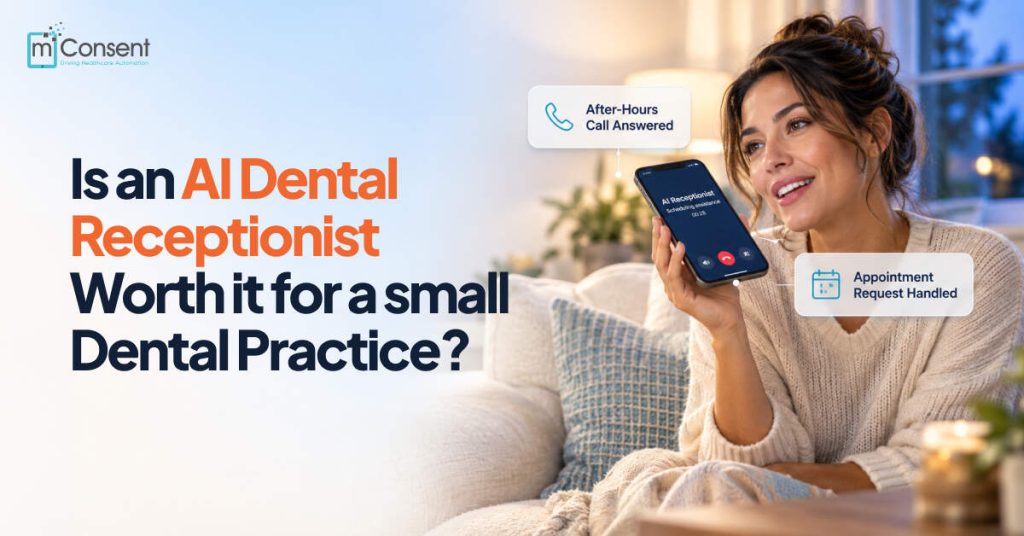




Every call your front desk can’t get to is a patient deciding whether to leave a voicemail or dial the practice down the street. For a small dental office, that single missed ring can be the difference between a booked new-patient exam and a lost one worth hundreds of dollars in lifetime value.
That’s the real question behind the hype. Not whether AI is impressive, but whether an AI dental receptionist actually earns its keep in a practice that already runs lean. This guide walks through what one does, when it pays for itself, and how to run the numbers for your own office before you commit a dollar.
The Front-Desk Math Every Small Practice Knows Too Well
Running a small practice means your front-desk team is never doing just one thing. In a single stretch of the morning, one or two people might be checking in a patient, collecting a payment, verifying insurance, and rescheduling a hygiene visit, all while the phone keeps ringing.
Something has to give. Usually it’s the phone. And every unanswered call quietly adds up to lost appointments, frustrated patients, a growing voicemail pile, and staff who feel constantly interrupted.
Hiring another receptionist is the obvious fix, but it’s rarely practical. Salary, benefits, training, and turnover make a full-time hire a heavy commitment for a practice trying to grow carefully. That gap too much phone work for the team you have, not enough volume to justify another salary is exactly where an AI receptionist for dental practice teams starts to make sense.
What Is an AI Dental Receptionist?
An AI dental receptionist is AI-powered software that answers your phones and handles routine front-office conversations the way a human receptionist would, but around the clock and without pulling anyone off the floor.
Unlike a voicemail system that records a message and hands your team more callbacks, a dental AI receptionist actually talks with the caller. Instead of “please leave a message after the tone,” the patient gets an immediate, natural conversation and, in many cases, an answer or a booked appointment on the spot.
Depending on the platform, a virtual dental receptionist can:
-
- Answer incoming calls instead of sending them to voicemail
-
- Schedule, confirm, and reschedule appointments
-
- Handle cancellations and collect basic patient information
-
- Answer routine questions (hours, location, new-patient availability)
-
- Cover calls after hours, on weekends, and during holidays
-
- Route or escalate complex requests to your team
Think of it less as a robot answering machine and more as a dental AI answering service that works a full shift, never takes lunch, and never puts a new patient on hold.
What an AI Dental Receptionist Actually Does
Capabilities vary by provider, but the strongest use cases cluster around the tasks that eat up the most front-desk time.
It answers the calls your team can’t get to. When staff are with a patient, on another line, or away from the desk, the AI dental receptionist answers instead of letting the call go to voicemail. Callers asking “Are you taking new patients?” or “What time do you open?” get an answer immediately.
It books and reschedules appointments. This is where a dental receptionist AI earns its place. It can understand a scheduling request, find an open slot, book it, send a confirmation, and handle the inevitable “can we move my Tuesday appointment?” all without a staff member touching the phone.
It covers you after hours. Patients don’t only call between 9 and 5. They search for a dentist and try to book early in the morning, on their lunch break, in the evening, and on weekends. If voicemail is the only option at those hours, those opportunities walk. An always-on AI dental answering service keeps capturing them while the office is dark.
It handles the repetitive questions. Hours, location, availability, basic policies many daily calls are predictable. Letting AI field them frees your team for the conversations that genuinely need a human.
It protects new-patient opportunities. A new patient calling your practice is potential long-term revenue. If that first call goes unanswered, most won’t leave a message; they’ll call the next office on the list. Ensuring new-patient inquiries always get a response is one of the highest-value things an AI receptionist for a dental practice does.
AI Dental Receptionist vs. a Traditional Receptionist
This isn’t really an either/or decision, and any honest look at it says so. Your human team and a dental AI receptionist are good at different things.
| Human Receptionist | AI Dental Receptionist |
| Empathy, judgment, and personal relationships | Consistent, instant responses at any hour |
| Handles complex and sensitive conversations | Handles high-volume, routine interactions |
| Limited to working hours | Available 24/7, including nights and weekends |
| Manages in-office tasks and exceptions | Works within configured workflows |
| Requires salary, benefits, and coverage | Scales routine calls without adding headcount |
The best-performing small practices don’t choose one over the other. They let AI take the predictable, repetitive work- routine scheduling, confirmations, after-hours calls, basic questions- so their people can focus on the patient in the chair, the anxious caller who needs reassurance, and the treatment conversations that actually build loyalty. That’s the human-plus-AI front office, and it’s usually the model that makes the most sense for a small team.
AI Dental Receptionist vs. Voicemail
If your current after-hours and overflow plan is voicemail, it’s worth being blunt about what that costs you.
| Voicemail | AI Dental Receptionist |
| Records a message | Holds a real conversation |
| Requires a staff callback | Can resolve many requests immediately |
| No scheduling | Can book the appointment on the call |
| Creates more follow-up work | Reduces the callback pile |
Most patients, especially new ones, won’t leave a voicemail. They hang up and dial the next practice. Replacing voicemail with a responsive virtual dental receptionist is often the single fastest way to stop leaking new-patient calls.
Is It Worth It? How to Run the ROI for Your Practice
The honest answer to “is an AI dental receptionist worth it” is: it depends on your numbers, and those numbers are easy to estimate. Work through five quick steps.
-
- Count your missed calls. Roughly how many calls go unanswered each month? Your phone system or VoIP reporting can usually tell you.
-
- Estimate the booking opportunities inside them. Not every missed call is a new appointment, but a meaningful share are new patients, reschedules, and existing patients trying to book.
-
- Apply your average patient value. Factor in the first visit plus follow-ups, hygiene, and treatment over time. Industry benchmarks put the average new-patient lifetime value around $900, so recovering even a handful of lost calls a month adds up quickly.
-
- Add the staff time you’d save. Estimate the hours your team spends each week on routine calls, scheduling, rescheduling, and confirmations. That time has a real cost, and much of it is automatable.
-
- Compare against the software cost.
AI ROI ≈ Recovered Revenue + Staff Time Saved − Software Cost
For most small practices, if a dental AI receptionist recovers just a few legitimate appointments a month, the recovered revenue alone tends to outweigh the software, before you even count the hours it hands back to your team. The exact figure varies by practice, so the smart move is to run the math on your own call volume rather than trust a generic promise.
7 Signs Your Small Practice Is Ready for an AI Receptionist
You probably don’t need a study to know whether this fits; you need an honest look at your front desk. If several of these sound familiar, an AI dental receptionist for small practices is worth a serious look:
-
- Calls regularly go unanswered. Rings that roll to voicemail during business hours are the clearest signal of missed coverage.
-
- Your front desk is constantly interrupted. Staff bounce between in-office patients and a ringing phone all day.
-
- You get after-hours calls. Patients try to reach you after hours and hit a dead end.
-
- Scheduling eats too much staff time. Routine booking and rescheduling dominate the day.
-
- You’re losing new patients. Prospective patients can’t reach you fast enough, so they book elsewhere.
-
- You want to grow without adding overhead. More volume shouldn’t automatically mean another salary.
-
- Your team is stuck on repetitive questions. The same predictable calls, over and over, pull people off higher-value work.
What to Look for in an AI Dental Receptionist
Not every tool marketed as an AI answering service is built for a dental front office. Before you commit, pressure-test any dental receptionist AI on these points:
-
- Dental-specific design: Does it understand dental terminology and real front-office workflows, or is it a generic call bot?
-
- Real scheduling and rescheduling: Can it actually book and move appointments, not just take messages?
-
- After-hours coverage: Does it converse with patients when the office is closed?
-
- Practice management integration: Does it connect to the systems you already run, like Dentrix, Eaglesoft, or Open Dental?
-
- Security and HIPAA: How is patient information protected, and will the vendor sign a BAA?
-
- Human escalation: Can complex or sensitive calls be handed off cleanly to your team?
-
- Reporting: Can you measure calls answered, appointments booked, and outcomes?
-
- Customization: Can you configure responses and workflows to match your practice?
If a platform can’t clearly answer these, it’s an answering machine with a friendlier voice, not a true AI receptionist for dental practice operations.
How mConsent and Zaha AI Help Small Dental Practices
mConsent helps dental practices modernize the entire front office, patient engagement, automation, and AI-powered communication with Zaha AI as its AI dental receptionist.
Zaha AI works as a 24/7 front-office assistant, managing routine patient conversations and scheduling-related workflows so your team doesn’t have to field every call by hand. For a small practice where the front desk juggles a dozen jobs at once, that’s coverage you’d otherwise have to hire for.
What sets Zaha AI apart is that it isn’t a standalone phone bot bolted onto your practice. It’s part of a connected front-office system, so patient communication doesn’t stop at the call; it flows into scheduling, digital intake forms, insurance verification workflows, patient reminders, and digital payments. The result is more coverage across busy periods and after hours without proportionally more staff.
The goal was never to replace your receptionist. It’s to give your team an intelligent assistant that handles the repetitive work so your people can focus on patients, complex conversations, and the relationships that keep a practice growing. mConsent supports more than 5,000 practices, so this is a proven model, not an experiment.
See Zaha AI in action
Is an AI Dental Receptionist Worth It?
For many small practices, yes, it’s worth it when the decision is grounded in real operational needs rather than the novelty of AI. It tends to pay off when your practice has frequent missed calls, heavy scheduling volume, limited front-desk capacity, meaningful after-hours demand, and new-patient opportunities you can’t afford to lose.
The strongest reason to adopt one isn’t “AI is the future.” It’s “our practice has repetitive work, missed calls, and communication bottlenecks that AI can realistically solve.” AI shouldn’t replace the human relationships that make a dental practice successful; it should handle the predictable tasks so your team can spend their time where it actually matters.
If your team spends too much time answering routine calls, or misses calls because they’re too busy to answer, an AI dental receptionist is worth evaluating. The best way to know is to review your call volume, staffing, and the opportunities you’re currently losing.
How Many Patient Calls Is Your Practice Missing?
See whether an AI dental receptionist could help your team answer more calls and reduce front-desk workload.
Frequently Asked Questions
Is an AI dental receptionist worth it for a small dental practice?
It can be especially useful for practices dealing with missed calls, high scheduling volume, after-hours inquiries, and repetitive front-desk tasks. Base the decision on your call volume, staffing costs, and potential ROI rather than the technology itself.
What does an AI dental receptionist do?
It handles routine patient communication, answering calls, scheduling, rescheduling, confirmations, and common questions depending on the system’s capabilities, so your team spends less time on the phone.
Can an AI receptionist schedule dental appointments?
Many can. A capable dental AI receptionist interacts with patients and connects to your scheduling workflow to book, confirm, and reschedule appointments. Always verify the specific scheduling and integration capabilities before choosing a provider.
Can an AI dental receptionist answer calls after hours?
Yes. After-hours coverage is one of the biggest advantages of a virtual dental receptionist, letting you capture calls and inquiries when the office is closed.
Can an AI receptionist replace a dental receptionist?
It’s best used to support your team, not replace it. AI handles repetitive, routine calls while your staff manage complex situations, sensitive conversations, and in-office responsibilities.
How does an AI dental receptionist help a small practice?
It reduces repetitive phone work, improves call coverage, supports scheduling, provides after-hours availability, cuts front-desk interruptions, and helps you respond to more patient inquiries, often without adding staff.
How much does an AI dental receptionist cost?
Pricing varies by provider, features, call volume, and integrations. The better question is net cost: weigh the price against the staff time saved and the appointments recovered, which for many practices more than covers it.