



Dental practices today are facing a financial shift and many don’t even realize it’s happening. Patient responsibility is rising. Insurance reimbursements are slower and more complex. In the meantime, front desk staff are swamped with billing, follow-ups, and calls that never end. The end result? Accounts receivable are going up, payments are taking longer, and everyone in the practice is getting more and more frustrated.
The real problem is that most practices don’t realize that their process for getting money back is quietly failing.
It’s not always one big problem. Instead, it’s little things like missed reminders, late invoices, and bad communication that add up over time to big money losses.
That’s where new technologies like mConsent come in. Practices can find hidden gaps in their revenue and fix them before they hurt growth by using automation, communication, and digital payments together.
What is Revenue Recovery and Why It Matters
What is Revenue Recovery?
Dental revenue recovery is the process of collecting unpaid bills quickly and easily while keeping a steady, predictable cash flow. It’s an important part of the revenue cycle that dental offices need to stay in business.
Why Revenue Recovery is Critical in 2026
The landscape has changed dramatically:
- Patients are paying more out-of-pocket than ever before
- Insurance delays are increasing
- Competition among practices is intensifying
To improve dental collections, practices must adapt to these new realities with smarter systems.
What Happens When It Fails?
When revenue recovery doesn’t work, the effects are felt right away:
- Cash flow that isn’t stable
- More stress for workers
- The practice is growing more slowly.
The Hidden Cost of Inefficient Revenue Recovery
Revenue Leakage Explained
You don’t lose all of your money at once. It’s happening slowly:
- Follow-ups that weren’t done
- A little bit of money owed
- Bills that were left out
Over time, these things add up to a lot of money lost.
Operational Impact
Inefficient processes create chaos:
- Staff spend hours chasing payments
- Productivity drops
- Focus shifts away from patient care
Financial Impact
Poor accounts receivable dental management leads to:
- High AR days
- Lower collection rates
- Increased patient payment delays
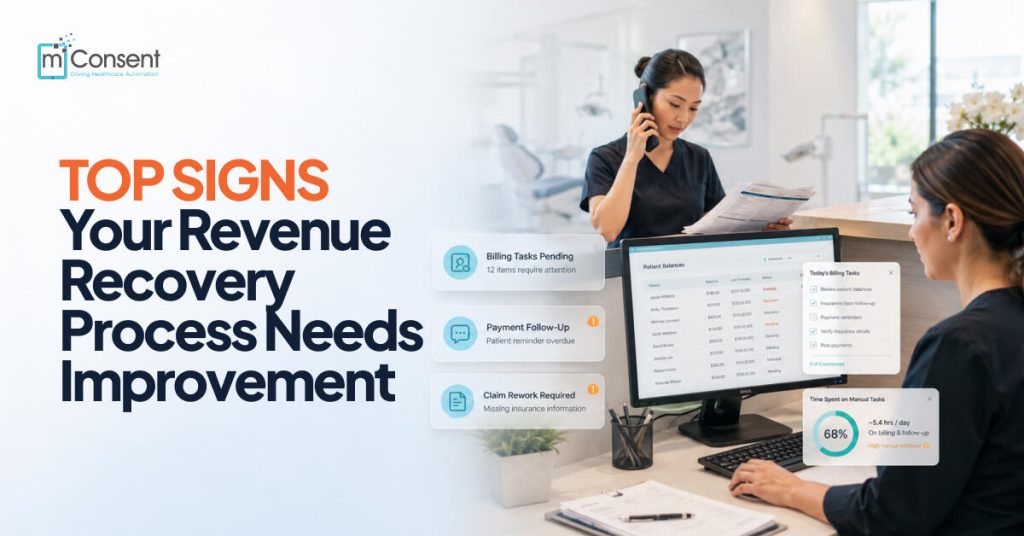
Top Signs Your Revenue Recovery Process Needs Improvement
Increasing Accounts Receivable (AR Days)
What It Means:
- Payments are taking longer to collect.
Root Causes:
- Delayed invoicing
- Lack of reminders
Impact:
- Cash flow instability
- Financial uncertainty
Fix:
- Automated billing
- Timely reminders to reduce AR days in dental
High Volume of Unpaid Patient Balances
What It Means:
- Patients aren’t paying on time.
Root Causes:
- Limited payment options
- Poor communication
Impact:
- Growing outstanding balances
Fix:
- Text-to-pay solutions
- Flexible payment plans
Frequent Insurance Claim Denials
What It Means:
- Billing errors or verification issues are common.
Root Causes:
- Manual processes
- Incomplete or incorrect data
Impact:
- Delayed revenue
- Increased rework
Fix:
- Automated insurance verification
- Pre-authorization workflows
High No-Show and Cancellation Rates
What It Means:
- Not showing up for appointments is costing you money.
Causes:
- No reminders
- Patients not being involved enough
Effect:
- Time for an empty chair
- Missed chances to make money
Fix:
- Automated reminders for appointments
- Systems for confirmation
Staff Spending Too Much Time on Billing Tasks
What It Means:
- Your workflows are not working well.
Main Causes:
- Processes manually
- Not enough automation
Effect:
- Less productive
- Burnout among staff
Fix:
- Automating workflows
- Systems that are all in one place
Inconsistent Follow-Ups on Payments
What It Means:
- Collection opportunities are being missed.
Root Causes:
- Human error
- No structured system
Impact:
- Delayed or lost payments
Fix:
- Automated follow-up sequences
Low Patient Engagement in Financial Communication
What It Means:
- Patients don’t pay attention to billing messages.
The main reasons are:
- Generic talking
- Bad timing
Effect:
- Longer wait times for patient payments
Solution:
- Text messages and emails that are unique to you
- Communication through many channels
Lack of Payment Transparency
What It Means:
- Patients don’t understand what they owe.
Root Causes:
- No clear estimates
- Complex billing
Impact:
- Payment hesitation
- Reduced trust
Fix:
- Digital treatment plans
- Clear cost breakdowns
Limited or Outdated Payment Options
What It Means:
- Patients experience friction when paying.
Root Causes:
- Traditional payment systems
Impact:
- Lower payment completion rates
Fix:
- Mobile payments
- Online billing systems
No Visibility into Revenue Metrics
What It Means:
- You don’t know where money is being lost.
Root Causes:
- Lack of analytics tools
Impact:
- Poor decision-making
Fix:
- Real-time dashboards
- KPI tracking
How These Signs Impact Overall Practice Growth
Less Profit: Inefficiencies and missed collections lower profit margins.
Slower Growth: Limited cash flow makes it hard to reinvest in technology and grow.
Bad Patient Experience: Patients get upset when billing is hard to understand.
Staff Burnout: Doing the same manual tasks over and over again wears out your team.
How to Fix Your Revenue Recovery Process
Step 1: Audit Your Current Workflow
Identify bottlenecks and gaps in your existing process.
Step 2: Automate Billing and Payments
- Digital invoicing
- Instant payment links
Step 3: Improve Patient Communication
- SMS reminders
- Email follow-ups
Step 4: Optimize Insurance Verification
- Pre-appointment eligibility checks
- Automated verification tools
Step 5: Track Key Metrics
Monitor KPIs like:
- Collection rates
- AR days
- Payment turnaround time
Role of Automation in Fixing Revenue Issues
No more missed follow-ups or forgotten invoices.
Speed: Faster billing cycles mean that payments come in faster.
Accuracy: Fewer mistakes by people makes claims more likely to be successful.
Scalability: You can grow your practice without making your staff work harder.
How mConsent Helps Identify and Fix These Issues
Automated Communication: Send patients text and email reminders to keep them engaged.
Digital Billing and Payments: Make it easier for people to pay so you can get your money faster.
Tools for checking insurance: Cut down on claim denials and delays.
Analytics Dashboard: See how well your dental practice is doing in real time with your revenue cycle.
Centralized Workflow Management: Make things run more smoothly and get rid of waste.
Best Practices for Continuous Improvement
Regular Performance Reviews: Track KPIs monthly to stay on top of performance.
Patient-Centric Approach: Make payments simple and convenient.
Continuous Optimization: Regularly refine workflows for better efficiency.
Staff Training: Ensure your team fully utilizes available tools.
Future Trends in Revenue Recovery
AI-Powered Insights: Predict patient payment behavior and optimize strategies.
Hyper-Personalized Communication: Deliver tailored financial messaging to improve engagement.
Fully Automated Revenue Cycles: End-to-end automation will redefine dental revenue recovery.
Conclusion
Problems with money don’t usually happen overnight, but they get worse quickly if you don’t deal with them. Small problems in your revenue cycle dental process can quickly become big ones that hurt your finances. They can cause accounts receivable dental to go up, patient payment delays to get longer, and your profits to slowly disappear.
It’s simple: if your collections are harder than they should be, your process for getting money back probably needs some work.
The good news is? With the right plan and tools, it can be fixed completely.
To improve dental collections, lower AR days dental, and make the payment process for patients easier and clearer, modern dental offices are moving toward automation. It’s not just about getting paid faster; it’s also about making a system that works all the time without putting too much stress on your team.
That’s where mConsent really shines:
- Finds hidden gaps in your income before they hurt your bottom line
- Gets rid of manual problems with billing and follow-ups
- Automated communication and payments speed up collections.
- Let’s you see how your finances are doing in real time
You are in charge of the next step.
Don’t wait for the problem to get worse if you see even a few of these warning signs in your practice. Take charge of your money, make your business run more smoothly, and make the financial experience better for both your staff and your patients.
Today, schedule a free demo with mConsent to find out how much money you’re missing out on and how quickly you can get it back.
Stop guessing. See your leakage number.