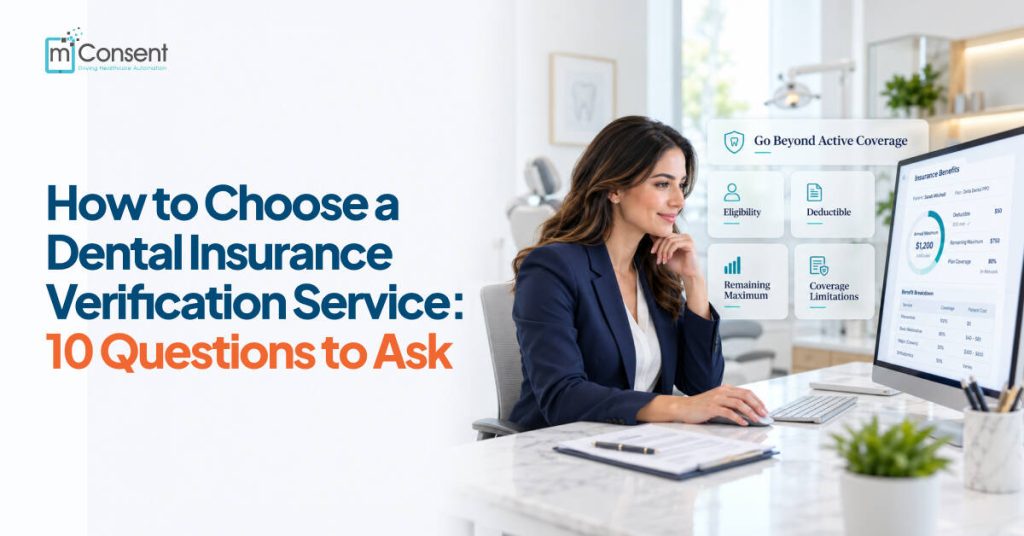




To choose a dental insurance verification service, compare how deeply each option verifies benefits, not just eligibility. Ask whether it confirms deductibles, remaining annual maximums, limitations, and procedure-specific coverage, how it handles missing information, how much manual work remains for your front desk, how results are documented, and whether it can scale with your practice.
The service you pick shapes every estimate your team gives, every claim you submit, and how much your patients trust the number they hear at checkout. Options vary widely. Some dental insurance verification services return a simple active/inactive status, while others deliver a full benefits breakdown before the patient walks in. Pick the wrong one and the work never really leaves your office. It shows up later as a callback to the payer, a corrected estimate, or a denied claim three weeks after treatment.
Use these 10 questions to compare your options side by side, whether you’re evaluating dental insurance verification software, an outsourced dental insurance verification team, or a hybrid approach that combines both.
What Does a Dental Insurance Verification Service Do?
A dental insurance verification service confirms a patient’s insurance eligibility and benefits before treatment, so the practice can estimate coverage and patient responsibility accurately.
In practice, that means checking payer portals, calling insurers when portal data falls short, and recording the results where your front desk and billing team can use them. How well that work gets done determines your dental insurance verification accuracy, which in turn decides whether estimates hold up and claims go through clean.
Eligibility Verification vs. Benefits Verification
These two terms get used interchangeably, but they answer different questions.
Dental insurance eligibility verification confirms the plan is active and the patient is covered on the date of service.
Dental insurance benefits verification confirms what the plan will pay, including coverage percentages, deductibles, annual maximums, limitations, and exclusions.
A patient can be fully eligible and still have a procedure that isn’t covered, a maximum that’s almost used up, or a waiting period that hasn’t ended. That’s why eligibility is where dental benefits verification starts, and why stopping there leaves your team guessing.
Types of Dental Insurance Verification Services
Most practices choose from four approaches. Each one solves a different problem and leaves different gaps.
In-House Manual Verification
Your staff make payer calls and check portals themselves. You keep full control over the process, but it’s time-intensive, and quality depends on who’s working that day and how busy the phones are.
Outsourced Dental Insurance Verification
An external dental insurance verification company verifies benefits on your behalf. Dental insurance verification outsourcing can take a real load off your team, though quality, turnaround, and data handling vary from vendor to vendor.
Dental Insurance Verification Software
Software runs automated dental insurance verification, usually through electronic eligibility checks. It’s fast, but depth varies. Some tools return only basic status, which leaves your team to chase the benefit details by phone.
Hybrid and AI-Assisted Verification
Hybrid models pair dental insurance verification automation with human review. Technology handles routine lookups, and trained people work the gaps and complex cases. Many AI dental insurance verification tools fall into this category.
10 Questions to Ask a Dental Insurance Verification Service
1. Does the service verify eligibility as well as benefits?
Eligibility confirms the plan is active. Benefits verification tells you what the plan will actually pay. A strong service does both. Plenty of vendors use the word “verification” to describe an eligibility check alone, so confirm which one you’re getting.
What a strong answer sounds like: A clear distinction between the two, with a benefits breakdown included by default.
Ask next: “Can I see a sample verification report?”
2. Does it provide more than an active/inactive coverage response?
An active/inactive result alone leaves gaps in coverage percentages, maximums, and limitations that can lead to inaccurate estimates. Your team still has to find those details before anyone can quote a fee with confidence.
What a strong answer sounds like: A detailed breakdown that includes coverage by category, network status, and plan dates.
Ask next: “Which fields come back on a typical verification?”
3. Can it verify deductibles and remaining annual maximums?
Remaining deductible and annual maximum determine what insurance will actually pay, so a service should report what’s remaining, not just plan totals. A $1,500 annual maximum tells you very little if the patient used most of it earlier in the year.
What a strong answer sounds like: It reports deductible remaining, annual maximum used and remaining, and plan year dates.
Ask next: “Do you report remaining amounts or only plan totals?”
4. Does it identify coverage limitations, waiting periods, and exclusions?
Limitations, waiting periods, and exclusions often cause denials even when a patient is active, so include them in every verification. These are the details that turn a “covered” procedure into a rejected claim.
What a strong answer sounds like: It covers frequency limitations, waiting periods, exclusions, and pre-authorization requirements.
Ask next: “How do you flag a waiting period that hasn’t been met yet?”
5. Can it provide information relevant to specific procedures, such as root canals?
Procedure-specific verification matters most for specialty practices, where coverage can vary by procedure code, tooth, and plan classification. Root canal insurance verification is a good test. Depending on the plan, endodontic treatment may fall under basic or major services, and retreatment can carry its own frequency rules.
What a strong answer sounds like: It can verify coverage for planned procedures, such as endodontic therapy and retreatment, including category and percentage.
Ask next: “Can you verify coverage by CDT code for the planned treatment?”
6. How does the service handle unclear or missing insurance information?
Payer data is often incomplete, so ask how gaps are flagged, followed up on, and resolved before the appointment.
What a strong answer sounds like:
- Gaps are clearly flagged.
- There’s a defined follow-up process, such as payer calls when portal data is missing.
- There’s a set turnaround expectation.
Ask next: “What happens if a verification isn’t complete before the patient arrives?”
7. How much manual work is still required from the dental front desk?
The right service should remove routine verification work from your front desk, not just shift it to a different screen. If your team still has to log in, cross-check, and rekey results, the time savings shrink fast.
What a strong answer sounds like: A clear explanation of which steps are handled and which still need staff input, such as entering patient insurance details.
Ask next: “Walk me through what my front desk does from booking to check-in.”
8. Does the service reduce payer calls and portal checks?
Repetitive payer calls and portal logins consume front-desk time, so a strong service should measurably reduce them. Hold times add up quickly when your team is also checking patients in and answering the phone.
What a strong answer sounds like: A clear explanation of how calls and portal checks are reduced, plus what still requires a call.
Ask next: “Which situations still require my team to call the payer?”
9. How is verification information documented and communicated to the practice?
Verification only helps if the right people can find it, so ask where results live, how they’re formatted, and how updates are shared.
What a strong answer sounds like:
- Results are stored in a consistent format.
- Results are accessible to front desk and billing.
- Each verification is date-stamped.
- Results ideally connect to the practice’s workflow.
Ask next: “Do results post to our practice management system, or live in a separate portal?”
10. Can the service scale with the practice as patient volume grows?
A verification service should handle growing patient volume, new locations, and busy seasons without slowing down or adding staff.
What a strong answer sounds like: Consistent turnaround at higher volume, plus multi-location support.
Ask next: “How does turnaround change during peak season or when we add a location?”
Why Specialty and Endodontic Practices Need Deeper Verification
General practices struggle with incomplete verification, but endodontic practices face greater pressure and higher costs when details are missed. Four factors make endodontic insurance verification more challenging.
Referral patients may have incomplete insurance details. Referring offices may send outdated or incomplete information, including secondary coverage.
Emergency cases leave little time for verification. Patients in pain need treatment quickly, making it hard to complete emergency dental insurance verification before treatment.
Expensive procedures mean bigger losses. Denied root canal or retreatment claims can lead to costly write-offs and unpaid patient balances.
Procedure-specific rules affect coverage. Retreatment limits, procedure classifications, and tooth history can change what insurance pays. A basic eligibility check may not catch these details.
How mConsent Insurance Concierge Goes Beyond Active Coverage
mConsent Insurance Concierge gives dental and endodontic practices a more complete insurance verification workflow than a basic eligibility check. Each verification is built to surface the benefit information your team needs, including treatment coverage, deductibles, remaining annual maximums, coverage percentages, waiting periods, limitations, exclusions, and patient responsibility.
That depth changes the front-desk day. Insurance Concierge reduces repetitive payer calls, portal checks, manual research, and data entry, so your team spends less time on routine verification and more time with patients.
Patient insurance information is handled within a HIPAA-compliant workflow, and a Business Associate Agreement is available to practices.
Where mConsent Insurance Concierge Fits
Choose a Dental Insurance Verification Service That Goes Beyond Active Coverage
Insurance Concierge is a managed approach to dental insurance verification. It sits between software-only tools, which often stop at eligibility, and a full-time in-house coordinator, which is costly to hire and hard to cover when that person is out.
The workflow is designed to help dental and endodontic practices move past a simple active/inactive response and surface benefit information your team can act on. A dedicated account manager sets it up around your practice, experienced agents do the verification work, and for scheduled appointments, verification is typically completed 24 to 48 hours ahead.
How mConsent Insurance Concierge Can Help Simplify Insurance Verification
1. Move Beyond Basic Eligibility
Active coverage is only the starting point. Insurance Concierge treats eligibility as the first step of each verification, then works through the benefit details that determine what the plan will actually pay.
2. Surface Relevant Benefit Information
Your team gets the information that supports treatment and financial conversations: coverage percentages, deductibles, remaining maximums, waiting periods, limitations, and exclusions. When that information is ready before the patient arrives, estimates are clearer and checkout conversations go more smoothly.
3. Reduce Repetitive Verification Work
Insurance Concierge is built to take the most repetitive tasks off your front desk:
- Payer calls
- Portal checks
- Manual research
- Data entry
4. Support Dental and Endodontic Workflows
The service is designed for the way different practices schedule and treat patients, including:
- General dentistry
- Endodontics
- Emergency treatment
- Root canals
- Specialty workflows
5. Combine Technology With a Managed Workflow
Software can retrieve data quickly, but exceptions usually bounce back to your front desk. A managed workflow adds people who work the case when portal data is incomplete, which is where insurance benefits verification services earn their value. With Insurance Concierge, you get the speed of technology and a team that follows through on the gaps.
Conclusion: Choose a Dental Insurance Verification Service That Goes Beyond Eligibility
Choosing the right dental insurance verification service takes more than finding a provider that can confirm whether a patient’s insurance is active. The right partner gives your team the information it needs to make better-informed treatment and financial decisions without adding work to an already busy front desk.
An active or inactive response answers one question and leaves several open. Does the plan cover the planned procedure? How much of the deductible remains? What’s left of the annual maximum? Are there waiting periods, frequency limitations, or exclusions? What could affect the patient’s expected responsibility?
These details matter. Incomplete insurance information leads to extra calls, portal checks, manual research, billing rework, unexpected patient balances, and difficult conversations at checkout. For endodontists, the pressure is more immediate when patients arrive for emergency care or need a root canal the same day.
That’s why the best dental insurance verification services should be judged on the value they deliver beyond basic eligibility. Before choosing a provider, ask whether it can:
- Verify both eligibility and benefits
- Provide more than an active/inactive response
- Identify deductibles and remaining annual maximums
- Surface applicable limitations, waiting periods, and exclusions
- Support procedure-specific verification
- Help with dental insurance verification for endodontists
- Handle unclear or incomplete insurance information
- Reduce manual payer calls and portal checks
- Clearly document and communicate verification results
- Scale as patient volume and practice needs grow
More insurance data alone won’t fix the problem. What helps is information your team can use.
Move From Insurance Uncertainty to a More Efficient Verification Workflow
Modern dental practices need more than manual research or disconnected tools. Automated dental insurance verification, dental insurance verification software, and managed verification services can all reduce repetitive administrative work while giving your team faster access to accurate dental insurance coverage verification. With the right workflow, insurance verification before treatment becomes routine, and your front desk spends less time in payer portals and on hold, and more time supporting patients.
That’s where mConsent Insurance Concierge can help. It’s designed to help dental and endodontic practices move beyond basic eligibility by supporting a more complete verification workflow. By surfacing important benefit information and reducing repetitive verification work, it helps your team have clearer financial conversations and a smoother front-desk day.
If your practice still verifies benefits manually, makes repeated payer calls, or works with incomplete insurance information, it may be time to rethink your verification workflow.
Ready to Go Beyond Active Coverage?
Automate Dental Insurance Verification and Reduce Staff Workload
See how mConsent Insurance Concierge can help your practice streamline verification, reduce repetitive administrative work, and give your team better insurance information before treatment.