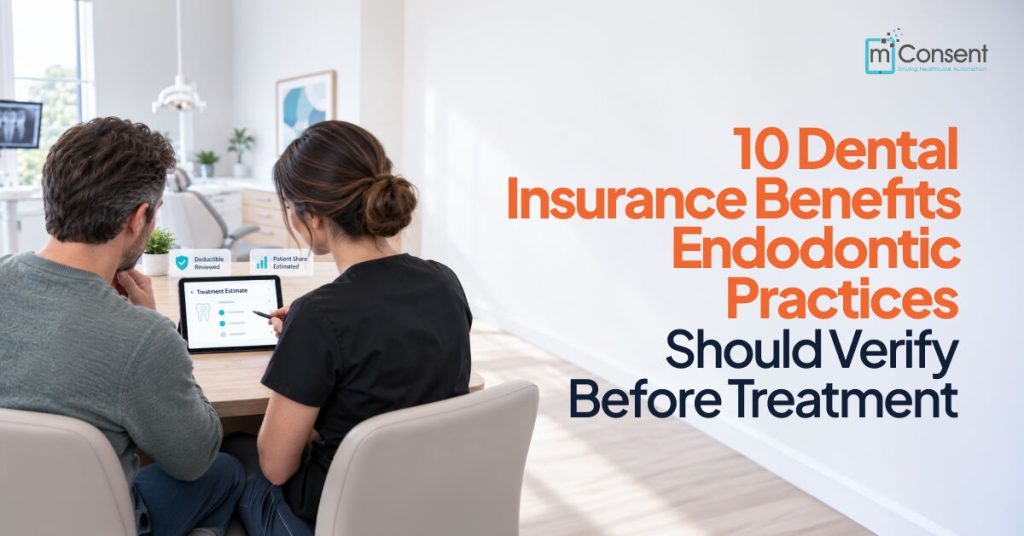




mConsent Insurance Concierge helps endodontic practices verify critical insurance details before treatment whenever possible. Practices get clearer visibility into eligibility, coverage, deductibles, annual maximums, waiting periods, and patient responsibility, reducing front-desk delays, minimizing billing surprises, and helping patients make faster treatment decisions.
Why Endodontic Practices Should Verify Insurance Benefits Before Treatment
Endodontic treatment often starts with a patient in pain. There’s rarely time to spare once someone is sitting in the chair with an urgent problem, which is exactly why the insurance conversation can’t wait until they arrive.
Confirming that a patient’s insurance is active only answers one question. Before treatment, the front desk usually needs to know a lot more: Is the planned treatment covered? What’s the deductible, and how much of it is left? What’s the annual maximum, and how much remains? Are there waiting periods, frequency limitations, or exclusions that apply? What portion of the cost is likely to fall to the patient?
That’s the core problem with treating “active insurance” as the finish line. Eligibility tells you coverage is turned on. Benefits verification tells you what that coverage actually pays for and what’s likely to be left over. The right information, verified early, lets endodontic practices prepare patients for treatment instead of reacting once they’re already in the room.
mConsent Insurance Concierge is built to help with exactly this: verifying critical insurance details before treatment, whenever possible, so practices aren’t piecing the picture together at check-in.
What Is Dental Insurance Benefits Verification?
Dental insurance benefits verification is the process of reviewing a patient’s eligibility and benefit information to understand applicable coverage, limitations, deductibles, annual maximums, and potential patient responsibility before treatment.
A thorough verification typically covers:
- Eligibility and effective dates
- Member information
- Coverage details
- Deductible and remaining deductible
- Annual maximum and remaining annual maximum
- Coverage percentage
- Waiting periods
- Frequency limitations
- Exclusions and plan restrictions
- Patient responsibility
Eligibility Verification vs. Benefits Verification
| Eligibility Verification | Benefits Verification |
| Confirms active coverage | Reviews applicable benefits |
| Checks effective dates | Reviews deductibles |
| Confirms member information | Reviews annual maximums |
| Determines whether the plan is active | Reviews coverage percentages |
| Provides basic coverage status | Identifies limitations and potential patient responsibility |
A patient’s insurance can be active, but not every planned endodontic service is covered the same way. That gap is where most front-desk surprises come from.
Why Insurance Benefits Verification Matters for Endodontic Practices
Endodontic practices are constantly balancing clinical urgency with financial clarity. Patients want to know what’s wrong and what it will cost, often in the same conversation.
Accurate benefits information helps practices prepare for treatment, reduce administrative delays, and catch potential insurance issues before they become billing disputes. It also improves the cost conversation itself; staff can speak with confidence instead of hedging, which reduces patient confusion and supports faster treatment decisions. The practical result is a front desk that runs more efficiently and fewer billing surprises after the fact.
The workflow looks straightforward on paper: verify insurance right after the appointment is booked, review benefits, discuss cost, then treat. Most practices, though, still run a version where insurance research doesn’t start until the patient arrives and sits in the waiting room, which pushes the cost conversation later and puts staff in the position of researching coverage. Meanwhile, a patient in pain waits to be seen. The difference between the two isn’t the number of steps; it’s simply where the research happens, before the visit or during it.
10 Dental Insurance Benefits Endodontic Practices Should Verify Before Treatment
1. Insurance Eligibility
The first step is confirming whether the patient’s dental insurance is currently active. Verify active/inactive status, the effective date, the termination date where available, and member information.
Why it matters: An inactive plan can change the entire financial conversation before treatment even begins.
Key takeaway: Verify eligibility before relying on any coverage information tied to that plan.
2. Endodontic Treatment Coverage
Confirm whether the plan actually provides benefits for the relevant endodontic treatment, root canal treatment, pulpal procedures, endodontic retreatment, related diagnostic procedures, and other applicable services, depending on the plan.
Important qualification: Coverage depends on the specific plan and payer rules, not on whether the patient’s insurance is active in general.
Key takeaway: Don’t assume active insurance means the planned endodontic service is covered.
3. Deductible and Remaining Deductible
A patient’s deductible directly affects their potential out-of-pocket cost. Verify the annual deductible, how much has already been met, how much remains, and whether the deductible applies to the planned service at all.
4. Annual Maximum and Remaining Annual Maximum
The annual maximum is the amount a dental plan may pay toward covered services during a benefit period, subject to the plan’s terms. Verify the annual maximum, the amount already used, the remaining balance, and the benefit-period dates.
Why it matters: A patient can have active coverage and still have very little annual benefit left.
Key takeaway: The remaining annual maximum matters as much as the maximum itself when setting financial expectations.
5. Coverage Percentage
Review the percentage the plan may cover for the relevant procedure or category of service; for example, an 80% insurance benefit implies a potential 20% patient responsibility. But the actual amount paid can depend on plan limitations, deductibles, maximums, allowed amounts, network status, and other payer rules.
Key takeaway: Coverage percentages provide useful context, but don’t present them to patients as a guaranteed payment amount.
6. Waiting Periods
Some dental plans include waiting periods for certain services. Verify whether a waiting period applies, which services it covers, and whether it’s already been satisfied.
Why it matters: A patient can have active insurance and still have limited benefits for a specific service simply because a waiting period hasn’t passed.
Key takeaway: Check waiting periods before assuming an active plan means immediate benefits for the planned treatment.
7. Frequency Limitations
Some plans limit how often a service can be covered. Verify procedure frequency limits, time since the previous treatment, other service limitations, and applicable benefit-period restrictions.
Why it matters: A patient’s treatment history can affect whether a service is eligible for benefits right now, regardless of current coverage status.
Key takeaway: Frequency limitations can reduce or eliminate coverage even on an active plan.
8. Exclusions and Non-Covered Services
Review plan exclusions that could affect the planned treatment, including excluded procedures, alternative treatment clauses, plan-specific restrictions, and other non-covered services.
Why it matters: Catching exclusions early makes for a more transparent financial conversation instead of an awkward one after the fact.
Key takeaway: Verification should cover potential exclusions, not just what’s covered.
9. Patient Responsibility
This is often the number patients care about most: what they’ll actually owe. It can be affected by the deductible, coinsurance, copayment, annual maximum, non-covered services, allowed amounts, network status, and other plan rules.
Key takeaway: Benefits verification helps practices prepare a more informed estimate of patient responsibility, but an estimate does not guarantee insurance payment. Final responsibility depends on claim adjudication and the patient’s plan terms.
10. Coordination of Benefits and Other Plan Restrictions
For patients covered by more than one insurance plan, coordination of benefits can affect who pays what. Verify primary and secondary insurance, coordination of benefits, subscriber information, plan restrictions, and other applicable payer requirements.
Why it matters: Understanding a patient’s full insurance picture before treatment reduces confusion once billing and claims are underway.
Key takeaway: Review every applicable plan and restriction before finalizing financial expectations with the patient.
Dental Insurance Benefits Verification Checklist for Endodontists
Before endodontic treatment, verify:
- Insurance eligibility
- Effective dates
- Member ID
- Subscriber information
- Group number
- Endodontic treatment coverage
- Deductible
- Remaining deductible
- Annual maximum
- Remaining annual maximum
- Coverage percentage
- Waiting periods
- Frequency limitations
- Exclusions
- Plan restrictions
- Coordination of benefits
- Potential patient responsibility
Why Verifying These 10 Benefits Before Treatment Matters
Reduce front-desk delays. Verifying earlier cuts down the insurance research staff need to do during an emergency visit or same-day appointment.
Improve patient cost clarity. Staff walk into the financial conversation with real information instead of guesses.
Reduce billing surprises. Catch limitations before treatment so they don’t turn into disputes after.
Support faster treatment decisions. Patients can decide with a clearer sense of what insurance will and won’t cover.
Improve front-desk efficiency. Less time re-verifying the same information means more time with patients.
Before vs. After: A Better Endodontic Insurance Verification Workflow
| Traditional Workflow | Earlier Verification Workflow |
| Patient arrives | Insurance information collected early |
| Staff starts insurance research | Verification begins before the visit when possible |
| Portal searches during the visit | Benefits information prepared in advance |
| Patient waits for financial information | Staff already has the information on hand |
| Financial conversation may be delayed | Cost discussion can happen earlier |
| Front desk handles multiple tasks at once | Staff can focus on patients and true exceptions |
The goal isn’t to remove human review from the process; it’s to move the routine parts of verification earlier so staff time goes toward the exceptions that actually need it.
How Automated Dental Insurance Verification Can Help
Automated workflows can help endodontic practices cut down on the repetitive parts of insurance verification: routine eligibility checks, benefits lookups, and the payer-portal research that eats up front-desk time. That includes reducing manual data entry and standardizing how verification happens across staff, so the process doesn’t depend on who’s working the front desk that day. It also means potential issues- an inactive plan, an approaching annual maximum, an unmet waiting period- can surface earlier, while there’s still time to do something about them.
Insurance information gets collected up front, automated verification runs against it, and the resulting benefits information goes to staff for review. Staff focus on the exceptions the system flags rather than rechecking everything manually, which feeds the patient financial conversation before treatment begins.
Dental Insurance Benefits Verification vs. Eligibility Verification
| Eligibility Verification | Benefits Verification |
| Is insurance active? | What benefits apply? |
| Checks coverage status | Reviews applicable services |
| Confirms effective dates | Reviews deductible |
| Confirms member information | Reviews annual maximum |
| Basic verification | More detailed financial information |
Eligibility tells the practice whether the patient’s insurance is active. Benefits verification tells the practice what that coverage and those financial factors actually mean for this specific treatment.
Common Insurance Verification Mistakes Endodontic Practices Should Avoid
Mistake 1: Checking only eligibility. Active insurance doesn’t guarantee coverage for every planned procedure.
Mistake 2: Ignoring remaining deductible. What’s left on the deductible can significantly change the patient’s out-of-pocket cost.
Mistake 3: Ignoring remaining annual maximum. A patient’s benefits for the year may already be mostly used up.
Mistake 4: Assuming coverage percentage equals final payment. A percentage is a starting point, not a guarantee.
Mistake 5: Not checking waiting periods. Some plans restrict benefits until you meet a waiting period, even with active coverage.
Mistake 6: Overlooking frequency limitations. Prior treatment history can affect whether a service qualifies for benefits now.
Mistake 7: Treating estimates as guarantees. Verification informs an estimate; it doesn’t promise a payment amount.
Mistake 8: Waiting until the patient arrives. Whenever possible, move verification earlier in the workflow, not into the appointment itself.
How to Build a Better Insurance Verification Workflow for Endodontic Practices
- Collect insurance information early during scheduling or pre-visit intake whenever possible.
- Verify eligibility, confirm active coverage, and confirm relevant patient details.
- Verify the 10 key benefits: coverage, deductible, annual maximum, waiting periods, limitations, and patient responsibility factors.
- Identify potential issues: flag inactive coverage, missing information, exclusions, or limitations.
- Review the information let the right staff member handle exceptions.
- Prepare the financial conversation: use what’s verified to discuss potential costs with the patient.
- Proceed with treatment; keep the clinical workflow moving while financial communication stays on track.
How mConsent Insurance Concierge Helps Verify Key Insurance Benefits
mConsent Insurance Concierge helps endodontic practices verify critical insurance details before treatment whenever possible, giving practices clearer visibility into eligibility, coverage, deductibles, remaining deductible, annual maximums, remaining annual maximum, waiting periods, benefit limitations, and potential patient responsibility.
What it supports:
- Earlier insurance verification
- Streamlined eligibility and benefits verification
- Reduced repetitive manual work and payer portal research
- Better front-desk efficiency and more consistent verification workflows
- Earlier identification of potential insurance issues
- Better-supported patient cost conversations
- Reduced administrative friction
Once an appointment is scheduled, Insurance Concierge collects insurance information and runs it through verification. Eligibility and benefits get reviewed, and any potential issues are flagged for staff to work through as exceptions rather than starting from scratch. That review feeds directly into the patient financial discussion, so the practice is prepared well before the endodontic treatment itself begins, verifying key insurance benefits before treatment, whenever possible, is the core of what Insurance Concierge is built to do.
How Better Benefits Verification Improves the Patient Experience
Patients get more financial clarity when the numbers are ready before their visit instead of being pieced together during it. Fewer administrative delays mean less time waiting at the front desk for information that could’ve been gathered in advance. Staff can have better-informed cost conversations, patients are less likely to be caught off guard by something that could’ve been flagged earlier, and clearer financial information generally means faster treatment decisions.
Signs Your Endodontic Practice Needs Better Insurance Benefits Verification
Your practice may benefit from a more streamlined process if staff are manually checking multiple payer portals, insurance is often verified only once the patient arrives, front-desk teams are frequently on the phone with insurance companies, benefits are manually re-entered into patient records, patients regularly ask about costs staff can’t yet answer, remaining deductibles and annual maximums are hard to pin down, insurance limitations tend to surface late, financial conversations get pushed back, or staff are spending a disproportionate amount of time on repetitive verification tasks.
Conclusion
For endodontic practices, insurance verification is about more than confirming a plan is active. It’s treatment coverage, deductibles and remaining deductible, annual maximum and remaining annual maximum, coverage percentage, waiting periods, frequency limitations, exclusions, and patient responsibility all reviewed before the patient sits in the chair.
Verifying these benefits earlier, whenever possible, reduces administrative delays, improves financial conversations, and gives patients more clarity before treatment even starts.
Verify Key Insurance Benefits Before Endodontic Treatment
Frequently Asked Questions
1. What insurance benefits should an endodontist verify before treatment?
Endodontic practices should consider verifying eligibility, treatment coverage, deductibles, remaining deductibles, annual maximums, remaining annual maximums, coverage percentages, waiting periods, frequency limitations, exclusions, and potential patient responsibility.
2. What is dental insurance benefits verification?
Dental insurance benefits verification is the process of reviewing a patient’s eligibility and plan benefits to understand applicable coverage, deductibles, annual maximums, limitations, exclusions, and potential financial responsibility before treatment.
3. Why is dental insurance verification important for endodontists?
It helps endodontic practices prepare for treatment, identify potential insurance issues earlier, support clearer patient financial conversations, and reduce administrative delays.
4. What’s the difference between eligibility and benefits verification?
Eligibility verification confirms whether a patient’s insurance is active. Benefits verification provides additional detail about coverage, deductibles, annual maximums, limitations, and other plan factors that may affect patient responsibility.
5. Should endodontists verify insurance before treatment?
Whenever possible, yes, verifying insurance before treatment gives the practice more time to review benefits, catch potential issues, and prepare patients for the financial conversation ahead of the appointment.