



The patient check-in process is the first real interaction patients have with your dental practice. Before they meet the provider or experience your clinical care, they form opinions based on how quickly, smoothly, and professionally they are welcomed. In many dental offices, this experience still depends on a traditional front desk workflow, paper forms, manual verification, and staff-led intake.
At the same time, more and more dental offices are using self-check-in kiosks, which are faster, more digital, and more private. Both methods have their pros and cons, but the real question is: which one is better for your practice right now, and where do you want to be in the future?
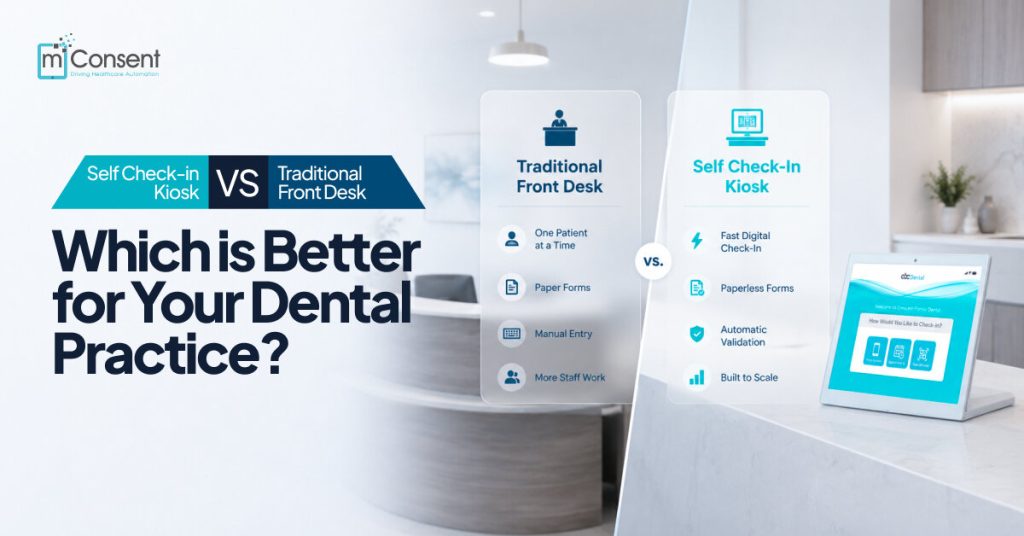
This blog compares traditional front desk check-in with self-check-in kiosks based on efficiency, staff workload, patient experience, accuracy, and scalability.
The Traditional Front Desk: What It Offers
What It Is
As usual, staff members help people check in at the front desk. When patients arrive at the office, the receptionist greets them, finds their appointment, provides paperwork, answers their questions, and then enters the information into the practice management system. This is how dentists have always done things.
Typical tasks include:
- Greeting and identifying patients
- Verifying appointment details
- Distributing and explaining paper forms
- Collecting insurance cards and IDs
- Manually entering or scanning data
Strengths
The best thing about a traditional front desk is that people can talk to each other. Some patients, especially older ones, those who are nervous, or those who are coming for the first time, like getting help in person. In a clinical setting, talking to someone one-on-one can help build trust and give them peace of mind.
This method can still feel manageable and familiar for small practices with few patients.
Limitations and Challenges
The traditional model is becoming less useful, even though it is well-known:
- Check-in happens one at a time, not all at once, which means lines form when there are many people.
- A lot of staff time is spent on paperwork.
- The front desk staff is often busy when people call, walk in, or ask about insurance.
- Bad handwriting, missing fields, or having to enter data again can all lead to mistakes.
This model becomes harder to scale without adding staff as the number of patients increases.
Self Check-In Kiosks: A Modern Alternative
What Is a Self Check-In Kiosk?
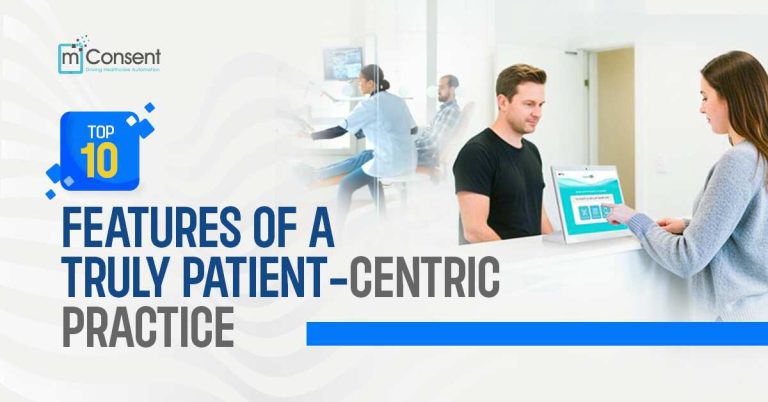
A self check-in kiosk is a digital, automated station that lets patients check themselves in without help. It usually has a touchscreen or QR code. Patients can verify their identity, confirm their appointments, complete digital forms, and provide consent without waiting for staff assistance.
These kiosks are fast, accurate, and give patients control, making things easier for them when they arrive.
Why mConsent’s Self Check-In Kiosk Stands Out
The Self Check-In Kiosk from mConsent is made just for dental offices and places with a lot of people. Some of the most important features are:
- Most patients check in in about a minute, so check-ins are very quick.
- Self-guided process: Patients can show who they are by giving a phone number, date of birth, or QR code.
- Patients fill out forms on a computer while they wait, so there is no need for paper or scanning.
- Real-time updates on the status: Staff can quickly tell who has arrived, who is missing something, and who is ready.
- Security that is up to HIPAA standards: Full audit trails for capturing encrypted data.
- Integrations that work without any problems: Works with popular PMS systems like Dentrix, Eaglesoft, Open Dental, and others.
- A setup that is ready to go and branding that is all your own: It comes ready to work with the look and feel of your practice.
Direct Comparison: Self Check-In Kiosk vs Traditional Front Desk
Speed and Efficiency
Traditional front desk:
One person checks in at a time. When things are busy, people have to wait in line, and things get behind.
Self check-in kiosk:
More than one patient can check in at the same time. Digital prompts and validations speed up the process for patients, which means that many more people can do it.
Staff Workload
Traditional front desk:
Receptionists often perform the same administrative tasks repeatedly, such as handing out forms, explaining paperwork, and entering data.
Self check-in kiosk:
Automates routine tasks and can free up 15+ hours per week of front desk time, allowing staff to focus on higher-value patient interactions.
Patient Experience and Satisfaction
Traditional front desk:
Offers personal interaction but often comes with longer wait times and crowded desks.
Self check-in kiosk:
Offers a more modern, faster, and private experience. Many patients like how easy and controllable it is, especially those accustomed to digital services.
Data Accuracy
Traditional front desk:
Manual entry introduces risk, illegible handwriting, missed fields, and transcription errors.
Self check-in kiosk:
Digital forms make sure that all required fields are filled out and that the formatting is the same, which makes the data more complete and trustworthy.
Scalability
Traditional front desk:
To see more patients, practices need to hire more people.
Self check-in kiosk:
It can easily grow in size and staff numbers without a linear increase in staffing, making it perfect for DSOs and practices that want to grow.
Addressing Common Concerns
Modern self-check-in kiosks have screens that are easy to use and options that are flexible, like scanning a QR code or entering a phone number. This means that patient comfort levels are rarely a problem. Patients can go through the process at their own pace, and staff are always there to help anyone who needs it, so they don’t have to do everything themselves.
Kiosks don’t take the place of the personal touch at the front desk, though. They take care of everyday administrative tasks so that staff can focus on what matters most: warmly welcoming patients, answering questions, and giving them a more personal and attentive experience.
ROI and Practice Growth
A self check-in kiosk contributes to growth in several ways:
- Insurance submissions are cleaner when fewer mistakes are made.
- Longer wait times mean worse online reviews and fewer patients staying with you.
- Staff time is spent on more important tasks rather than on paperwork.
- More efficient work means more patients each day.
Over time, these gains translate into measurable operational and financial ROI.
Decision Guide: Which Is Right for Your Practice?
Best Fit for Traditional Front Desk
- Practices with older patients who really want to talk to someone in person.
- Offices with few patients where there isn’t much time pressure.
Best Fit for Self Check-In Kiosk
- Busy practices with a lot of patients
- Offices that wanted to be efficient and go digital
- Practices that want a modern, touchless check-in process
- DSOs and groups with multiple locations that need to have the same workflows across all of them
Conclusion
You should know that traditional front desks and self-check-in kiosks have very different effects on day-to-day operations. Even though manual check-in is still common, it was introduced when things were slower and paper-based. It doesn’t meet modern standards for speed, accuracy, or scalability. When things are busy, the front desk staff have to greet people, handle paperwork, enter data, and answer the phone all at once. This leads to delays, errors, and more stress.
The mConsent Self Check-In Kiosk modernizes the process by automating arrival, verification, and form completion in a single guided flow. Patients check in faster, staff have more time to do other things, and data is collected digitally with more accuracy and completeness. As a result, the front desk runs more smoothly, patients wait less time, and the whole experience is more polished and professional from the moment they walk in.
This isn’t just a convenience for most modern dental offices; it’s also a smarter way to run their business. By making things easier at the front desk, practices can grow more easily, keep their staff from getting burned out, and give patients the kind of experience they expect.
Are you ready to change how your patients check in?
Set up a demo today to see how the mConsent Self Check-In Kiosk can help your business run more smoothly, calmly, and profitably.