



Right now, there are patients in your database who used to come in every six months like clockwork, but they’ve quietly stopped coming.
They didn’t cancel. They didn’t complain. They may not have switched to another dentist. They stopped scheduling their next hygiene appointment.
And the worst part? You may not even realize they’re gone.
That’s the danger of hygiene drop-off, one of the most overlooked revenue leaks in a dental practice.
Unlike a broken appointment or an empty spot on tomorrow’s schedule, hygiene drop-off doesn’t show up in your daily huddle. There’s no obvious red flag. It happens quietly, patient by patient, month after month.
But every patient who doesn’t return represents missed preventive care, missed treatment opportunities, and recurring revenue your practice could have retained.
By the time you notice the gap, it may already be costing your practice thousands.
The Number Every Practice Owner Needs to See
Here’s a statistic that should stop you mid-scroll: only about 60% of hygiene patients return within 12 months. That means roughly 40% disappear.
Now apply that to your own practice.
If you have 2,000 active patients, that could mean 800 patients have already stopped coming in. Not next year. Not next quarter. Right now.
And this is usually how it happens:
A reminder text goes out. The patient doesn’t respond. No one follows up with another message or a phone call. The front desk gets busy and moves on to the next task.
And just like that, a patient relationship that may have lasted 10 years quietly ends.
They didn’t necessarily choose another dentist. They simply stopped coming.
Now ask yourself: How many hygiene patients have you lost in the last four months?
If you don’t know, you’re not alone. Most practice owners have never pulled that list or measured the number.
It could be 50 patients. It could be 800.
And that uncertainty is exactly what makes hygiene drop-off so dangerous.
You can’t fix a revenue leak you can’t see.
Why “It’s Just a $200 Cleaning” Is the Wrong Way to Think About It
It’s easy to look at a missed hygiene appointment and think, “It’s only a $200 cleaning.”
But that’s not what you’re actually losing.
A hygiene visit can be worth $800 to $1,200 a year when you consider cleanings, exams, and the restorative treatment those exams can uncover.
Over 10 years, one loyal hygiene patient could represent $10,000 or more in lifetime value.
And that entire relationship can disappear simply because no one followed up after the first missed appointment.
Now multiply that by every patient who has quietly stopped coming to your practice.
Most practice owners have never calculated that number. When they do, the result can be alarming.
And there’s another layer to this leak.
Hygiene isn’t just a cleaning. It’s the entry point to your practice’s entire treatment pipeline.
During a routine visit, your team may identify early periodontal disease, a cracked tooth, a failing restoration, or treatment the patient didn’t know they needed.
When that patient stops coming in, you don’t just lose the hygiene appointment.
You lose the exams, diagnoses, restorative procedures, periodontal treatment, and referrals that could have followed.
Hygiene is the engine that feeds the rest of your practice.
When that engine slows down, everything downstream starts to slow down with it.
Why This Keeps Happening: 3 Root Causes
If hygiene drop-off is costing practices this much, why does it continue to happen?
Because in most practices, the problem comes down to three simple gaps.
One Reminder Isn’t a Recall System
Many practices send one text, maybe one email, and consider the job done.
If the patient doesn’t respond, no one follows up. The front desk gets busy, moves on to the next task, and the patient falls through the cracks.
One reminder isn’t a recall strategy. It’s a hope.
A real recall system needs consistent follow-up until the patient schedules or clearly indicates they no longer want to return.
Every Overdue Patient Gets the Same Generic Message
A patient who is two weeks overdue is not the same as a patient who is six months overdue.
Yet many practices send both patients the same generic reminder.
The patient who is only slightly overdue may need a simple nudge.
The patient who has been gone for six months needs a reactivation strategy with more persistent outreach.
Treating every overdue patient the same creates two problems: you risk over-messaging patients who are easy to bring back, while under-serving the patients who are already drifting away.
Nobody Owns the System
Ask your team, “Who is responsible for following up with overdue hygiene patients and getting them back on the schedule?”
If the answer is unclear, that’s the problem.
Your practice management system already contains the information on who is overdue, how long they’ve been overdue, and when they were last seen.
But data alone doesn’t bring patients back.
Someone has to own the process, follow up consistently, and make sure those patients get rescheduled.
Without clear ownership, overdue patients continue to disappear and the revenue goes with them.
The Fix: A Tiered Recall System That Actually Works
The solution isn’t sending more reminders to everyone.
It’s matching your follow-up to how overdue the patient is.
A tiered recall system helps your team focus the right amount of effort on the patients who need it most.
Tier 1: Due Within 30 Days: Light Touch
These patients are due soon or only slightly overdue.
Keep the outreach simple:
- Send a couple of automated reminders.
- Include a direct scheduling link.
- Make it easy for the patient to choose a convenient appointment.
Most patients in this tier can schedule on their own, without requiring staff intervention.
Tier 2: 30-90 Days Overdue: Moderate Urgency
Now the patient is starting to drift.
Increase the frequency and personalization of your outreach:
- Send a text.
- Follow up with an email.
- Send another text with specific appointment options.
- If there’s still no response, have a team member make a personal phone call.
The goal is to turn a patient who is becoming inactive into a patient who is back on the schedule.
Tier 3: 90+ Days Overdue: Full Reactivation
At this point, you’re no longer simply reminding the patient.
You’re trying to win them back.
This may require an in-house reactivation process or help from a dedicated reactivation specialist.
Your outreach should focus on reasons to return, such as unused insurance benefits, overdue preventive care, and the value of staying on top of their oral health.
Continue consistent outreach for at least 30 days before considering the patient inactive.
The rule is simple. The longer a patient stays overdue, the more proactive your outreach needs to become.
A tiered approach gives your team a clear process instead of leaving every overdue patient to a single automated reminder.
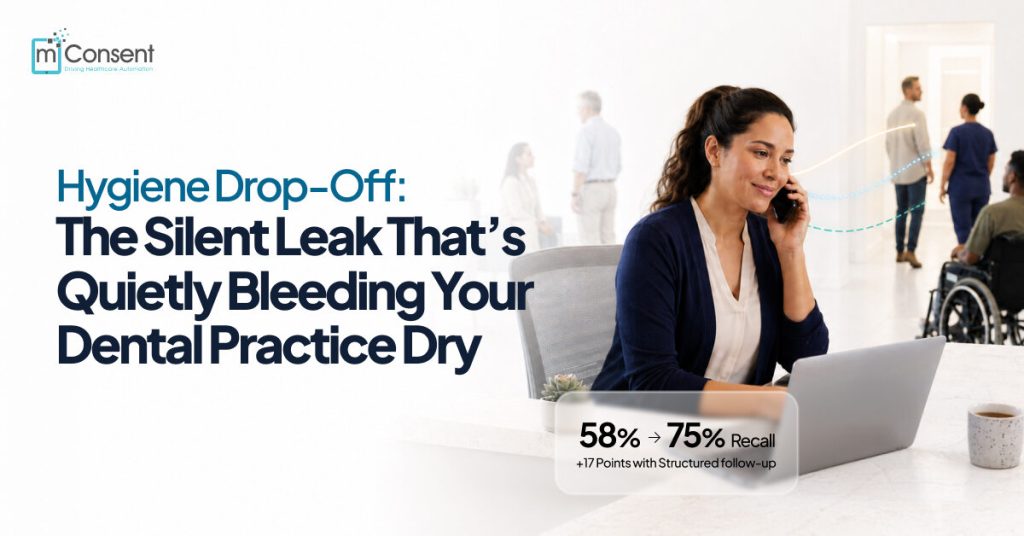
And the impact can be significant. Practices using a structured recall strategy have reported increasing recall rates from around 58% to 75%, a 17-point improvement that can mean hundreds of patients returning and substantial revenue recovered.
Don’t treat every overdue patient the same. Match the follow-up to the risk of losing them.
How to Audit Your Own Hygiene Recall Right Now
You don’t need new software to start. You need fifteen minutes and an honest look at your own numbers. Pull a report from your practice management system of every hygiene patient who is more than 30 days past due. Don’t estimate; pull the actual list.
Then ask three questions:
- How many patients are on it? If you’re surprised by the size of the list, that’s your first sign this leak has been running unchecked.
- When was the last time each patient was contacted, and how? If the answer is “one automated text, weeks ago,” you’ve found reason number one from above in action.
- Who on your team is responsible for working this list every week? If nobody can answer with a name, you’ve found reason number three, and it’s probably the biggest one.
This audit alone won’t fix the leak, but it will tell you exactly how large it is in your practice, which is the step most owners skip entirely. You can’t build a recall system around a guess.
Measuring the ROI of a Fixed Recall System
Before deciding whether this is worth fixing, put a real number on the problem.
Take your average annual hygiene patient value conservatively ($800 to $1,200) and multiply it by the number of overdue patients in your database.
For example, if your audit finds 300 overdue patients, that represents roughly $240,000 to $360,000 in potential annual patient value sitting dormant on a list that may not be actively worked.
That’s the opportunity hiding in your database.
And fixing it doesn’t necessarily require new equipment, additional staff, or a bigger marketing budget.
It requires a clear process, defined ownership, and consistent follow-through.
When you compare that investment with the revenue sitting on your overdue patient list, the business case becomes hard to ignore.
What Changes When You Fix This
When your recall system actually works, the impact goes far beyond a fuller hygiene schedule.
- Your hygiene schedule stays full instead of developing preventable gaps.
- Your restorative pipeline stays active because routine exams continue to uncover treatment needs.
- Your patient base becomes more stable because you’re retaining the patients you already worked hard to acquire.
- Your practice generates more revenue from existing patients instead of relying entirely on new-patient acquisition.
That’s the bigger opportunity.
Reactivation isn’t about recovering one missed cleaning. It’s about recovering an entire patient relationship and the years of care and revenue that relationship can generate.
Find Out What This Leak Is Actually Costing You
Hygiene drop-off is dangerous because it happens quietly.
Patients don’t always call to say they’re leaving. They stop scheduling. And by the time you notice, you may have already lost the cleaning, the exam, the treatment opportunity, and years of future patient value.
You don’t have to guess.
We built a free, two-minute assessment that helps you identify how many patients have dropped off and estimate what that lost hygiene revenue could be costing your practice.
Take the assessment today and uncover the real number behind your hygiene recall before the leak gets any bigger.
Think hygiene is the only revenue leak?
Insurance claim denials can drain your practice just as quietly. In our next breakdown, we’ll look at why dental practices can face claim denial rates of 10-12% and what high-performing practices do differently at the front desk to prevent those losses.