



If your front desk team is still spending hours chasing down payments, printing paper statements, or playing phone tag with insurance companies, you know the frustration firsthand. That pit in your stomach when you look at your accounts receivable aging report? It doesn’t have to be a permanent part of practice ownership. If your practice is still chasing payments manually, it may be time to rethink your workflow. The reality is, the way most dental practices have always handled billing simply doesn’t work in 2026.
Overhead is climbing, staffing is tight, and patients are carrying more financial responsibility than ever before. Relying on a reactive billing system, where you treat, then bill, then wait, then follow up, is like trying to fill a bathtub with the drain wide open. It’s exhausting, and frankly, it’s unsustainable.
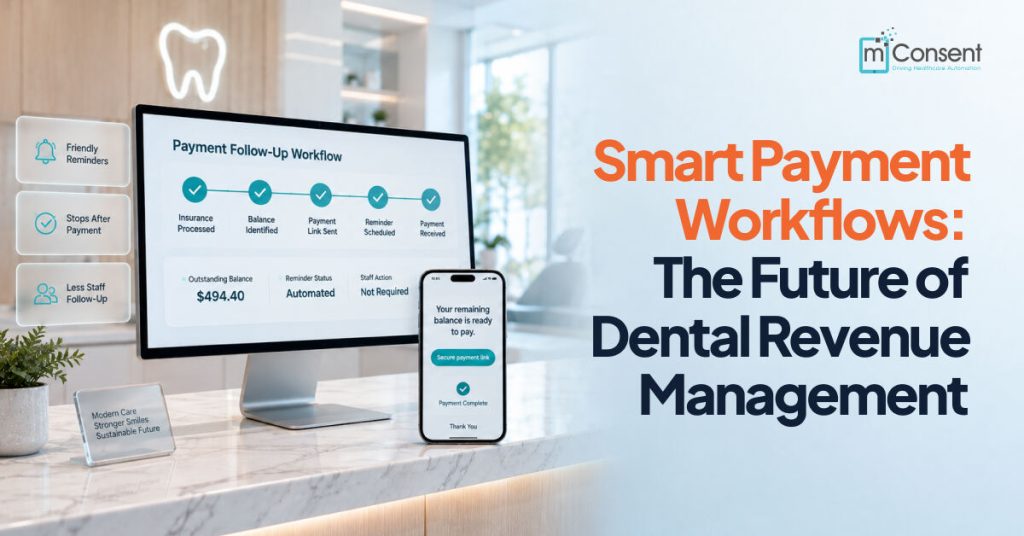
The shift happening now is toward something smarter. We’re talking about smart payment workflows: proactive, automated systems that handle the heavy lifting of revenue management before a patient even sits in your chair. This isn’t just a new software feature; it’s the foundation of modern dental revenue management. Let’s break down why it matters, how it works, and how it can finally get your practice off the billing hamster wheel.
What Are Smart Payment Workflows?
Let’s strip away the jargon for a second. A smart payment workflow is exactly what it sounds like: a system that uses automation and real-time data to manage the entire financial side of a patient’s visit with minimal manual effort.
Think of it like a GPS versus a paper map. A traditional billing system is the paper map. It’s static. If there’s a roadblock (like a denied claim or a missed payment), you don’t find out until you’re already lost. A smart workflow is the GPS. It recalculates in real-time. It sends alerts. It reroutes based on traffic (or in this case, insurance updates and patient behavior).
Traditional systems are fragmented. Your practice management software sits in one corner, your payment processor in another, and your patient communication tools somewhere else. A smart workflow brings all of that together into one seamless, automated stream.
The Problem with Traditional Dental Payment Systems
To understand why this shift is so critical, we have to look at the mess traditional systems create. It usually goes like this:
A patient comes in for a crown. The front desk estimates the insurance portion, but they’re rushed. They collect a rough copay. The treatment happens. The claim goes out. Weeks later, the EOB comes back, and surprise—the insurance paid less than estimated. Now the practice owes the patient a refund, or worse, the patient gets a surprise bill in the mail three weeks later. They’re confused, they’re annoyed, and they don’t pay. Now your front desk is spending 20 minutes on the phone explaining the “unexpected” balance while three other patients wait to check out.
This is the daily reality in thousands of practices. The consequences pile up:
- Delayed collections: Accounts receivable days creep past 60, 70, even 90 days.
- Front desk overload: Staff burn out because they’re acting as debt collectors instead of care coordinators.
- Patient friction: Unexpected bills erode trust. Patients feel like they’re being nickel-and-dimed.
- Insurance dependency: When you rely on insurance to tell you what to collect, you’re giving up control of your cash flow.
It’s a reactive cycle, and it’s costing you money and peace of mind.
Key Components of Smart Payment Workflows
So, what does a smart system actually look like in action? It’s more than just an online payment portal. It’s a connected ecosystem that works from the moment an appointment is booked.
Digital Forms and Pre-Visit Data Capture
The workflow starts before the patient walks in. Digital intake forms capture insurance information and consent electronically. This data feeds directly into the system, so you aren’t scanning paper cards or manually entering data that could be mistyped.
Real-Time Eligibility Checks
Instead of crossing your fingers and hoping insurance pays, smart systems run real-time eligibility checks. You know the patient’s active benefits, remaining deductibles, and annual maximums before the hygienist seats them.
Automated Cost Estimates
Based on that real-time insurance data and your fee schedule, the system generates an accurate out-of-pocket estimate for the patient. This estimate can be delivered via text or email before the appointment, eliminating the “surprise bill” scenario entirely.
Integrated Payment Solutions
This is the game-changer. Instead of sending an invoice after the fact, smart workflows embed payment links directly into the treatment presentation. The patient can pay their portion instantly on a tablet in the op or via a text message on their way out to the car.
Payment Plans and Financing
For larger cases, automation connects to financing options. Patients can apply for third-party financing or set up automated installment plans directly through the workflow, ensuring you get paid without having to manually track installment schedules.
Automated Reminders and Follow-Ups
If a balance remains, the system handles it. It sends friendly, automated reminders via text or email. If the patient still doesn’t pay, the system escalates—maybe a different message, or a nudge to the front desk to make a personal call. The key is that the reminders stop the moment the payment is made.
Benefits for Dental Practices
When you implement these components, the benefits ripple through every corner of the practice.
Faster cash flow is the most obvious. When payments are collected same-day, you aren’t financing treatment for weeks or months. Your deposits are higher, and your accounts receivable days shrink dramatically.
But the quieter benefit is the reduced admin workload. Your front desk team stops dreading the end-of-day reconciliation. They stop spending mornings printing and folding statements. They get to focus on what they do best: welcoming patients and keeping the schedule running smoothly.
And because the system handles the math and the follow-ups, billing errors drop significantly. There are fewer disputes, fewer refund requests, and fewer awkward conversations about money.
How Smart Workflows Improve Patient Experience
Here’s where it gets good. Patients don’t hate paying for dentistry. They hate surprises and hassles.
A smart payment workflow offers total transparency. They know what they owe before the appointment. They know what their insurance covers. There’s no guessing.
It also offers convenience. Modern patients want to handle everything from their phone. If they can pay for their groceries with Apple Pay, they expect to pay for their crown the same way. Offering mobile payments and contactless checkout shows you respect their time.
This builds trust. When a patient feels confident in the financial transaction, they’re more likely to say yes to treatment. And when they say yes to treatment, case acceptance goes up.
Real-World Scenario: A Practice Transformed
Let me paint you a picture. I worked with a practice in the Midwest last year that was drowning. Their AR was hovering around 65 days. The office manager was spending every Tuesday afternoon making collection calls. The doctor was frustrated because treatment plans kept falling through due to “cost confusion.”
We shifted them to a smart workflow system. We set up digital forms and automated eligibility checks. We started sending cost estimates before the appointment. We integrated payment links into their treatment presentation.
Within 90 days, their AR dropped to 28 days. Their same-day collections increased by 40 percent. But the biggest change? The office manager started leaving at 5 p.m. instead of 7 p.m. She wasn’t chasing down payments anymore. She was managing the team and the schedule. The practice didn’t just get more profitable; it got happier.
See what smart payment workflows could recover for your practice.
Future Trends in Dental Revenue Management
Looking ahead, this is only going to get more sophisticated. We’re already seeing AI-driven insights that predict which patients are likely to pay on time and which need a different approach. Soon, systems will be able to automatically re-run insurance benefits for patients with upcoming balances and generate new payment plans without human intervention.
Fully integrated practice ecosystems are the next frontier. The lines between the clinical record, the patient communication platform, and the billing system will blur entirely. Revenue management won’t be a separate task; it will be an invisible part of the clinical workflow.
A Note on Making the Shift
If you’re reading this and thinking, “This sounds great, but where do I start?” you’re not alone. The key is finding a platform that connects all the dots. Solutions like mConsent, paired with mPayr, are designed specifically for this. They handle the digital intake, the insurance concierge, the payment links, and the automated follow-ups in one unified interface.
It’s not about buying a new piece of software; it’s about rethinking how money moves through your practice. The tools exist to make collections seamless, accurate, and far less labor-intensive.
Conclusion
Manual billing isn’t just outdated; it’s a liability. In an era of razor-thin margins and high patient expectations, relying on paper trails and manual follow-ups puts your practice at a distinct disadvantage. Smart payment workflows flip the script. They make revenue management proactive, predictable, and patient-friendly.
If you’re tired of high AR days, burned-out staff, and treatment plans falling through due to financial friction, it’s time to look at automation. The practices that adopt smart workflows today are the ones that will scale faster, stress less, and enjoy their work more tomorrow.
Stop chasing payments. Start recovering revenue.
Frequently Asked Questions
1: What is a smart payment workflow in dentistry?
A: It’s an automated system that uses real-time insurance data, integrated payment links, and AI-driven follow-ups to manage collections from pre-visit to final payment, reducing manual work and accelerating cash flow.
2: How do smart workflows reduce accounts receivable?
A: They automate payment reminders, enable same-day collections, and sync insurance updates instantly so balances are accurate and paid faster, preventing balances from aging out.
3: Are smart payment systems HIPAA compliant?
A: Yes, when implemented through secure, dedicated platforms that use encryption, audit trails, and secure messaging to protect patient data.
4: How quickly can a practice see results?
A: Most practices see measurable improvements in collection rates and a drop in AR days within 30 to 60 days of full implementation.
5: Does automation replace billing staff?
A: No. It eliminates repetitive, low-value tasks like printing statements and manual follow-ups, allowing your team to focus on high-value work like financial consultations and patient care.