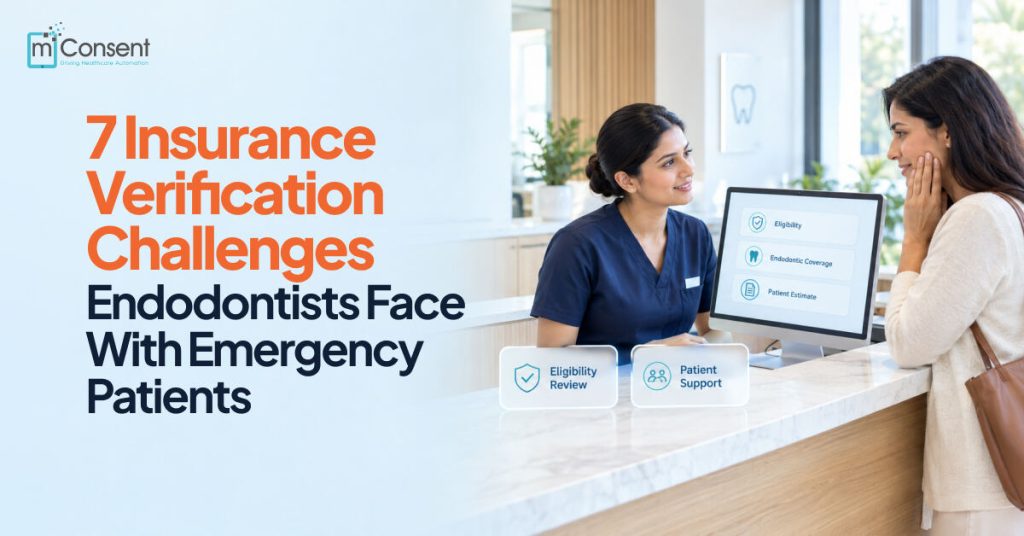


An emergency endodontic patient doesn’t call ahead to check if your front desk has time to verify their benefits. They show up in pain, need treatment fast, and expect someone to tell them what it’s going to cost. Meanwhile, your team is trying to confirm eligibility, figure out what the plan covers, and calculate a deductible, all before the appointment is over.
That tension between speed and accuracy is where most dental insurance verification breakdowns happen. Emergency visits compress a process that normally takes time into a window that barely has any, and the cost of getting it wrong shows up later as billing disputes, denied claims, and frustrated patients.
This post breaks down what dental insurance verification involves, why emergency cases make it harder, the seven biggest challenges endodontic practices face, and what a more streamlined workflow looks like in practice.
What Is Dental Insurance Verification?
Dental insurance verification is the process of confirming a patient’s coverage details before treatment: whether their plan is active, what it covers, what they’ve already used, and what they’re likely to owe. Done well, it turns an unknown into a number the front desk can say confidently. Done under pressure, as it often is with emergency patients, it becomes a scramble across payer portals and phone trees while a patient waits in the operatory.
Information Endodontic Practices May Need to Verify
-
- Patient eligibility and insurance plan status
-
- Effective and termination dates
-
- Endodontic treatment coverage, including diagnostic coverage
-
- How preventive, restorative, and endodontic benefits are split
-
- Deductible and remaining deductible
-
- Annual maximum and remaining benefits
-
- Waiting periods and frequency limitations
-
- Coverage percentages, exclusions, and limitations
-
- Estimated patient responsibility
-
- Preauthorization requirements, when applicable
Why Emergency Patients Create Unique Insurance Verification Challenges
Routine appointments give a practice days or weeks to verify benefits. Emergency endodontic cases don’t. Patients call or walk in unexpectedly, often in significant pain, expecting treatment to start the same day. There’s little time for manual lookups, insurance information is often incomplete, and coverage can vary widely by procedure. Front-desk staff end up managing two priorities at once: clinical urgency and financial communication with almost no buffer between them.
7 Insurance Verification Challenges Endodontists Face With Emergency Patients
Challenge 1: Verifying Insurance Eligibility Under Time Pressure
Before anything else, staff need to confirm the patient’s dental insurance is actually active, but eligibility checks often require logging into a payer website or calling a carrier directly. Patient information may be incomplete or outdated, especially if insurance changed recently. Manual verification takes staff time, and when eligibility confirmation is delayed, everything downstream- treatment planning, cost conversations, scheduling- gets delayed with it.
Challenge 2: Determining Whether Endodontic Treatment Is Covered
Confirming that a patient’s insurance is active is only the first step. It doesn’t tell the practice whether the specific endodontic procedure they need is actually covered. Coverage varies by plan, endodontic procedures often carry their own benefit rules, and some procedures come with limitations or exclusions that only show up once someone checks.
Key point: eligibility confirms that coverage exists; dental insurance benefits verification is what tells you what the plan will actually pay for.
This is where endodontic insurance verification and dental insurance verification for endodontists diverge from general eligibility checks; they require procedure-level detail, not just a yes/no on active coverage.
Challenge 3: Calculating Deductibles, Remaining Benefits, and Patient Responsibility
Emergency treatment brings immediate financial questions. Verification needs to account for the annual deductible and how much of it remains, the annual maximum and remaining benefits, the coverage percentage, and an estimate of what the patient will owe. Without this information, patients don’t know what to expect, staff are left explaining uncertain estimates on the spot, treatment conversations get harder, and billing questions inevitably resurface later.
Challenge 4: Managing Manual Payer Calls and Insurance Portals
Manual verification usually means calling carriers, navigating payer phone systems, logging into multiple portals, searching for patient records, reviewing benefit details, documenting what you find, and repeating it all for the next patient. During an emergency appointment, these administrative tasks compete directly with check-in, scheduling, clinical coordination, treatment preparation, patient communication, and billing, all at once, with the same staff.
Challenge 5: Handling Incomplete or Inaccurate Insurance Information
Emergency patients often show up with outdated insurance cards, incorrect member IDs, missing subscriber information, incomplete plan details, or new coverage that hasn’t been updated in the system yet. Incorrect information doesn’t just slow down that one visit; it leads to repeated payer checks, inaccurate patient estimates, billing rework, claim issues, and, eventually, patient frustration when the numbers don’t match what they were told.
Challenge 6: Communicating Coverage and Costs Without Delaying Care
Insurance verification isn’t purely administrative; it shapes the patient’s experience of the visit. Someone in pain wants fast, direct answers: Is my insurance active? Does it cover this treatment? Have I met my deductible? How much of my annual benefit is left? How much will I owe? Can treatment start today? When emergency patient insurance verification takes too long, those questions go unanswered right when the patient needs reassurance most.
Challenge 7: Balancing Emergency Treatment Speed With Verification Accuracy
The hardest part is usually reconciling two priorities that pull in opposite directions: move quickly, or verify accurately. Moving too fast without solid insurance information creates financial uncertainty that surfaces later. Spending too long on manual verification creates the exact delay emergency patients came in trying to avoid. The goal isn’t picking one over the other; it’s building a workflow that surfaces insurance information as early as possible without adding more manual work to the front desk.
The Hidden Cost of Manual Emergency Insurance Verification
The cost of manual verification isn’t just the minutes spent on hold with a payer. It shows up as lost front-desk productivity, longer patient wait times, repetitive calls, portal switching, manual data entry, verification errors, billing rework, patient confusion, delayed financial conversations, and a steadily growing administrative workload that never quite gets smaller.
How Streamlined Insurance Verification Helps Endodontic Practices
A more streamlined approach to dental insurance eligibility verification addresses these challenges directly:
Verify eligibility earlier: Access eligibility information before or earlier in the patient workflow whenever possible.
Identify important benefit details: Surface coverage, deductibles, and remaining benefits without a separate manual lookup for each.
Reduce manual payer calls: Reduce repetitive phone-based verification.
Reduce portal-checking work: Spend less time logging into multiple payer systems.
Give staff more time for patients: Free up front-desk capacity for the emergency patient in front of them.
Improve financial visibility: Give staff real numbers to work with in cost conversations.
Create a more consistent verification workflow: Standardize how insurance information gets gathered and reviewed, visit to visit.
Manual vs. Streamlined Insurance Verification
| Manual Process | Streamlined Process |
| Repetitive payer calls | Reduced manual calling |
| Multiple portal checks | Simplified verification workflow |
| Manual benefit lookups | More automated information gathering |
| Repeated data entry | Reduced administrative work |
| Information gathered late | Information accessed earlier when possible |
| Staff spends more time verifying | Staff can focus more on patients |
| Greater administrative friction | More consistent workflow |
Streamline Insurance Verification for Emergency Endodontic Patients
mConsent Insurance Concierge helps endodontic practices simplify insurance verification for emergency patients by reducing manual payer calls, portal checks, and repetitive benefit lookups. By helping teams access eligibility, coverage, deductibles, remaining benefits, and patient responsibility earlier, practices can reduce front-desk delays, improve the emergency patient experience, and make treatment decisions with greater financial clarity.
Insurance Concierge is built around dedicated agents, not just software, who work in the background to surface 18+ data points per patient with a 24-48 hour turnaround before the appointment, so the front desk isn’t starting from zero when an emergency patient walks in.
How mConsent Insurance Concierge Helps Endodontic Practices
Reduce manual insurance verification work – spend less time on repetitive eligibility and benefits checks.
Move verification earlier in the workflow – get available insurance information ahead of treatment whenever possible.
Simplify benefits verification – access key benefit details without relying entirely on manual processes.
Improve financial visibility – give staff better information for patient-responsibility conversations.
Support a better emergency patient experience – reduce unnecessary administrative delay while patients wait for urgent care.
Make Emergency Insurance Verification Less of a Bottleneck
Emergency endodontic patients shouldn’t have to sit through administrative delays because insurance information is hard to pin down. A streamlined dental insurance verification workflow helps practices access eligibility, benefits, deductibles, remaining benefits, and patient responsibility earlier, whenever possible.
With mConsent Insurance Concierge, endodontic practices can cut manual payer calls, portal checks, and repetitive benefit lookups, so front-desk teams spend less time chasing insurance information and more time supporting emergency patients.
Streamline Dental Insurance Verification for Emergency Patients
FAQ
What is dental insurance verification?
Dental insurance verification is the process of confirming a patient’s insurance eligibility, coverage, benefits, deductibles, remaining benefits, and potential patient responsibility before treatment whenever possible.
Why is insurance verification important for emergency endodontic patients?
Emergency patients often need timely treatment, so having insurance information available earlier can help reduce administrative delays and improve financial communication.
What is emergency dental insurance verification?
Emergency dental insurance verification is the process of checking a patient’s eligibility and relevant dental benefits when they require urgent dental care.
What should endodontists verify before emergency treatment?
Endodontists may verify eligibility, treatment coverage, deductibles, annual maximums, remaining benefits, limitations, exclusions, and potential patient responsibility.
How can endodontic practices speed up insurance verification?
Practices can streamline the process by collecting insurance information early, standardizing verification workflows, reducing manual payer calls and portal checks, and using automated dental insurance verification technology.
What is endodontic insurance verification?
Endodontic insurance verification focuses on confirming insurance eligibility and benefits relevant to endodontic services and helping practices understand available coverage and potential patient responsibility.