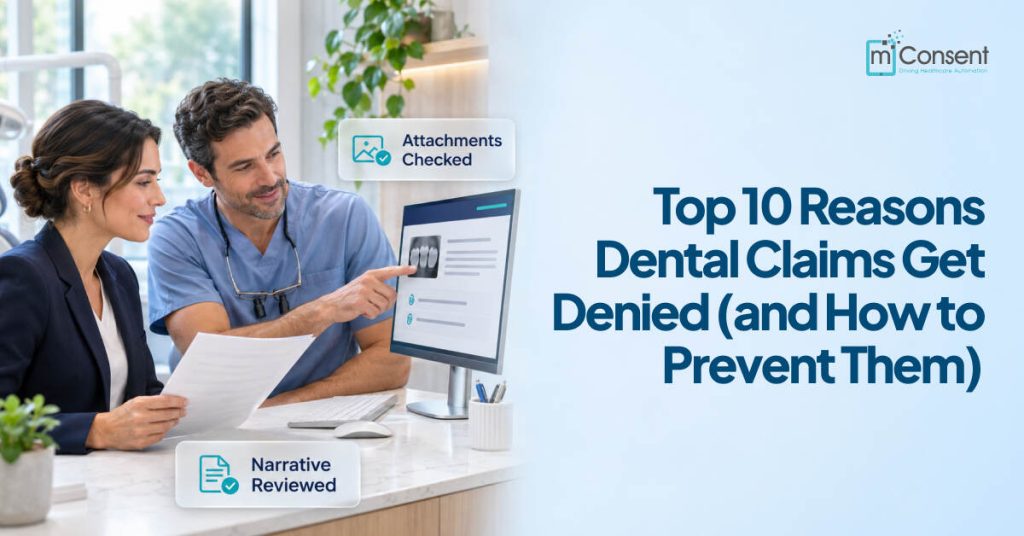




The crown is placed, the patient leaves satisfied, and three weeks later, an EOB arrives with a denial. Now your team has to review the patient’s chart, identify what went wrong, correct and resubmit the claim, and explain an unexpected balance to the patient.
Many dental insurance claim denials can be traced back to issues that occur before a claim is even submitted. It could be coverage that was never verified, an incorrect subscriber ID entered at check-in, or missing patient information. Industry research suggests that 15 to 25% of claim denials are linked to faulty or missing verification.
Why Do Dental Claims Get Denied?
Dental claims are commonly denied because of inactive coverage, incorrect patient or subscriber information, outdated CDT codes, missing documentation, frequency limits, waiting periods, plan exclusions, missing pre-authorizations, coordination-of-benefits errors, bundling or downcoding, and late filing.
Many of these issues can be caught early through thorough dental insurance verification 24 to 48 hours before the appointment, followed by a quick review of the claim before submission.
1. Coverage Was Inactive on the Date of Service
Patients change jobs, employers drop plans, and premiums are often paid in arrears so that a plan can be cancelled retroactively. Payers judge eligibility on the date of service, not on the date of the last visit or the pre-authorization. Dependents also age out, and some plans require proof of student enrollment.
How to prevent it: Run dental insurance eligibility verification for every appointment, including returning patients. Re-check on the day of service for major treatment or recent plan changes, and keep a copy of the eligibility response until the claim is paid.
2. Incorrect Patient, Subscriber, or Provider Details
A transposed digit in the member ID, a date of birth that doesn’t match the payer’s record, or a dependent listed as the subscriber can stop a claim before anyone reviews it. So can entering the office name instead of the treating dentist’s name and NPI.
How to prevent it: Scan both sides of the insurance card and a photo ID at check-in. At every visit, ask whether the patient’s name, address, or employer has changed, and match the claim exactly to the payer’s record.
3. Outdated or Incorrect CDT Codes
HIPAA requires the CDT version in effect on the date of service. CDT 2027 takes effect January 1, 2027, with 67 changes, including 28 new codes and 33 revisions. For example, D2390 can now be reported on any tooth instead of only anterior teeth.
How to prevent it: Update the code set in your practice management system before January 1, review the changes that affect your highest-volume procedures, and use the full code nomenclature on every claim.
4. Missing Documentation or Weak Narratives
Most claims are adjudicated by computer first. Claims for scaling and root planing, crowns, buildups, and endodontics are often flagged when X-rays, perio charting, or intraoral photos are missing. A generic narrative such as “crown needed due to decay” rarely proves medical necessity.
How to prevent it: Build an attachment checklist for each common procedure. Write narratives that name the tooth, the condition, and its severity, such as pocket depths and bone loss for SRP or the share of tooth structure lost for a crown. Send labeled, readable images.
5. Frequency Limits Were Exceeded
Most plans cap how often a procedure is covered: cleanings, bitewings, fluoride, full-mouth x-rays, and crown replacements all carry limits. Calendar-year versus benefit-year rules, a mid-year plan switch, or treatment done at a previous office can push a claim outside the allowed window.
How to prevent it: Verify frequency limits and the last date of service by procedure code, not just the coverage percentage. When replacing a restoration within the limit, document the original placement date and the clinical reason.
6. Waiting Periods, Exclusions, and the Missing Tooth Clause
Major services commonly carry waiting periods of 6 to 12 months. The missing tooth clause denies replacing a tooth that was extracted before coverage began, and cosmetic procedures are frequently excluded altogether.
How to prevent it: Complete dental insurance benefits verification before you present a major treatment plan. Compare the plan’s effective date with its waiting periods, ask when the tooth was lost, and send a predetermination for bridges, implants, and crowns.
7. Pre-Authorization Was Required but Not Obtained
Some plans, including many DHMOs that require referrals, need approval before treatment. Even an approved pre-authorization isn’t a guarantee of payment, because benefits are based on eligibility and the remaining maximum on the date of service.
How to prevent it: Flag pre-authorization requirements during verification, submit requests close to the treatment date, and re-verify if the approval was issued in a previous benefit year.
8. Coordination of Benefits Errors
Billing the wrong plan first, misapplying the birthday rule for dependents, or sending the secondary claim without the primary EOB will trigger a denial when a patient has two plans.
How to prevent it: Ask about other coverage at every visit, verify both policies, bill the primary plan first, and attach the primary EOB to the secondary claim.
9. Bundling, Downcoding, and Alternate Benefits
Payers may combine separate procedures into one, for example by treating individual radiographs as a full-mouth series, or pay a lower-cost code than the one billed. In late 2025, the ADA reported payers paying multi-surface composite restorations as single-surface fillings and encouraged dentists to keep appealing.
How to prevent it: Verify downgrades and alternate benefit clauses in advance, reflect them in the patient estimate, and appeal with clinical documentation when distinct procedures are bundled.
10. The Claim Was Filed Late or Resubmitted as a Duplicate
Timely filing limits vary by payer. Delta Dental’s general limit is 12 months from treatment, while some programs allow as little as 90 days. Resubmitting the same claim for an aging balance often gets it denied as a duplicate.
How to prevent it: Submit claims within 24 to 48 hours of service, run a daily unsent-claims report, and check claim status before resubmitting. Label any corrected claim clearly.
A Dental Insurance Verification Timeline That Catches Most Denials
Strong dental claims management starts with scheduling, not the billing queue.
-
- 3 to 7 days before the visit: Collect missing card and subscriber details.
-
- 24 to 48 hours before: Complete eligibility and a full benefit breakdown covering maximums, deductibles, frequency limits, waiting periods, the missing tooth clause, downgrades, COB, and pre-authorization needs.
-
- Day of service: Re-check high-risk visits such as major treatment, emergencies, or recent plan changes.
-
- Before submission: Spend five minutes confirming codes, attachments, narratives, and provider details.
-
- Monthly: Review denials by reason code, payer, and procedure, then fix the upstream step.
Why Eligibility Checks Alone Leave Gaps
Automated dental insurance verification and dental insurance eligibility software can confirm “active coverage” in seconds. Many of the causes above, though, live in details portals return only partially, or not at all: treatment history, frequency by code, missing-tooth clauses, and downgrades. In mConsent’s comparison, dental insurance verification software alone completes only 30 to 60% of verifications, leaving the hardest cases with your front desk.
How mConsent Insurance Verification Helps Prevent Denials
mConsent Insurance Verification (Insurance Concierge) combines dental insurance verification automation with a dedicated team of experienced agents led by a US-based Director of Insurance Verification. As a dental insurance verification service, the team uses insurer portals, phone calls, and fax-backs to complete eligibility checks and full benefit breakdowns, typically 24 to 48 hours before each appointment, with a 99%+ completion rate.
Each breakdown is uploaded directly to your PMS, including Dentrix, Eaglesoft, Open Dental, Dolphin, and Dentrix Ascend, so there’s no rekeying. It covers the fields behind most denials: frequency limits, waiting periods, the missing tooth clause, downgrades and limitations, coordination of benefits, treatment history, eligibility by CDT code, secondary and family insurance, and inactive or terminated alerts.
As a dental insurance verification company serving 5,000+ practices since 2017, mConsent assigns every practice a named account manager who leads onboarding and stays involved after launch. Your team gets dental insurance verification services that work ahead of the schedule, so patients arrive with benefits already in the chart.
Book a Demo of mConsent Insurance Verification
Frequently Asked Questions
What is the most common reason dental claims are denied?
Incorrect or incomplete patient and insurance information, along with eligibility problems, are among the most common causes. You can catch both during verification before the patient is seen.
How far in advance should dental insurance be verified?
Verify eligibility and benefits 24 to 48 hours before the appointment, collect missing card details 3 to 7 days out, and re-check high-risk visits on the day of service.
What is the difference between eligibility and benefits verification?
Eligibility verification confirms that the plan is active. Benefits verification confirms what the plan will pay for a specific procedure, including frequency limits, waiting periods, maximums, and exclusions.
Should you appeal a denied dental claim or write it off?
Appeal when you can supply missing information, dispute bundling with documentation, or show that a frequency limit was misapplied. Most payers allow 60 to 180 days. Write off small amounts that a clear plan limitation explains, and track those write-offs to fix the root cause.
Is a dental insurance verification service better than verification software?
Software handles quick eligibility checks well. A service with human agents completes the calls and portal lookups that software can’t finish, which matters most for major treatment and complex plans.
Stop Denials Before the Patient Sits Down
Each of these 10 denial reasons has a point in your workflow where it can be caught. Make dental insurance verification part of every appointment, document clearly, and review every claim before it goes out, and your team will spend far less time on rework.
Want verified benefit breakdowns in your PMS before every appointment?