



There are patients in your practice right now who said yes to treatment.
They agreed to the crown. They wanted the root canal. They were ready to move forward.
And then nobody called them back.
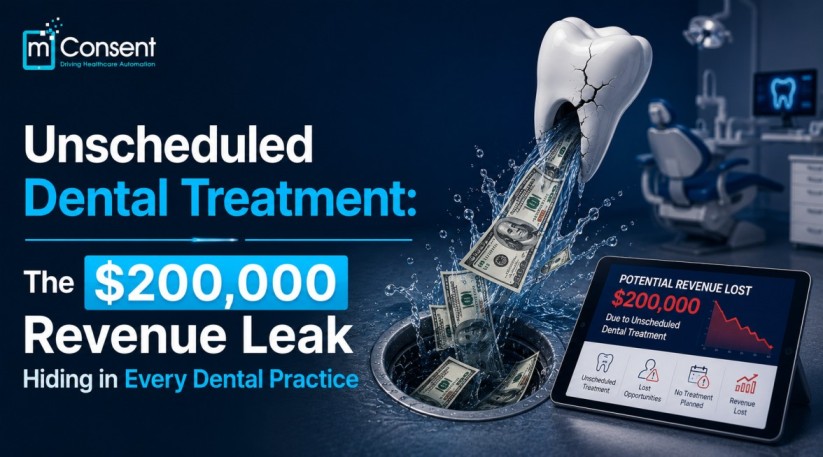
That treatment is still sitting in your practice management software, Dentrix, Eaglesoft, Open Dental, whichever you use. Aging. Dying. In most midsize practices, we’re talking about $200,000 to $500,000 in diagnosed care that never converted into a single appointment.
This is the most expensive problem in dentistry and the most invisible. It’s the single largest source of dental revenue leakage in most midsize practices, and it doesn’t show up on your daily production report.
Here’s what most owners get wrong about it, what it actually costs you, and the structured 5-touch follow-up sequence that the best-run practices use to recover 15-25% in 90 days.
Unscheduled treatment isn’t a “no.” It’s a “yes” nobody followed up on.
Let’s be clear about what unscheduled treatment actually is, because most owners get this wrong.
Unscheduled treatment is not treatment that patients declined.
They didn’t say no. They didn’t shop you. They didn’t go to another practice. They didn’t think about it and decided it wasn’t worth the money.
This is unscheduled dental treatment your dentist diagnosed, your patient verbally accepted, and your front desk never put on the calendar.
What usually happens:
- The patient says, “Let me check my schedule and call you back.”
- The front desk is slammed with another patient walking up.
- Someone at the desk says, “No problem, we’ll reach out next week to get this on the books.”
- The plan gets entered into the system.
- Nobody touches it again.
They’ve already said yes. They need to be brought back to the chair and how you follow up on unscheduled treatment is what determines whether they come back at all.
Pull this report. Today!
Before you read another word, go do this one thing.
Open your practice management software. Find the unscheduled treatment report.
- Dentrix: Office Manager – Reports – Lists – Treatment Plan Report
- Eaglesoft: Reports – Patient – Treatment Plan
- Open Dental: Reports – Standard – Lists – Treatment Plan
Pull the last 12 months. Look at the dollar value at the bottom of the report.
I’ve seen this number hundreds of times. The reaction from practice owners is almost always the same: they look puzzled, like the number can’t be right.
It is right.
Most midsize practices have between $200,000 and $500,000 sitting on that list. I’ve seen single-location practices over a million.
That’s not hypothetical revenue. That’s not a marketing projection. That’s a treatment your team already diagnosed, your patients already accepted, and your practice never scheduled.
Once you see this number, you cannot unsee it.
The three reasons unscheduled treatment piles up
Every practice has unscheduled treatment for the same three reasons. None of them is about clinical skill, case presentation, or fee strategy. All of them are operational.
1. Nobody owns the list
Ask your team this Monday: “Whose job is it to work the unscheduled treatment report?”
You’ll get a version of: “We all do.”
You know what that actually means? Nobody does.
The front desk is on the phones with today’s patients. The treatment coordinator is in charge of presentations. The office manager is putting out fires. The list grows by the week, and nobody reviews it on any regular cadence.
If everyone owns it, no one owns it.
2. Patients walk out without an appointment
The hygiene appointment ends. The exam wraps up. The patient walks to the front desk. The front desk is buried under two other check-ins and a ringing phone.
Someone says, “Let’s just give you a call to get this scheduled. What works better, mornings or afternoons?”
That call happens three weeks later. Or never.
After 60 days, you’ve lost most of those patients, not to a competitor, but to inertia. Life moves on. The toothache they had isn’t actively hurting today. The crown can wait. Then it waits forever.
3. “Follow-up” means one phone call
When someone on your team tries to follow up, it’s usually just one phone call. No answer? Voicemail? Done. Move to the next patient.
Your front desk isn’t a marketing team. They don’t have a structured cadence. They don’t have automation. They don’t have a sequence across text, email, and phone that meets the patient where they actually respond.
Meanwhile, your practice is spending thousands of dollars a month on Google Ads, Facebook, and SEO to get strangers in the door, while patients who already said yes are sitting in your system, ignored.
The math doesn’t make sense. But it’s the default in almost every practice.
Why unscheduled treatment compounds and costs you a patient for life
Here’s the part most owners miss.
Unscheduled treatment doesn’t just sit there as a static dollar amount on a report. It compounds. And the compounding cost is far higher than the original case value.
Here’s how it plays out:
A patient accepts a crown. The crown never gets scheduled. Six months later, that patient is due for a hygiene appointment. But they have unfinished treatment hanging over them. They feel awkward calling in for a cleaning when they know the crown is still on their chart and the hygienist will ask about it.
So what do they do? They skip the hygiene visit. Then the next one. Then the next.
Now you’ve lost:
- The crown
- The hygiene appointment that triggered the avoidance
- Every subsequent recall visit
- Every future exam and the diagnoses those exams would have caught
- The lifetime value of that patient and the patients they would have referred
One unscheduled treatment plan can cost you a patient for life.
Multiply that across 50, 100 and 200 patients sitting on your unscheduled list. That’s not a number on a report. That’s a pipeline of patients quietly disappearing, and nobody is watching it happen.
Curious how much your hidden revenue leak costs you?
Calculate your practice’s recoverable revenue: https://mconsent.net/roi-calculator/
What practices that fix this actually do
The practices that recover their unscheduled treatment aren’t doing anything sophisticated. They’re doing three things consistently and consistency is the whole game.
1. One named person owns the list
Not “everyone.” One named person. Usually, the treatment coordinator or office manager. They review the unscheduled treatment report every week, not when they have time, not when they get around to it. Every week, on the calendar, with the same priority as payroll.
Owning the list means knowing the dollar value, knowing which patients are nearest to insurance benefit expiration, and knowing which ones to prioritize.
2. Every patient leaves with an appointment on the books
Even if it’s six weeks out. A scheduled appointment, even one far in the future, is roughly 10 times more likely to actually happen than a “we’ll call you back.”
If the patient genuinely can’t commit to a date in the moment, they get the next-best thing: enrollment in a structured follow-up sequence that starts the next day, not three weeks later.
3. A real follow-up sequence, not a single call
This is the part almost every practice skips, and it’s the single biggest lever you can pull. Here’s what the sequence looks like:
- Day 1 – Text: Specific to the treatment that was diagnosed. “Hi John wanted to follow up on the crown Dr. Mckinsey recommended. Want me to send a few open times this week?”
- Day 3 – Email: Insurance coverage breakdown. “Here’s what your plan covers if we get this scheduled before benefits reset.”
- Day 7 – Text: Two or three specific open appointment times. Frictionless.
- Day 10 – Phone call: From the treatment coordinator. Personal, short, helpful.
- Day 20 – Final touch: Tied to benefit timing, urgency, or a soft “we don’t want to lose track of you.”
Five touches. Three channels. Across 20 days. Meeting patients where they actually respond.
That’s it. No high-pressure sales script. No clinical hard sell. Just structured, consistent follow-up to patients who have already said yes.
The practices that do this recover 15-25% of their unscheduled treatment within 90 days. The ones that don’t? The list keeps growing.
The math: what 20% recovery actually looks like
Let’s run the numbers on a typical midsize practice.
- Unscheduled treatment on the list: $200,000 (conservative – many practices are higher)
- 90-day recovery rate with a structured 5-touch sequence: 20%
- Production recovered in 90 days: $40,000
That’s $40,000 with:
- No new patients acquired
- No new marketing spend
- No new clinical hires
- No new operatory
- No fee increases
Just following up, consistent with what patients who already said yes said.
That is the money hiding in your practice right now. You don’t need more leads. You don’t need a bigger ad budget. You need a system that catches patients who are already telling you they want treatment.
Why manual follow-up almost always fails
Here’s the honest part: even when owners see this problem clearly, the fix rarely sticks.
Asking your front desk to run a 5-touch sequence manually doesn’t work. They don’t have the time, the tooling, or the consistency. By month two, the spreadsheet stops getting updated. By month three, it’s abandoned and the list is bigger than when you started.
What actually works is a system that:
- Pulls unscheduled treatment plans automatically from your PMS (Dentrix, Eaglesoft, Open Dental, Dolphin)
- Runs the full multi-touch sequence – text, email, phone, without manual effort
- Sends from your practice’s existing phone number so patients recognize who’s reaching out
- Let patients book directly without having to call you back
- Reports recovery numbers so you can see actual ROI, not theoretical
That’s exactly what mConsent does. It plugs into your existing PMS, runs the structured follow-up sequence automatically, and pulls patients off your unscheduled list and onto your schedule, without adding a single task to your front desk.
What to do this week
You don’t need to overhaul anything yet. Just do three things this week:
- Pull the unscheduled treatment report. Look at the dollar value. Sit with it for a second.
- Assign one named owner. Even if the system isn’t built yet, someone needs to own the list. Write the name down.
- Map your current follow-up sequence. How many touches? Which channels? Honest answer.
When you see the gap between what you’re doing and what the best-run practices do, the fix becomes obvious.
See exactly how mConsent recovers unscheduled treatment automatically.
Book a 15-minute demo. We’ll show you the sequence, the analytics, and the dollar-value recovery you can expect in your first 90 days.
FAQ
1. What is unscheduled treatment in a dental practice?
Unscheduled treatment refers to treatment plans that have been diagnosed by the dentist and accepted by the patient, but have not been scheduled into the calendar. It’s tracked in your practice management software (Dentrix, Eaglesoft, Open Dental) and typically represents $200,000 to $500,000 of recoverable revenue in midsize practices.
2. How is unscheduled treatment different from canceled appointments?
Canceled or broken appointments are scheduled appointments that the patient didn’t show up for. Unscheduled treatment is treatment that the patient agreed to but was never scheduled in the first place. There are two separate revenue leaks, each with a different fix.
3. How much unscheduled treatment is normal?
There’s no “normal.” Most practices have far more than they realize. A typical single-location midsize practice carries $200,000 to $500,000 in unscheduled treatment on a rolling 12-month basis. Larger practices and DSO locations can carry over $1 million.
4. What’s the best way to follow up on unscheduled treatment?
A structured 5-touch sequence over 20 days, using text, email, and phone. Not a single phone call. The sequence should reference the specific treatment, include insurance coverage information, offer specific appointment times, and tie the final touch to the timing or urgency of the benefit.
5. How much unscheduled treatment can a practice realistically recover?
Practices with a structured follow-up sequence and one named owner of the list typically recover 15-25% of their unscheduled treatment within 90 days. On a $200,000 list, that’s $30,000-$50,000 in production with no new patients required.
6. Can software handle this automatically?
Yes. mConsent pulls unscheduled treatment plans directly from your PMS and automatically runs the multi-touch follow-up sequence, without adding tasks to your front desk.