
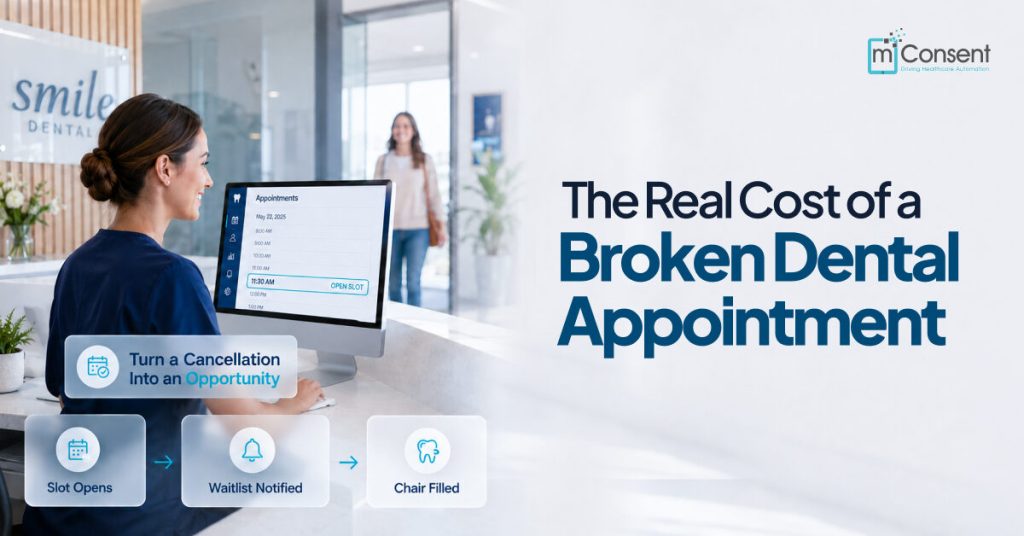




You look at your schedule, see a cancellation, and think: there goes a $200 cleaning.
That’s the mistake almost every practice owner makes. And it’s why broken appointments quietly become one of the most expensive leaks in your practice, right behind unscheduled treatment.
The missed cleaning was never just a cleaning. It was an exam. It was the visit where your hygienist catches the cracked molar, the early perio pocket, the crown that’s about to fail. Skip that visit, and you don’t just lose the cleaning fee; you lose the diagnosis. No diagnosis means no treatment plan. No treatment plan means the patient drifts. Six months later, they’re overdue for a recall, they already feel behind, and the reminder gets ignored.
One broken appointment. One cascade. A missed cleaning, a missed diagnosis, a lost restorative case, a patient who quietly stops coming back and every referral they would have sent your way.
Why “Patients Are the Problem” Doesn’t Fix Anything
It’s tempting to blame the no-show. Patients don’t value their time, they forget, they don’t call ahead. Maybe some of that’s true. But blaming patients doesn’t fill the chair, and it doesn’t recover the revenue that already walked out the door.
Practices that bring no-show rates down significantly don’t do it with guilt-trip signage or cancellation fees. They do it with a system, one that works in three layers: prevent, fill, recover.
Layer 1 Prevent – Reminders That Actually Work
A single reminder the day before an appointment isn’t a system. It’s a formality. Practices that see real drops in no-shows run a sequence: a touch 72 hours out, another at 24 hours, and a same-day reminder with the office address, each one with a one-tap confirm or reschedule link.
This is the layer where Automated Appointment Reminders and Communication Suite already do the heavy lifting inside mConsent, reducing no-shows without adding a single task to your front desk’s day.
Layer 2 Fill – Turn Cancellations Into Same-Day Wins
Cancellations happen no matter how good your reminders are. The difference between a practice that absorbs the loss and one that doesn’t is speed. As soon as a slot opens, the best practices text a batch of waitlisted patients at once first to confirm they get the chair. Minutes, not hours.
Manual outreach can’t move that fast. By the time your front desk starts dialing down a list, the window’s closed.
Layer 3 Recover – Don’t Let the Patient Drift
A missed appointment isn’t the end of the story unless you let it be. A same-hour text (“We missed you today, want to reschedule?”), a follow-up on day two, an email on day five, a call on day ten. This isn’t chasing patients. It’s making it easy for them to come back before they quietly become someone else’s patient.
The 10% Who Cause Most of Your Problem
Here’s what most schedules hide: a small share of patients account for the majority of broken appointments. Treat them the same as every other patient on your schedule, and you’ll keep absorbing the same losses on repeat.
The fix isn’t punishment; it’s a different protocol. More confirmation touches. Earlier reminders. A personal call the day before with a verbal yes. Some practices double-book those slots or require a deposit. The point is simple: stop treating every patient like they behave the same way when your own data says they don’t.
What the Math Looks Like When You Fix It
Reduce your no-show rate in half through prevention, fill, and recovery, and you’re not recovering one appointment here and there; you’re recovering chairs, every single day, at the real per-visit cost of a broken appointment (diagnosis and downstream treatment included).
And unlike a marketing campaign, this process costs you nothing extra to capture. These were already your patients, already on your schedule. You’re not generating new demand; you’re just closing the leak.
This Is Revenue Leak 2 of 5
Broken appointments sit right alongside unscheduled treatment, insurance friction, hygiene drop-off, and aging A/R as one of the five places dental practices lose collectible revenue before it ever reaches billing. Results vary by practice; figures are illustrative, not guarantees.
Most practices don’t know their real number until they measure it.
See exactly what broken appointments and the other four leaks are costing your practice.