



The Hidden Revenue Leak Most Practices Don’t Notice
A patient sits down in the chair. Treatment goes smoothly. Everyone assumes the visit was a win.
Then, three or four weeks later, the claim comes back denied. The annual maximum was already exhausted. A waiting period hadn’t cleared. Coverage had quietly lapsed the month before. Nobody at the front desk knew, because nobody could have known, not with a phone call and a printed benefit summary from six months ago.
This is one of the most common ways dental practices lose money, and it rarely shows up as a single dramatic loss. It shows up as:
- Reimbursements that take weeks longer than they should
- Front-office staff spending hours chasing corrections
- Claim denial rates that quietly erode monthly collections
- Patients blindsided by bills they weren’t expecting
- Profitability that never quite matches production numbers
Most practices try to fix this by chasing new patients or pushing more production. But the faster win is usually upstream: stopping the leak before treatment even starts.
That’s what real-time eligibility checks are built to do: Confirm active coverage, benefits, and limitations the moment they matter, instead of days or weeks after the damage is done. This guide breaks down how real-time eligibility verification protects dental revenue, and how mConsent’s Insurance Concierge turns this from a manual chore into a built-in safeguard.
What Are Real-Time Eligibility Checks?
Eligibility verification is the process of confirming a patient’s active insurance coverage before treatment is delivered, not after the claim is submitted.
A proper check tells your team:
- Whether the plan is currently active
- Effective and termination dates
- Remaining annual maximums
- Deductibles already met
- Co-insurance percentages by procedure category
- Waiting periods on specific treatments
- Frequency limitations (e.g., cleanings, X-rays)
- Any missing documentation the carrier will require
Traditional Verification vs. Real-Time Verification
Traditional verification relies on phone calls, insurance portals, and manually typed notes. It’s slow, often 10 to 30 minutes per patient and every manual step is a chance for human error: a missed waiting period, an outdated maximum, a benefit that changed last quarter without anyone noticing.
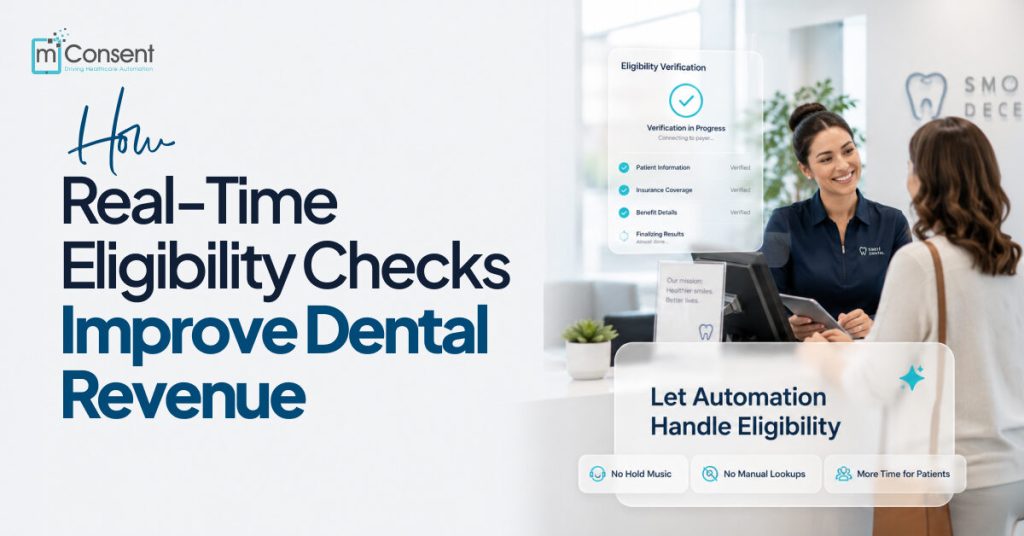
Real-time verification replaces that with automated benefit retrieval the moment an appointment is scheduled. Coverage details populate instantly, workflows stay integrated with scheduling and treatment planning, and staff get accurate numbers without a single hold-music minute.
The difference isn’t just speed. It’s the difference between a front desk that’s guessing and one that’s certain.
Why Insurance Verification Is a Revenue Function, Not a Clerical Task
It’s tempting to treat eligibility checks as busywork a box to tick before the patient sits down. In practice, verification is one of the highest-leverage revenue protection activities in the entire office, because nearly every downstream financial problem traces back to it.
When verification is weak or manual, practices absorb these risks:
- Claim denials. Incorrect or outdated eligibility data is one of the most preventable causes of rejected claims.
- Delayed payments. Every denied claim means a resubmission cycle, and resubmissions can add weeks to reimbursement timelines.
- Unexpected patient balances. When estimates are wrong, patients owe more than they were told, and trust takes the hit.
- Lost staff productivity. Correcting avoidable errors eats hours that could go toward scheduling, follow-up, or patient care.
- Treatment delays. Incomplete benefit information stalls scheduling decisions that should be same-day.
None of these shows up as one big number on a P&L. They show up as a slow, steady drag on collections, which is exactly why so many practices don’t notice the leak until they measure it directly.
The Real Cost of Manual Eligibility Checks
Manual verification isn’t just inconvenient; it’s expensive in ways most practices never formally calculate.
- Staff time. Checking benefits manually can take 10-30 minutes per patient. Multiply that across a full schedule, and a practice can lose hundreds of hours a year to a task that adds zero clinical value.
- Labor cost. That time comes from somewhere, usually a front-office team that’s already stretched between scheduling, check-in, and billing.
- Verification errors. Even careful staff miss things: an outdated policy number, a waiting period that started last month, a benefit assumption that hasn’t held true since the plan year renewed.
- Patient satisfaction. Patients remember surprise bills far more than they remember a smooth appointment. A wrong estimate at checkout can undo months of goodwill in a single conversation.
6 Ways Real-Time Eligibility Checks Improve Dental Revenue
1. Fewer Claim Denials
When eligibility data is accurate at the point of scheduling, claims go out clean the first time. Fewer denials means fewer resubmissions, fewer write-offs, and less staff time spent playing insurance detective after the fact.
2. Faster Insurance Payments
Clean claims move through the payer pipeline faster. Instead of waiting on a rejection, a correction, and a resubmission, practices see reimbursements land closer to the original submission date, which means healthier, more predictable cash flow.
3. Higher Case Acceptance
Patients say yes to treatment more often when they understand what it will actually cost them. Real-time benefit data lets your team walk through accurate out-of-pocket estimates during the treatment conversation, not a guess that gets corrected later.
4. Stronger Point-of-Service Collections
Collecting the right amount at checkout instead of chasing a balance weeks later is one of the single biggest levers for improving cash flow. Accurate real-time data makes that possible on day one, not after a billing cycle.
5. Less Revenue Leakage
Every denied claim, every write-off, every “we’ll just eat this one” moment adds up. Reducing the errors that cause them directly reduces leakage, often the single largest hidden gap between production and actual collections.
6. More Predictable Cash Flow
When reimbursements arrive on a consistent, predictable timeline instead of a rolling backlog of resubmissions, practices can plan more confidently around payroll, supply orders, and growth investments.
How Real-Time Verification Fits Into the Patient Journey
- Appointment scheduling: Insurance information is captured up front.
- Automatic eligibility check: Coverage is verified instantly, without a phone call.
- Benefits analysis: The system surfaces deductibles, maximums, and limitations automatically.
- Treatment planning: Your team builds accurate cost estimates using real numbers, not last quarter’s assumptions.
- Point-of-service collection: Financial conversations happen with confidence, before the patient leaves.
- Claim submission: Claims go out clean, backed by verified data.
Each step removes one more place where revenue could quietly slip through.
Turning Insurance Verification Into a Profit Center
The best revenue recovery strategy isn’t chasing down denials after the fact; it’s preventing them in the first place. Practices that treat eligibility verification as a strategic function, not an administrative afterthought, tend to see the benefit compound across three areas:
- Revenue growth, from fewer denials and faster collections
- Financial stability, from more predictable reimbursement timing
- Operational efficiency, from staff time that’s freed up for higher-value work
The Patient Experience Side of Eligibility Verification
Revenue protection and patient experience aren’t competing priorities here; they move together.
- No more surprise bills. Patients see accurate estimates before treatment, not a confusing statement weeks later.
- More trust. Clear, upfront financial conversations build the kind of relationship that keeps patients coming back.
- Less financial anxiety. Patients can plan for a cost they actually understand.
- Higher satisfaction scores. Transparency is one of the most consistent drivers of positive reviews and referrals.
Measuring the ROI of Real-Time Eligibility Checks
To know whether verification is actually working for your practice, track:
- Claim denial rate
- Average reimbursement time
- Accounts receivable (AR) days
- Collection rate
- Verification time per patient
- Front-office productivity/hours recovered
Example scenario: A practice seeing 20 patients a day that saves 15 minutes of manual verification per patient recovers roughly 75+ hours a month, time that can go straight back into scheduling, follow-up calls, or additional production capacity.
Common Eligibility Verification Mistakes to Avoid
- Waiting until the day of the appointment to verify coverage
- Assuming a patient’s coverage hasn’t changed since their last visit
- Working from incomplete or outdated patient information
- Skipping the review of frequency limitations and waiting periods
- Relying entirely on manual, phone-based processes
Best Practices for Stronger Verification
- Verify early, ideally 48-72 hours before the appointment
- Automate wherever possible to remove human error from the process
- Standardize the workflow so every team member follows the same steps
- Train your team on what to look for and how to flag exceptions
- Monitor performance regularly instead of assuming the process is working
How mConsent’s Insurance Concierge Protects Dental Revenue
This is exactly the gap mConsent’s Insurance Concierge module was built to close.
- Automated eligibility verification. Accurate benefit data pulled instantly, without staff picking up the phone
- Faster insurance processing. Fewer manual steps between scheduling and a clean claim
- Stronger point-of-service collections. Your team collects the right amount, the first time
- Fewer claim denials. Cleaner data going in means cleaner claims going out
- Integrated patient communication. Financial expectations are shared clearly, before treatment begins
- Revenue analytics. See denial trends, collection performance, and verification turnaround in one place
It’s part of mConsent’s broader Front Desk Revenue Control System, designed to close the everyday gaps unscheduled treatment, broken appointments, hygiene drop-off, insurance friction, and aging AR that quietly cost practices real revenue every month.
Where Insurance Verification Is Headed
Eligibility verification is moving from a reactive check to a predictive safeguard:
- Predictive eligibility intelligence that flags coverage issues before scheduling even happens
- Fully automated verification with minimal staff intervention required
- Real-time financial estimates patients can see and understand instantly
- Connected revenue ecosystems where verification is woven into every step of the patient journey, not treated as a separate task
Conclusion: Stop the Leak Before It Reaches Billing
Insurance verification isn’t a box to check before treatment; it’s one of the most direct levers a dental practice has over its revenue. Real-time eligibility checks reduce denials, speed up reimbursements, improve collections, and give patients the transparency they actually want.
Practices that replace manual, after-the-fact verification with real-time automation aren’t just saving staff time; they’re protecting revenue that would otherwise quietly disappear.
See what mConsent’s Insurance Concierge catches before it ever reaches billing.
FAQ
What are real-time eligibility checks?
Automated insurance verification processes that instantly confirm a patient’s active benefits and coverage details, rather than relying on manual phone calls or outdated portal lookups.
How do real-time eligibility checks improve dental revenue?
They reduce claim denials, speed up reimbursements, improve point-of-service collections, and prevent the kind of revenue leakage that manual processes miss.
Why are manual eligibility checks inefficient?
They’re time-consuming (often 10–30 minutes per patient), prone to human error, and frequently based on outdated benefit information.
Can eligibility verification actually reduce claim denials?
Yes. Accurate, up-to-date verification means claims are submitted with fewer errors the first time, which directly lowers denial rates.
How do eligibility checks improve patient satisfaction?
By eliminating surprise bills, patients get an accurate financial picture before treatment instead of a confusing statement afterwards.
When should insurance eligibility be verified?
Ideally, 48-72 hours before the patient’s scheduled appointment.
How do real-time checks improve cash flow?
Faster claim processing combined with stronger point-of-service collections makes reimbursement timing far more predictable.
What metrics should practices track?
Claim denial rate, average reimbursement time, AR days, collection rate, and verification turnaround time per patient.
How does automation improve the verification process?
It removes manual, repetitive work from staff, increases consistency across the team, and reduces the human-error rate that drives denials.
How does mConsent support eligibility verification?
Through Insurance Concierge, automated real-time checks, integrated patient communication, and revenue analytics that help practices identify and close leaks before they hit billing.