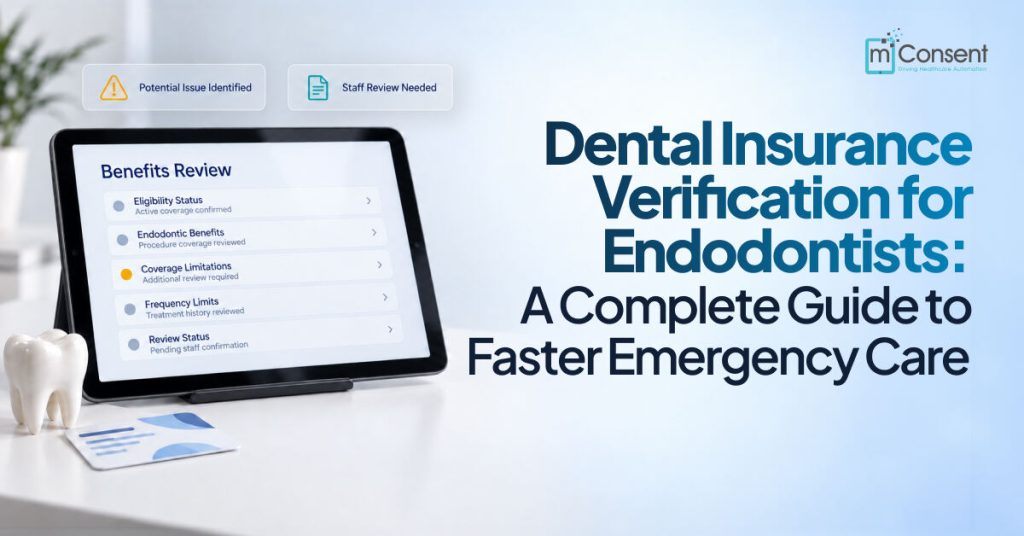



A patient calls in severe pain. Your team needs a chair open in the next hour, not a login screen for three different payer portals.
That’s the real tension behind dental insurance verification in an endodontic practice: clinical urgency on one side, administrative process on the other. Get the sequencing right, and both move faster. Get it wrong, and the patient in pain waits at the front desk while staff hunt for a group number.
This guide breaks down what dental insurance verification involves, why it plays out differently in endodontics than in general dentistry, and how shifting verification earlier with automation helps emergency patients get to treatment faster.
Get Insurance Benefits Verified Before Emergency Treatment
mConsent Insurance Concierge helps endodontic practices move insurance verification ahead of treatment whenever possible, so urgent patients don’t have to wait while the front desk chases payers and portals.
What Is Dental Insurance Verification?
Dental insurance verification is the process of confirming a patient’s eligibility, coverage, benefits, and limitations before treatment begins. Depending on the payer and the practice’s workflow, that typically includes:
- Patient eligibility and effective dates
- Member ID, subscriber information, and group number
- Deductible and remaining deductible
- Annual maximum and remaining annual maximum
- Coverage percentages and coinsurance
- Waiting periods and frequency limitations
- Plan restrictions and exclusions
- Estimated patient responsibility
Eligibility Verification vs. Benefits Verification
These two terms get used interchangeably, but they answer different questions:
- Eligibility verification answers: Is the patient’s insurance active?
- Benefits verification goes further and answers: What does the plan actually cover, and what financial responsibility might remain?
A practice can confirm a patient is “eligible” in seconds and still not know what they’ll owe after treatment. Both steps matter, especially before a procedure a patient didn’t plan for.
Why Dental Insurance Verification Is Different for Endodontists
General dentistry usually has the luxury of a scheduled visit and a few days of lead time. Endodontic practices often don’t.
Patients arrive same-day, in pain, frequently referred over from a general dentist who just discovered a pulpal or periapical problem. That changes the shape of the challenge:
- Same-day or urgent appointments with little scheduling notice
- Patients in significant pain who aren’t focused on paperwork
- Referrals arriving with incomplete or secondhand insurance details
- Little to no time for the front desk to research benefits in advance
- Complex benefit structures that take real time to interpret
- Patients asking about cost while they’re still in the chair
- All of this landing during a practice’s busiest, most unpredictable hours
The workflow endodontic teams are actually managing:
Here’s what that workflow looks like for most endodontic teams: an urgent patient arrives, gets registered, insurance is verified, the treatment plan and cost are discussed, and then care begins.
Why Emergency Dental Insurance Verification Can Delay Care
Emergency dental insurance verification is a balancing act between speed and financial preparation. When verification happens during the visit instead of before it, a few predictable bottlenecks show up.
Manual Payer Portal Checks
Every payer has its own portal, login, and layout. Staff may need to check two or three separate systems to confirm one patient’s coverage.
Insurance Phone Calls
When a portal doesn’t have the answer, someone picks up the phone and waits on hold while a patient waits in the lobby.
Incomplete Insurance Information
Referred and walk-in emergency patients often don’t have their insurance card, current group number, or subscriber details on hand.
Time-Consuming Benefits Research
Deductibles, remaining maximums, and frequency limitations aren’t always visible on the surface of a portal; someone has to dig for them.
Patient Financial Questions
Patients in pain still want to know what they’ll owe. Without verified benefits, staff can only offer a rough guess.
In practice, that means an emergency patient arrives, the front desk starts verification, staff search portals or call the payer, the patient waits, benefits get reviewed, and only then does the financial discussion begin. None of these steps is unnecessary. The problem is when they happen. Moving them earlier, before the patient sits in the operatory, closes the gap.
The 7 Benefits of Dental Insurance Verification for Endodontists
1. Helps Verify Benefits Before Emergency Treatment
This is the core solution. Whenever insurance information is available even an hour before the appointment, verification can start before the patient walks in.
A better sequence looks like this: schedule the appointment, collect insurance information, verify benefits, staff review the information, the patient arrives, and emergency treatment begins right away. Verify first when possible, so urgent patients spend less time waiting on administrative work that could have happened before they arrived.
2. Helps Reduce Front-Desk Work During Urgent Visits
Emergency appointments already put pressure on front-desk teams. Automating routine verification, portal searches, eligibility checks, benefits lookups, repetitive calls, and manual data entry frees staff to focus on the patient in front of them and the exceptions that genuinely need a human.
3. Helps Provide Clearer Patient Cost Expectations
Patients in the chair tend to ask the same questions: Is my insurance active? Does this treatment get covered? How much of my deductible is left? What will I owe?
Earlier benefits verification means staff can actually answer, instead of promising to “check and call back.”
The patient journey follows a simple sequence: verify, review, estimate, communicate, then treat. Worth noting: verification supports a better estimate; it’s not a guarantee of final insurance payment. Claims still go through adjudication.
4. Helps Reduce Repetitive Insurance Calls and Portal Checks
Manual verification means bouncing between payer portals, insurance websites, phone systems, patient records, and the practice management system for every single patient. Automated workflows take this repetitive task off staff’s plate.
Automate the routine work so staff can focus on emergency patients and the cases that actually need judgment.
5. Helps Improve Verification Consistency
That inconsistency shows up later as billing surprises. A standardized workflow closes the gap: consistent verification criteria lead to consistent information, which leads to better patient communication.
6. Helps Identify Insurance Issues Earlier
Verifying earlier gives staff time to catch problems while there’s still time to act: inactive coverage, incorrect member information, missing details, waiting periods, frequency restrictions, or an unexpectedly high deductible. Finding these the day before feels very different from finding them mid-appointment.
7. Gives Front-Desk Teams More Time for Patients
The point of all of this isn’t automation for its own sake; it’s what that automation frees people up to do: greet patients, coordinate emergency appointments, communicate clearly, manage referring-office relationships, handle complex insurance cases, and follow up after treatment.
Emergency Dental Insurance Verification: Before vs. During the Visit
| Verification During Visit | Verification Before Visit |
| Staff workload: Higher during visit | Staff workload: More distributed |
| Portal research: May occur during visit | Portal research: Can happen earlier |
| Patient waiting: Potentially longer | Patient waiting: Potentially reduced |
| Cost discussion: May be delayed | Cost discussion: Can happen earlier |
| Front-desk focus: Administrative tasks | Front-desk focus: Patient-facing tasks |
| Preparation: Limited | Preparation: More opportunity to prepare |
How Automated Dental Insurance Verification Supports Endodontic Practices
Automated dental insurance verification helps endodontic practices streamline routine eligibility and benefits checks, reducing the manual, repetitive work that eats into staff time.
Automate Routine Eligibility Checks
Cut down on repetitive manual eligibility research across payers.
Streamline Benefits Verification
Give staff faster access to the benefit details that matter for the case at hand.
Reduce Manual Data Entry
Minimize repetitive re-keying of insurance information across systems.
Standardize Verification Workflows
Create one consistent process, regardless of which team member handles it.
Surface Potential Issues Earlier
Flag information that needs attention before the patient is already in the chair.
Here’s how that works in practice: insurance information comes in, automated verification runs, benefits information comes back, staff review it, exceptions are handled, and the patient receives emergency care.
What Insurance Benefits Should Endodontists Verify?
A quick reference checklist for what actually needs confirming:
Eligibility
- Active coverage
- Effective dates
Patient Information
- Member ID
- Subscriber information
- Group number
Financial Benefits
- Deductible and remaining deductible
- Annual maximum and remaining annual maximum
- Coinsurance and copayment
- Estimated patient responsibility
Treatment-Related Benefits (where applicable, depending on plan)
- Covered services
- Coverage percentages
- Waiting periods
- Frequency limitations
- Exclusions
- Plan restrictions
- Coordination of benefits
Benefits and estimates can change, and final claim adjudication determines the actual insurance payment. Verification improves accuracy, but it isn’t a guarantee.
How to Build a Faster Insurance Verification Workflow for Endodontic Emergencies
Step 1: Collect Insurance Information Early
Gather insurance details at scheduling whenever possible, not at check-in.
Step 2: Verify Eligibility
Confirm coverage is active before the patient arrives.
Step 3: Review Relevant Benefits
Check the specific benefits tied to the planned treatment.
Step 4: Identify Potential Issues
Flag inactive coverage, missing information, or limitations that need follow-up.
Step 5: Prepare the Patient Financial Conversation
Equip staff with the numbers they need to explain coverage and out-of-pocket costs.
Step 6: Handle Exceptions
Route anything unusual to staff for direct payer follow-up.
Step 7: Proceed With Emergency Care
Keep the visit focused on treatment, with financial groundwork already in place.
How mConsent Insurance Concierge Helps Endodontic Practices
Get Insurance Benefits Verified Before Emergency Treatment
mConsent Insurance Concierge helps endodontic practices verify insurance before treatment whenever possible, so urgent patients don’t have to wait while the front desk chases payers and portals.
What it helps with:
- Streamlined eligibility and benefits verification
- Reduced repetitive manual work and payer portal research
- Fewer routine insurance calls
- More consistent verification workflows across staff
- Earlier access to insurance information
- Better-supported patient cost conversations
- Improved front-desk efficiency during emergency-heavy days
Suggested workflow with Insurance Concierge:
The emergency appointment gets scheduled, insurance information is collected, Insurance Concierge verifies eligibility and benefits, potential issues are identified, staff review the information, exceptions get handled when needed, the patient arrives, staff communicate the expected financial responsibility, and emergency treatment proceeds.
Get Insurance Benefits Verified Before Emergency Treatment
Common Insurance Verification Challenges for Endodontic Practices
Challenge: Same-Day Emergency Appointments
Start verification as soon as insurance information becomes available, even if that’s only minutes before the patient arrives.
Challenge: Patients Arrive Without Complete Information
Collect and confirm insurance details during scheduling or pre-visit communication whenever possible.
Challenge: Multiple Payer Portals
Use technology-supported verification to reduce repetitive portal research.
Challenge: Complex Benefits
Review case-relevant benefits and flag limitations before treatment begins.
Challenge: Front-Desk Capacity
Automate the routine verification work so staff can stay focused on patients and true exceptions.
Signs Your Endodontic Practice Needs Better Insurance Verification
Your practice may benefit from a more streamlined workflow if:
- Staff manually check multiple payer portals for every patient
- Emergency patients wait while insurance gets verified
- Staff frequently call insurance companies for basic answers
- Benefits information is entered manually, more than once
- Insurance is usually verified immediately before treatment, not before
- Patients often ask about cost and staff can’t answer confidently
- Verification volume is outpacing staff capacity
- Different team members follow different verification steps
- Insurance issues surface late sometimes after treatment
- Front-desk staff spend a disproportionate amount of time on repetitive verification
Best Practices for Dental Insurance Verification in Endodontic Practices
- Collect insurance information as early as possible
- Verify eligibility before the appointment whenever possible
- Review relevant benefits before emergency treatment
- Identify potential coverage issues early
- Communicate estimates clearly
- Avoid guaranteeing insurance payment
- Standardize verification procedures across the team
- Automate repetitive verification tasks
- Let staff focus on exceptions, not routine checks
- Keep verification information accessible to the right team members
The Future of Insurance Verification for Endodontists
A few shifts are already shaping where this is headed:
- Automated dental insurance verification increasingly handling repetitive, routine checks
- Real-time eligibility becoming the baseline expectation, not a bonus
- AI-assisted benefits organization helping staff make sense of complex plan details faster
- Automated exception detection surfacing missing or inconsistent information before it becomes a problem
- Earlier patient cost communication, backed by verified data instead of estimates
- Connected emergency-care workflows, linking scheduling, verification, treatment, claims, and payments into one process
Here’s where this is heading: the emergency appointment comes in, insurance information is collected, automated verification runs, benefits are reviewed, the patient is prepared, and treatment follows.
Conclusion: Verify Earlier, Help Emergency Care Move Faster
Emergency endodontic care means constantly balancing clinical urgency against administrative and financial requirements. Manual insurance verification adds friction to that balance through payer calls, portal checks, benefits research, data entry, reverification, and on-the-spot patient financial questions.
Moving verification earlier whenever possible is what relieves that pressure.
Key takeaways:
- Verify insurance benefits before emergency treatment whenever possible
- Collect insurance information early, ideally at scheduling
- Automate routine eligibility and benefits verification
- Give staff the information they need for confident cost conversations
- Free front-desk teams to focus on urgent patients and true exceptions
- Use one consistent verification workflow across the practice
Get Insurance Benefits Verified Before Emergency Treatment
mConsent Insurance Concierge helps endodontic practices verify insurance before treatment whenever possible, reducing repetitive manual work and helping front-desk teams focus on patients.
Frequently Asked Questions
What is dental insurance verification for endodontists?
Dental insurance verification for endodontists is the process of confirming a patient’s eligibility, benefits, coverage limitations, and potential financial responsibility before endodontic treatment.
Why is insurance verification important for emergency endodontic care?
Insurance verification helps practices understand coverage and prepare financial information before treatment whenever possible, reducing administrative delays and supporting clearer patient communication.
What is endodontic insurance verification?
Endodontic insurance verification involves checking a patient’s relevant insurance eligibility and benefits information before endodontic treatment begins.
How does emergency dental insurance verification work?
Emergency dental insurance verification typically involves confirming active coverage and reviewing relevant benefits and limitations. When insurance information is available before the visit, verification can begin before the patient arrives.
Can insurance verification delay emergency dental treatment?
Manual verification can create administrative delays when staff need to complete portal searches, phone calls, and benefits research during an urgent visit. Moving verification earlier whenever possible helps reduce this friction.
What insurance benefits should an endodontist verify?
Relevant information may include eligibility, deductibles, annual maximums, coverage percentages, waiting periods, frequency limitations, exclusions, and potential patient responsibility.