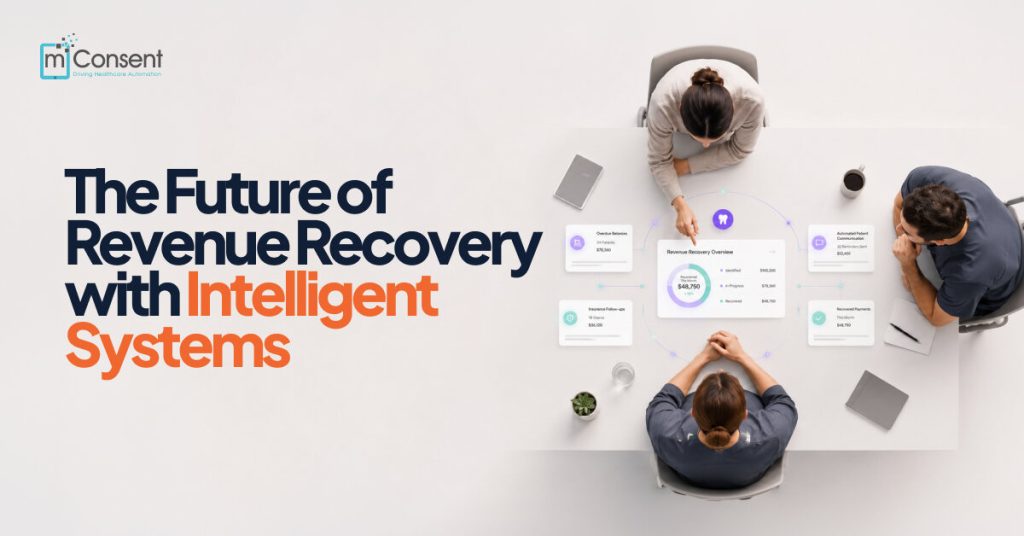




“Revenue recovery is no longer about chasing payments, it’s about predicting them.”
What if your dental practice could identify revenue gaps before they happen, before claims are denied, before patients delay payments, and before your accounts receivable (AR) starts climbing?
That’s exactly where the industry is heading.
For years, dental revenue recovery has been reactive, teams chasing unpaid balances, fixing claim errors after submission, and manually following up with patients. But today’s environment has changed. Insurance complexity is rising. Patients are responsible for a larger share of costs. And expectations around convenience, speed, and transparency are higher than ever.
This shift demands a new approach.
We’re moving from manual processes to automated workflows to intelligent systems, which are platforms that not only do tasks but also learn, predict, and improve every step of the revenue cycle.
mConsent and other solutions like it are at the forefront of this change. They combine communication, payments, analytics, and AI to create a smarter, more proactive system for recovering lost revenue.
Evolution of Revenue Recovery in Dentistry
Understanding the future starts with understanding how we got here.
Traditional Revenue Recovery
- Manual billing processes
- Follow-ups by phone
- Statements on paper and late communication
A lot of staff work went into this model. It took a long time, made mistakes, and was reactive.
Automated Systems
- Systems for billing online
- Reminders by text and email
- Websites for paying online
Automation made things work better, but it still follows set rules instead of using intelligence.
Intelligent Systems
- AI-driven decision-making
- Predictive analytics
- Self-optimizing workflows
These systems don’t just follow instructions; they continuously improve based on data.
Milestones Timeline
Paper → Digital → Automated → Intelligent
Each stage has reduced friction, but only intelligent systems truly eliminate it.
What Are Intelligent Revenue Recovery Systems?
Definition
Intelligent revenue recovery systems use AI, data analytics, and automation to optimize how practices manage billing, collections, and patient payments.
Core Capabilities
- Predictive analysis
- Making decisions in real time
- Communication with patients that is tailored to them
- Learning and improving all the time
Key Technologies Behind Intelligent Systems
- Artificial Intelligence (AI)
- Machine Learning (ML)
- Natural Language Processing (NLP)
- Advanced data analytics
Automation vs. Intelligence
| Feature | Automation | Intelligent Systems |
| Rules | Fixed | Adaptive |
| Learning | None | Continuous |
| Decision-making | Predefined | Data-driven |
| Personalization | Limited | Advanced |
Automation executes. Intelligence evolves.
Why Traditional Revenue Recovery Is No Longer Enough
Increasing Complexity in Billing
- There is a lot of variation in insurance plans.
- There are more strict coding requirements.
- Patients are becoming more responsible for their own money.
Rising Patient Expectations
Patients now expect:
- Instant communication
- Transparent pricing
- Flexible payment options
Limitations of Manual & Basic Automated Systems
- Not enough personalization
- Insights that come too late
- Workflows that respond
In short, traditional systems only respond after problems happen. Smart systems stop them.
Key Benefits of Intelligent Revenue Recovery Systems
Smart revenue recovery systems improve the entire financial workflow in ways that can be measured. With predictive revenue management, businesses can identify payments that are likely to be late before they actually are, so they can take action before they are late.
Real-time processing cuts down on mistakes and speeds up collections, which supports this claim. Hyper-personalized patient communication makes sure that reminders are based on how each patient acts, how they pay, and how they like to talk to you. Patients are more likely to respond and get involved when this happens. These features help lower accounts receivable (AR) days, which speeds up collections and makes cash flow better.
In addition to making more money, practices benefit from a better patient experience by making the payment process easy and stress-free, which builds trust and satisfaction. In the end, these systems help practices grow in a way that is easy to manage, so they can handle more patients without adding more work.
Core Components of Intelligent Revenue Recovery
Predictive Analytics Engine
- Forecast payment delays
- Identify high-risk accounts
- Anticipate revenue gaps
Smart Communication Systems
- AI-driven messaging
- Optimal timing and channel selection
Intelligent Payment Systems
- Auto-pay recommendations
- Personalized payment plans
Automated Insurance Processing
- Smart claim validation
- Error detection before submission
Real-Time Analytics Dashboard
- Live performance insights
- KPI tracking
- Immediate decision support
Use Cases of Intelligent Systems in Dental Revenue Recovery
Smart systems change how dental offices get paid by making it easier to predict and more accurate at every step of the process. AI can use predictive analytics to figure out which patients are most likely to be late with their payments. This gives practices a chance to do something before problems happen.
This information helps smart payment reminders work by making sure that messages are sent at the right time and through the best channel. People are more likely to respond to this.
Automated claim error detection also finds mistakes before they are sent in, which saves money on having to do the work again and getting denied. These systems also let practices make payment plans that take into account each patient’s past behavior and financial situation. This makes it easier for patients to pay and for practices to get paid.
Finally, advanced revenue forecasting makes it easier and more accurate for practices to see how much money they collect each month. This helps them make better decisions and plan their money better.
Intelligent Revenue Recovery Workflow
Stage 1: Pre-Visit
- Predict how patients will pay
- Check insurance automatically
Stage 2: During Visit
- Real-time cost estimation
- Smart payment recommendations
Stage 3: Post-Visit
- Automated billing
- Personalized payment links
Stage 4: Follow-Up
- AI-driven reminders
- Escalation based on patient response
Stage 5: Recovery Optimization
- Strategies adjust dynamically
- System learns from outcomes
This creates a closed-loop system that continuously improves.
Challenges in Adopting Intelligent Systems
When practices start using smart revenue recovery systems, they have to carefully deal with some problems. One of the main reasons is that workers don’t want to change because they might not be sure how to use new technologies that replace old ways of doing things. When different systems that aren’t connected create silos, it can also cause problems with data integration. This makes automation and insights less useful.
Cost is also a factor because the initial cost of advanced systems may seem high, even though the long-term return on investment is great. Last but not least, data security is still very important, and there are strict rules about HIPAA compliance and keeping patient data safe.
To get past these problems, practices should focus on giving structured training to make it easier to adopt, choosing platforms that can grow and work together to bring all workflows together, and making sure that strong compliance and encryption standards are in place to keep sensitive information safe.
Best Practices for Implementing Intelligent Systems
Planning ahead is the first step to successfully setting up intelligent revenue recovery systems. Once a practice has a solid operational base, it should start with automation and then add more advanced AI features. Knowing how to use data well is just as important. To make good predictions and insights, you need data that is clean, structured, and well-organized.
But you need to train your team so that the system works well and to its full potential. To keep doing well, you need to be able to watch and improve performance all the time. You should also change how you work based on what you see happening right now. First and foremost, practices should focus on the patient’s experience. Even with AI-powered systems, people should still be able to talk to each other clearly and easily. This will make sure that everyone is happy with and trusts every step.
How mConsent Leads the Future of Revenue Recovery
mConsent is more than just another piece of dental AI software; it’s a whole smart ecosystem made for modern practices.
AI-Powered Communication
- Smart reminders
- Two-way patient messaging
Integrated Payment Solutions
- Text-to-pay functionality
- Online billing and payment portals
Automated Insurance Verification
- Faster approvals
- Reduced claim errors
Advanced Analytics
- Real-time performance insights
- Revenue tracking dashboards
End-to-End Workflow Automation
- Seamless integration across intake, billing, and payments
This combination makes mConsent the best choice for AI dental billing and revenue cycle automation for dental offices.
Measuring ROI of Intelligent Systems
Important Numbers
- Days of AR
- Rate of collection
- Time it takes to process payments
ROI Formula
(revenue rise – cost) ÷ cost
Expected Results
- Collections that happen faster
- Lower costs for running the business
- More efficient operations
Future Trends in Intelligent Revenue Recovery
The future of recovering dental revenue is moving toward highly advanced, intelligent ecosystems where efficiency and automation reach new heights. We are entering a time when revenue cycles will be completely automated. AI will handle all workflows with little help from people, which will cut down on mistakes and speed up collections. AI financial assistants will also work as virtual support staff, answering billing questions, sending follow-ups, and helping patients make payments in real time.
Predictive patient financing will help collections even more by giving patients personalized payment plans based on their financial habits and risk levels. New technologies like blockchain in billing will make transactions safer and more open, which will build trust and make sure everyone follows the rules. Lastly, voice and conversational AI will change how patients interact with billing systems. Patients will be able to use simple voice commands to pay, which will make the whole process faster, easier to understand, and more accessible.
Conclusion
The world of revenue recovery is changing quickly. We are already making the switch from reactive to proactive and from manual to smart. Using smart ways to get money back will not only help you make more money, but it will also make the patient experience better and help your business grow faster.
mConsent and other platforms are leading the way in this change by bringing together:
- Insights from AI
- Workflows that do their own thing
- Good communication
- Payment systems that can talk to each other
It’s not about working harder to get your money back later; it’s about working smarter to keep it from being lost in the first place.
With smart systems powered by mConsent, you can step into the future of getting your money back.
FAQs
1. What are systems for smart revenue recovery?
They are AI-powered systems that use predictive analytics and real-time data to automate and improve billing, collections, and patient payments.
2. How does AI help get back lost money?
AI predicts how people will pay, identifies risks, and automates workflows, speeding things up and reducing delays.
3. Can smart systems cut down on AR days?
Yes, a lot. Faster billing, proactive communication, and predictive insights all help speed up collections.
4. What kinds of technology do these systems use?
Artificial intelligence, machine learning, natural language processing, and data analysis.
5. Are smart systems safe?
Yes, but only if they are done using HIPAA-compliant platforms with strong encryption and data protection standards.