



Most dental practices face the same decision. Should we create an in-house membership plan, or continue relying on PPOs and their negotiated reimbursement rates?
Many practices successfully do both. But if you’re considering reducing your dependence on PPOs and expanding your membership program, the key is understanding the financial trade-offs.
Here’s a simple framework to help you evaluate which approach makes the most sense for your practice.
What a PPO Actually Costs You
When your practice is in-network with a PPO, the insurer sets the reimbursement rate for every procedure you perform; you don’t set your own price for that patient. In exchange, you get placement in their provider directory and a stream of patients who chose you because you’re in-network.
The costs aren’t just the discounted fee schedule, though that’s the most visible one. There’s also:
- Administrative time spent verifying benefits and submitting claims
- Reimbursement timelines that are slower than a card payment at checkout
- Occasional denied or delayed claims that require follow-up
- Annual fee schedule renegotiations that rarely move in your favor
None of this makes PPO participation a bad decision; for many practices, especially newer ones building a patient base, the volume PPOs bring in is worth the discounted rate. But it’s worth being honest about what you’re trading for that volume.
What Fee-for-Service Actually Means
A fee-for-service (FFS) practice sits outside insurance networks. The practice sets its own full price for every procedure, and the patient pays it directly; either the patient submits to their insurer for reimbursement afterwards, or the practice simply doesn’t participate in that conversation at all.
The upside is straightforward: you collect what you’re actually owed, at the time of service, without a third party setting the number. You’re not waiting 30, 45, or 60 days for a claim to process, and you’re not writing off the gap between your fee and the negotiated rate.
The tradeoff is that FFS asks more of the patient upfront, both financially and in terms of trust. Patients accustomed to “my insurance covers this” need a reason to accept a bill that isn’t run through a claims process. That’s the gap a membership plan is built to close.
Where the Membership Model Fits In
A dental membership plan isn’t a replacement for insurance in the technical sense; it’s a way to give fee-for-service patients something that functions like insurance from their perspective: a predictable monthly or annual cost, in exchange for defined included care (typically two cleanings and exams a year), a discount on additional treatment.
For the practice, it turns each enrolled patient into recurring revenue instead of a single per-visit transaction, and it removes the reimbursement delay entirely: you set the price, you collect it directly, and there’s no claim sitting in a queue.
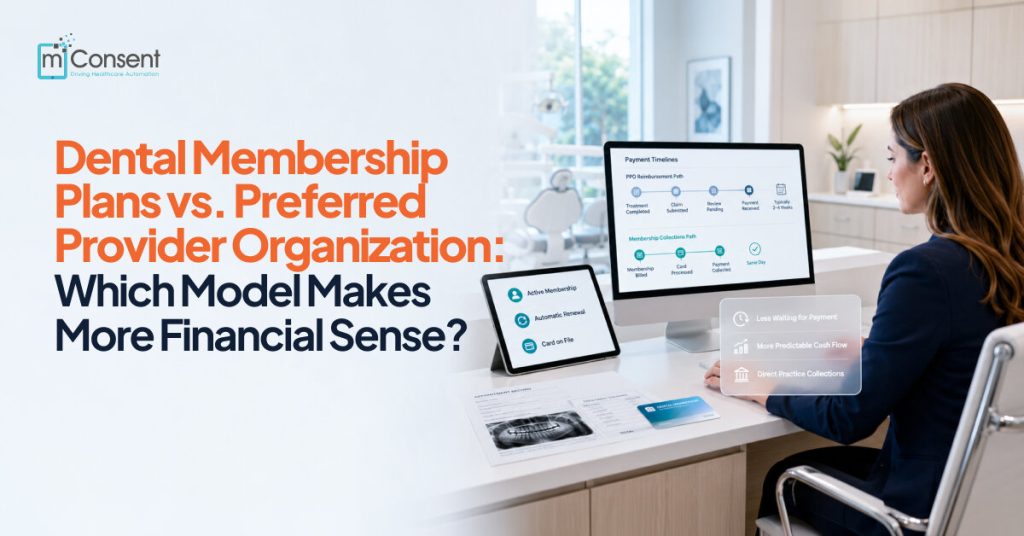
Comparing the Two Models Side by Side
Who sets the price
PPO: the insurer, via the negotiated fee schedule.
Membership/FFS: the practice.
When you get paid
PPO: after claims processing, days to weeks later, sometimes with a partial reimbursement if a claim is challenged.
Membership: at the time of billing, typically via card on file.
Predictability of revenue
PPO: variable, tied to patient volume and claim approval.
Membership: more predictable once a patient base is enrolled, since it’s a recurring charge rather than a per-visit bill.
Patient acquisition
PPO: the network itself brings in patients searching for in-network providers.
Membership: requires your own marketing and case-presentation to convince patients an out-of-network relationship is worth it.
Administrative load
PPO: claims submission, benefit verification, and appeals.
Membership: enrollment, recurring billing management, and following up on failed or expired card payments.
Neither model eliminates administrative work; it just moves where that work sits. PPOs push the admin burden into claims and verification. Memberships push it into billing and collections.
The Real Financial Question to Ask
The comparison practices actually need to run isn’t “which model is better” in the abstract; it’s this: for your specific patient base, what’s the gap between what a PPO reimburses you per patient per year, versus what a comparable membership price would collect from that same patient, accounting for the discount you’re extending on additional treatment?
If your PPO fee schedule is deeply discounted relative to your full fee, and you have a patient base willing to pay directly for predictable, quality care, the math often favors reducing PPO dependence. If your patient volume is heavily driven by insurance-directory visibility, dropping out of network is a bigger risk to weigh carefully before committing.
Many practices don’t make this an all-or-nothing decision. It’s common to remain in-network with select PPOs while offering a membership plan specifically for the uninsured or out-of-network patients already coming through the door, capturing revenue from a segment that would otherwise be paying full price with no structure around it at all, or not booking treatment at all due to cost hesitation.
Making the Transition Work Financially
If you do decide to build out a membership option, the practices that see it work best treat it as its own P&L, not an afterthought bolted onto existing operations. That means:
- Pricing the plan against your actual cost to deliver included care, not just against what feels attractive to patients
- Committing to real billing infrastructure. Card-on-file, automated recurring charges, and a way to catch failed payments rather than tracking it manually
- Giving your team a clear script for presenting the membership as a genuine alternative to insurance, not a consolation prize for patients without coverage
This is where the operational side matters as much as the financial modeling. mConsent’s Membership module handles the billing mechanics of this transition: recurring monthly or annual charges, card-on-file management, and a dashboard that flags overdue or failed payments, so the revenue you’ve modeled on paper actually comes in reliably each month.
Weighing a move toward membership plans and want to see how the billing side would actually run? Book a demo with mConsent and we’ll walk through it.