




A patient walks in for a same-day emergency root canal. Before the handpiece even comes out, someone at the front desk has to answer a question that matters more than almost anything else in the visit: is this covered, and by how much?
Get it wrong, and the consequences show up later: a patient disputing a bill they didn’t expect, a claim denied because a waiting period wasn’t checked, a practice absorbing cost it never priced in. Dental insurance verification for an emergency root canal isn’t paperwork that happens alongside treatment. It’s a step that determines how smoothly the whole visit runs, whether the patient trusts what they’re told, and whether the practice gets paid without having to fight for it.
Root canal cases make this harder than routine care. The procedure costs more, so a coverage mistake costs more. Many plans apply frequency limits, waiting periods, or annual maximums specifically to major and endodontic work. And the patient in the chair is often new to the practice, referred in by a general dentist with no benefits history on file, verified in the middle of a pain emergency, not during a calm scheduling call two weeks out.
This is a practical, step-by-step walkthrough of how to verify insurance before treating an emergency root canal patient: what to confirm, in what order, and where a service like mConsent Insurance Concierge fits into that process.
How Do You Verify Insurance for an Emergency Root Canal?
Verifying insurance for an emergency root canal means confirming the patient’s active coverage, checking benefits for the specific endodontic procedure code, and identifying any deductible, waiting period, or frequency limitation before treatment begins. Doing this before the patient is in the chair helps the practice estimate patient responsibility accurately and avoid unexpected billing issues after treatment.
Why Root Canal Insurance Verification Needs Its Own Process
Routine dental insurance verification and root canal insurance verification aren’t the same task, and treating them the same way is where practices get into trouble.
Higher cost, higher stakes
A missed detail on a cleaning might mean a $30 surprise. A missed detail on a root canal can mean a bill in the hundreds, sometimes over a thousand dollars, landing on a patient who assumed insurance had it handled. The dollar amount at risk changes what “close enough” verification costs the practice in trust and in collections.
Endodontic-specific coverage rules
Root canal treatment falls under specific procedure codes (the D3310–D3330 range for initial treatment, with separate codes for retreatment). Confirming “the patient has dental insurance” says almost nothing about whether that plan pays toward those codes. Many plans set separate annual maximums or coverage percentages for major and endodontic work, apply waiting periods before covering major work, or limit how often a retreatment on the same tooth will be reimbursed.
New or referred patients
Emergency root canal patients often arrive via referral or first-time call-in, with no benefits history in the practice’s system. Verification has to start from zero, which takes longer and leaves more room for something to be missed under pressure.
Time pressure
A scheduled restorative case can wait a few days for benefits to come back from a payer. A patient with acute pain from a compromised tooth cannot. Root canal insurance verification has to happen fast, sometimes within the hour, without cutting corners on what gets checked.
What to Confirm Before Treating an Emergency Root Canal Patient
A verification that only confirms “yes, they have insurance” isn’t verification; it’s a guess with extra steps. Before treatment starts, confirm each of the following.
Active coverage and plan type
Is the plan active as of today, not just on file from a past visit? Is it PPO, HMO, or indemnity? The plan type affects both what’s covered and how the claim needs to be filed.
Coverage for the specific procedure code
Not “is dental covered,” but “is this endodontic code covered, and at what percentage.” A plan can cover preventive care fully and still pay very little toward D3330.
Remaining annual maximum
How much of the patient’s yearly benefit is left. A root canal scheduled in November, against a maximum already used up by earlier treatment, can change the patient’s out-of-pocket number substantially.
Deductible status
Whether the deductible has been met, and how much of it applies to this specific procedure.
Waiting periods and frequency limits
Some plans withhold coverage on major work for the first six to twelve months of a policy. Others limit how often a retreatment on the same tooth will be reimbursed. Check both before treatment, not after the claim is filed.
Estimated patient responsibility
The number that actually matters to the patient: what they will be asked to pay, based on everything above.
This list doubles as a quick internal reference; if a verification didn’t check all six of these, it isn’t finished yet.
Step-by-Step: Verifying Insurance Before Treatment
- Collect patient and payer details before the appointment. Ideally, gather the name, date of birth, member ID, and payer at the referral or call-in stage, not at check-in.
- Confirm active coverage. Verify the plan is active today and note the effective dates.
- Check endodontic-specific benefits. Confirm procedure code coverage, any waiting period, and frequency limits on retreatment.
- Calculate estimated patient responsibility. Combine remaining deductible with the plan’s co-insurance percentage for the procedure.
- Communicate findings to the patient before treatment. Walk them through what’s covered and what they’ll owe, before the procedure starts.
- Document the verification for the claim. Record who verified, when, and how this record matters if the claim is questioned later.
Each step is a single, clear action. Skip one, and the gap usually surfaces as a billing dispute weeks after the patient has already left.
Manual vs. Automated Root Canal Insurance Verification
| Manual verification | Automated/software-assisted verification | |
| Turnaround | Minutes to hours, via phone or payer portal | Real-time or near-real-time |
| Procedure-level detail | Depends on staff following up on each code | Checked consistently every time |
| Consistency during emergencies | Can slip when the front desk is under time pressure | Standardized regardless of patient volume |
| Best fit | Low-volume, scheduled patients | Emergency, walk-in-heavy endodontic practices |
Automation speeds up the process and removes the inconsistency that creeps in during a busy or urgent moment, but it doesn’t remove payer-side variability. If a payer’s data is incomplete or delayed, no verification method gets a complete picture. Automation changes how often that gap is caught before treatment, not after.
Verifying Benefits Before Emergency Root Canal Treatment
The highest-leverage change most practices can make isn’t a new checklist; it’s moving verification earlier. Instead of checking benefits while a patient waits in the chair, verification runs before treatment, ideally before the patient even arrives.
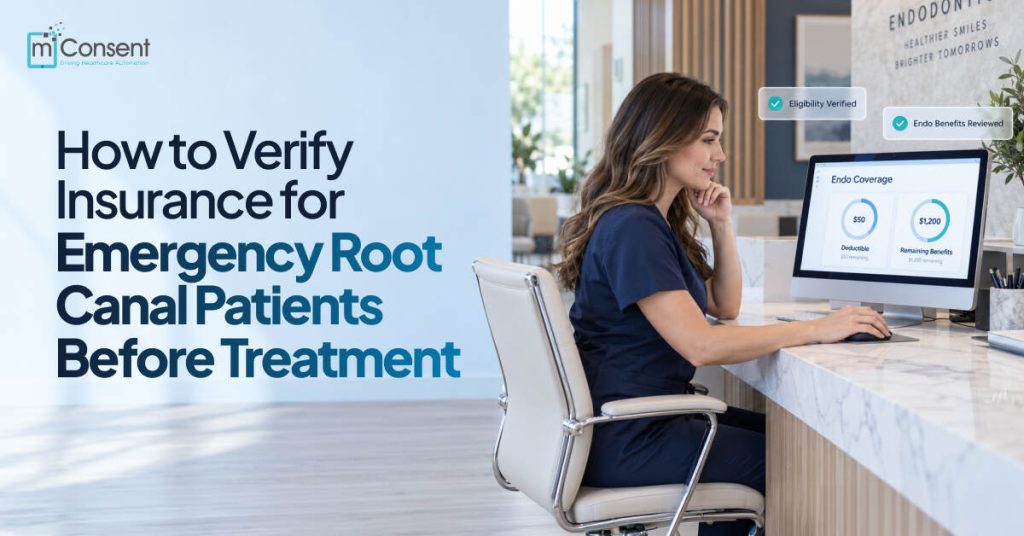
For root canal cases specifically, that means coverage, deductible status, remaining benefits, and estimated patient responsibility are all known before the appointment starts. The clinical team knows the case can move forward without a billing surprise attached. The front desk isn’t estimating costs on the fly. And the patient hears a real number before treatment, not an apology after it.
This is the workflow mConsent Insurance Concierge is built around: verifying patient insurance benefits before treatment whenever possible, so coverage, deductibles, remaining benefits, and patient responsibility are identified earlier. Insurance Concierge pulls 18+ data points per patient and reduces manual payer calls and portal checks that eat into front-desk time; dedicated agents handle the work, not just software running against a database.
Verify Insurance Benefits Before Emergency Root Canal Treatment
mConsent Insurance Concierge helps endodontic practices verify patient insurance benefits before treatment whenever possible, identifying coverage, deductibles, remaining benefits, and patient responsibility earlier so emergency patients move into treatment faster with fewer billing surprises.
What to Look for in Dental Insurance Benefits Verification Tools
Not every dental insurance verification tool is built for endodontic or emergency workflows. Before choosing one, check for:
- Procedure-code-level detail, not just an active/inactive status check
- The ability to verify before the patient arrives, not only at check-in
- Deductible and remaining-benefit visibility, not coverage alone
- A documentation or audit trail that holds up if a claim is questioned later
- Support built for emergency and same-day workflows, not just scheduled recalls
A tool built only for routine, scheduled visits will struggle the moment a walk-in emergency root canal patient needs answers in minutes, not days.
Verify Coverage Before the Chair, Not After
Verifying insurance before an emergency root canal isn’t a formality; it protects treatment timing, patient trust, and clean claims. The practices that do this well aren’t the ones with the most thorough phone calls; they’re the ones who’ve moved verification earlier in the process, so nothing about coverage is still in question once the patient sits down.
Verify Insurance Benefits Before Emergency Root Canal Treatment, see how mConsent Insurance Concierge fits into your front-desk workflow.
FAQ
How do you verify insurance for an emergency root canal?
Confirm the plan is active, check benefits for the specific endodontic procedure code, and identify any deductible, waiting period, or frequency limit before treatment starts. Doing this ahead of the appointment lets the practice give the patient an accurate cost estimate instead of a guess.
What does dental insurance typically cover for a root canal?
Coverage varies by plan, but root canal treatment usually falls under “major” or “endodontic” services rather than preventive care, often with a lower coverage percentage, a separate annual maximum, and sometimes a waiting period. The only way to know the actual number for a given patient is to check their specific plan and procedure code.
Can insurance be verified before the patient arrives for treatment?
Yes, when the practice collects the patient’s name, date of birth, member ID, and payer at the referral or call-in stage. That gives enough lead time to verify benefits before the patient walks in, rather than while they’re waiting in the chair.
What’s the difference between checking eligibility and checking benefits?
Eligibility confirms whether the plan is active. Benefits go further: what a specific procedure code is covered at, what’s left of the annual maximum, and what the patient owes. A practice can confirm eligibility and still have no idea what a root canal will actually cost the patient.
How is patient responsibility calculated before root canal treatment?
It’s the remaining deductible plus the co-insurance percentage the plan applies to that procedure code, based on the patient’s remaining annual maximum. All three numbers need to be confirmed before an accurate estimate is possible.
Does verifying insurance early reduce billing issues after treatment?
Yes. Most post-treatment billing disputes trace back to something that wasn’t checked beforehand: a waiting period, a maxed-out annual benefit, an unmet deductible. Confirming those details before treatment gives the patient an accurate number upfront and gives the practice a documented basis for the claim.