


Why Dental Claim Denials Often Start Before the Claim Is Submitted
Dental claim denials get treated as a billing problem. But many claim issues actually begin much earlier in the revenue cycle, during dental insurance verification. When eligibility, coverage, benefits, deductibles, or frequency limitations are incomplete or inaccurate, the practice moves forward with bad information, and that shows up later as denials, corrections, billing rework, delayed payments, extra staff follow-up, and confused patients.
A small verification error before treatment can create hours of administrative work after you submit the claim. The traditional path looks like this:
Collect insurance information → check eligibility → review benefits → research limitations → enter information manually → submit claim → discover an issue → correct and resubmit.
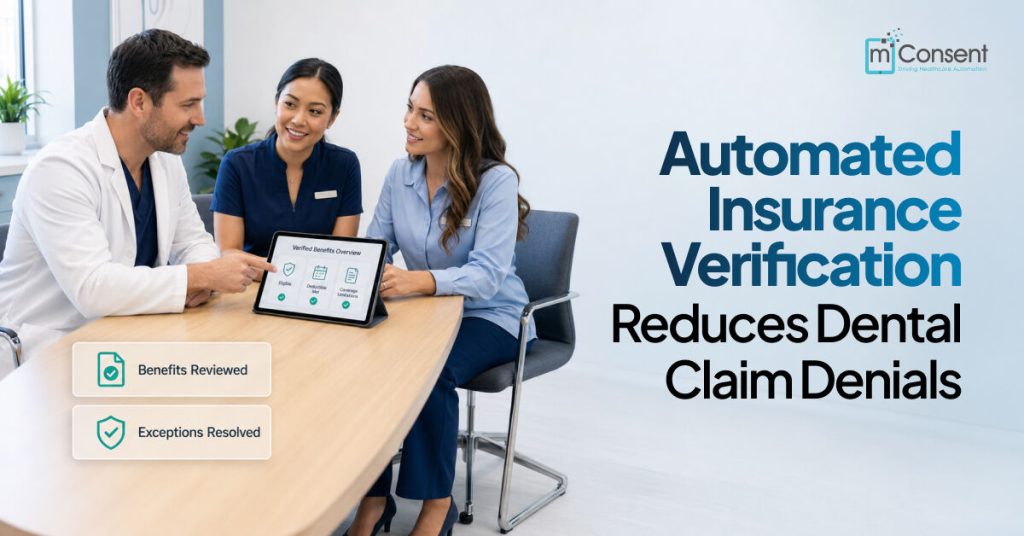
Automated dental insurance verification moves the important checks earlier, before treatment locks in the outcome:
Verify → identify issues → resolve exceptions → treat → submit cleaner claims.
Shifting to checking before instead of correcting after is how practices start reducing preventable insurance errors and the rework that follows.
What Causes Dental Claim Denials and Rework?
Not every denial traces back to verification, but inaccurate or incomplete insurance information contributes to a predictable set of problems:
- Inactive coverage the patient no longer has by the time of treatment
- Incorrect patient information names, dates of birth, member or subscriber IDs
- Incorrect benefit information that gets misread or recorded wrong
- Deductible issues that change how much a plan actually pays
- Frequency limitations on how often a procedure is covered
- Waiting periods that delay when coverage applies
- Coverage limitations, exclusions, or plan-specific requirements
- Missing or incomplete verification, which leaves staff with less visibility into problems before they happen
The Connection Between Verification and Claim Denials
Verification sits near the start of the revenue cycle, making it one of the best opportunities to catch a problem early.
Without proactive verification: incomplete information → treatment provided → claim submitted → issue discovered → denial → staff investigates → claim corrected and resubmitted.
With automated verification: patient insurance information → automated check → eligibility, benefits, and limitations reviewed → issues identified → staff handles exceptions → treatment and billing proceed with better information.
The earlier a potential issue surfaces, the easier it is to fix.
Why Manual Verification Increases the Risk of Errors
Manual verification asks staff to repeat the same steps for every patient: find the insurance information, locate the payer, log into the portal, search for the patient, confirm eligibility, review benefits and deductibles, check limitations, record everything, and update the chart.
Repeated across dozens of patients, this creates real opportunities for mistakes, typos, missed benefit details, incorrect member information, incomplete documentation, outdated data, missed limitations, and verification processes that vary from person to person. Automation doesn’t remove staff from the process; it removes the repetitive, error-prone parts.
The Role of Automated Dental Insurance Verification
Automated dental insurance verification uses technology to streamline how staff check patient insurance before treatment. Instead of requiring staff to do every routine task by hand, it automatically gathers and organises relevant information, confirms it, reviews it, identifies issues, surfaces them, and flags them earlier.
The goal isn’t to eliminate staff involvement. It’s to move their attention from repetitive checks to the exceptions that actually need human judgment.
How Automated Verification Reduces Dental Claim Denials
1. Verifies patient eligibility before treatment
Confirming active coverage is a basic check, but an easy one to get wrong manually. Automated verification moves straight from patient information to eligibility results for staff to review, catching inactive or problematic coverage before treatment instead of after the claim is submitted.
This is where Insurance Concierge fits in. It helps dental practices verify patient eligibility, coverage, benefits, deductibles, and limitations before treatment, identifying issues that could lead to billing errors, claim denials, and costly rework before they ever reach a claim.
2. Verifies benefits, deductibles, and coverage details
Active coverage doesn’t mean a specific procedure is fully covered. Staff often need to check covered procedures, deductibles, annual maximums, coverage percentages, waiting periods, and frequency limits. Misunderstood benefits create inaccurate expectations and claims built on faulty assumptions. Automated verification organises this information before treatment.
3. Identifies potential issues before claims are submitted
Instead of treat → submit → denial → investigate → correct, practices can work toward verify → identify → resolve → treat → submit. Catching inactive coverage, incorrect member details, benefit limitations, or exclusions early means prevention instead of post-denial correction, moving issue detection earlier in the dental claim denials cycle, where it belongs.
4. Reduces manual data entry and verification errors
Every manual entry step is another chance for an incorrect member ID, a misspelled name, or an incomplete note. Dental insurance verification software standardizes these workflows and gives staff organized, reliable information instead of scattered notes across formats and people.
5. Reduces claim rework and administrative follow-up
A denied claim rarely ends with the denial staff still have to research it, contact the payer, correct records, resubmit, and follow up again. That cycle (verification issue → claim problem → denial → research → correction → resubmission → follow-up) shrinks when verification accuracy improves at the front end: better verification → fewer preventable errors → less rework → a more efficient revenue cycle.
How AI Dental Insurance Verification Improves the Workflow
AI dental insurance verification adds another layer of automation on top of routine checks, processing repetitive tasks, organizing information, surfacing relevant coverage details, and letting staff focus on exceptions. The goal isn’t just speed; it’s consistency and scale. AI and automation are meant to support staff, not replace the judgment complex insurance situations still require.
Before vs. After
Manual verification means staff check each patient by hand, run multiple portal searches, enter data repeatedly, research benefits manually, discover issues late, and handle more claim follow-up. Automated verification means routine checks handled automatically, a streamlined workflow, organized benefits information, earlier issue detection, less preventable rework, and staff free to focus on patients and genuine exceptions.
Manual verification → automated verification → earlier issue detection → fewer preventable errors → less claim rework.
Where Verification Fits Into the Revenue Cycle
Verification is one link in a longer chain: scheduling → insurance verification → eligibility and benefits review → treatment planning → patient financial communication → treatment → claim submission → payment posting → accounts receivable. An error at the start doesn’t stay contained; it travels through every stage that follows.
Measuring the Impact
The real opportunity depends on claim volume, payer mix, verification complexity, existing workflows, and current denial rate, so it varies by practice. Rather than chasing one universal number, practices can track their own baseline: insurance-related denial rate, number of corrected claims, average rework time, verification error rate, staff hours spent on follow-up, first-pass claim acceptance, and insurance-related write-offs.
Improve Verification Accuracy Before the Claim Is Submitted
The most effective place to address many insurance-related problems is before they become claims problems. Insurance Concierge helps practices verify eligibility and benefits, identify coverage issues and limitations, review relevant information before treatment, resolve exceptions before billing, and submit claims with better information from the start proactive verification instead of reactive claim correction.
What Practices Can Do
Beyond automation, practices can verify insurance before every treatment rather than relying on outdated data, reverify when appropriate, confirm member and subscriber details, review benefits carefully instead of stopping at eligibility, document verification results consistently, flag unclear situations for review, automate routine work, and monitor denial trends to catch recurring root causes.
Less Rework Means More Productive Staff
With less time spent on repetitive verification and correction, front-desk teams can focus on patient communication, scheduling, and financial conversations. Meanwhile, billing teams have more capacity for complex claims, denial management, and revenue recovery. Less repetitive verification and rework adds up to more productive staff time and a more efficient revenue cycle.
Why Practices Should Consider Automated Insurance Verification
As a practice grows, manually verifying every patient’s insurance becomes harder to sustain. Automation builds a consistent process without requiring staff to do every routine task by hand: more proactive verification, better visibility into eligibility and benefits, less manual data entry, earlier issue detection, fewer preventable claim errors, and a more productive team. The goal was never to verify insurance faster; it’s to verify it accurately enough to keep avoidable problems from moving downstream.
Conclusion
Not every denial is preventable through verification alone, but improving the accuracy and completeness of insurance information before treatment reduces a meaningful share of preventable errors. Automated dental insurance verification helps practices verify eligibility before treatment, review benefits and limitations up front, catch issues earlier, reduce manual data-entry errors, and cut avoidable claim rework.
Automated dental insurance verification → better eligibility and benefits information → earlier issue detection → fewer preventable errors → less claim rework → a more efficient dental revenue cycle.
Improve Dental Insurance Verification and Reduce Claim Errors
Insurance Concierge helps dental practices automate insurance verification, improve information accuracy, and identify potential coverage issues before they become claim denials and billing rework.
FAQ
1. How does dental insurance verification help reduce claim denials?
Accurate verification can help identify inactive coverage, incorrect patient information, benefit limitations, deductibles, and other issues before claims are submitted.
2. Can automated dental insurance verification prevent all claim denials?
No. Denials can have many causes, and verification cannot prevent every one. But accurate verification can reduce certain preventable insurance-related errors.
3. What information should be verified before dental treatment?
Eligibility, coverage, benefits, deductibles, annual maximums, waiting periods, frequency limitations, and other plan restrictions.
4. How does dental insurance verification software reduce rework?
It automates routine verification tasks, reduces repetitive data entry, organizes insurance information, and helps staff identify issues earlier.
5. What is AI dental insurance verification?
AI-powered technology that streamlines verification workflows, helping practices gather, organize, and review eligibility and benefits information with less manual effort.
6. What is automated dental insurance verification?
Technology that streamlines eligibility and benefits checks, reducing repetitive manual portal searches, calls, research, and data entry.