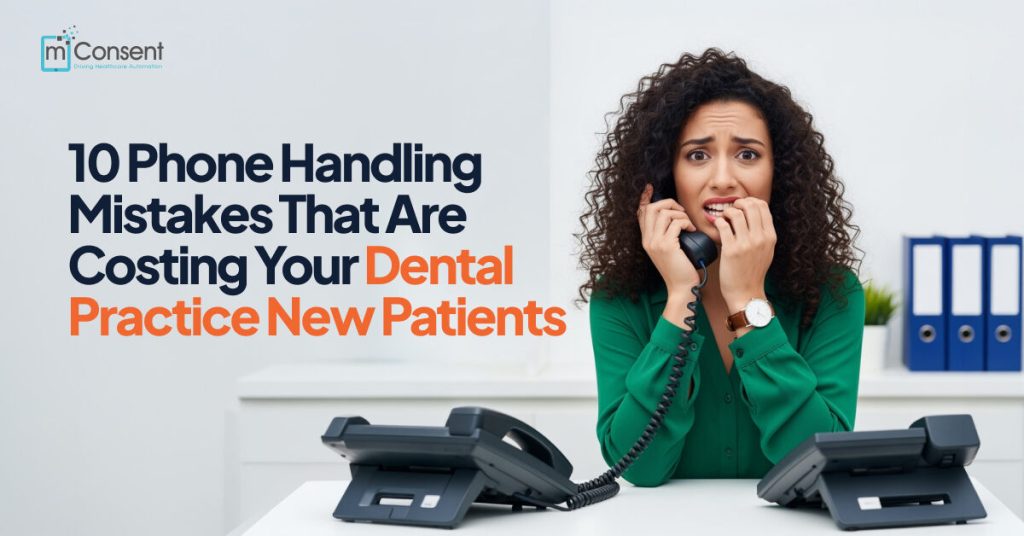




A woman wakes up at 6:47 a.m. with a throbbing molar. She’s scared. She’s Googling “dentist near me” before her coffee is even poured. She finds your practice. She calls.
Nobody picks up.
She doesn’t leave a voicemail. She doesn’t try again later. She calls the next office on the list and books a $250 new-patient exam there instead.
You spent thousands on Google Ads, SEO, and Instagram to make that phone ring. And it rang. You just never heard it.
Here’s the uncomfortable truth most dental practices won’t admit: your marketing isn’t broken. Your phone is.
Every missed call, rushed conversation, or robotic script is a revenue leak hiding in plain sight. And in 2026, when patients expect high-level convenience from their dentist, the practices that fix their phone experience are the ones quietly winning the new-patient race.
This blog breaks down the 10 most common and most expensive dental phone handling mistakes, with practical fixes you can implement this week. We’ll also show how mConsent helps modern practices automate communication, reduce friction, and turn more callers into booked appointments.
Why Phone Handling Still Decides Whether Patients Stay or Leave
You’d think in a world of online booking, texting, and chatbots, phone calls would matter less. The opposite is true.
When someone is anxious, in pain, or unsure about cost, they reach for the phone. Industry data consistently shows that phone calls convert to appointments at 3-5x the rate of web form fills. A great call book. A bad one bounces them straight to your competitor.
Three things make dental calls uniquely high-stakes:
- They’re emotional. Callers are often in pain, embarrassed about their smile, or worried about money.
- They’re judged in seconds. Patients form an impression of your professionalism within the first 8 seconds of a call.
- They’re invisible when they fail. Callers rarely complain. They just don’t come back.
That last one is the killer. You’ll never see the patient you lost because nobody answered on the third ring.
The Real Cost of Poor Phone Handling
If your average new patient is worth $1,200 in first-year value, and you miss just 3 new-patient calls per week, you’re walking away from roughly $187,000 a year. That’s not counting the referrals those patients would have brought.
Poor phone handling doesn’t just cost you new patients. It quietly damages your practice in seven ways:
- Lost new patient revenue: the most obvious leak
- Lower conversion on callers who do reach you: they hang up frustrated
- More no-shows: weak confirmation flows mean weak commitment
- Negative reviews: “I called three times, nobody picked up” appear more than you think
- Lower retention: existing patients feel like a hassle when calls feel rushed
- Front desk burnout: chaotic phones break good people
- Stalled growth: you can’t scale a practice on a phone that’s already drowning
The good news: every single one of these is fixable.
Mistake No. 1 — Letting Calls Go Unanswered
The problem: During lunch, hygiene check-ins, or back-to-back checkouts, calls go to voicemail. Most callers don’t leave one. They just move on.
Why it hurts: Patients today expect an instant response. A 2025 study on healthcare consumer behavior found that 62% of callers won’t try a practice a second time if their first call goes unanswered.
The fix:
- Track your missed-call rate weekly (most VoIP systems show this)
- Set up an after-hours overflow line or virtual receptionist for peak hours
- Send an automated text to every missed caller within 60 seconds: “Sorry we missed you, would you like to book online or have us call you back?”
How mConsent helps: Two-way SMS automatically engages missed callers before they reach a competitor. The patient never has to call twice.
Mistake No. 2 — Sounding Rushed or Distracted
The problem: Your front desk is multitasking, checking out a patient, signing for a delivery, answering the phone, all at once. The caller hears it.
Why patients notice: Tone is louder than words. A clipped “Dental office, please hold” tells a nervous new patient, “you’re not important here.”
Watch for these tells:
- Interrupting the patient mid-sentence
- Talking faster than the caller does
- Long pauses with audible typing
- Flat, monotone greetings
The fix:
- Implement a “pause and breathe” rule before answering, one full second
- Use a consistent warm greeting: “Thanks for calling Happy Dental, this is Maria, how can I help you today?”
- Move admin tasks off the front desk where possible
Mistake No. 3 — Failing to Sound Warm and Empathetic
The problem: The team treats calls like transactions. “Name? DOB? Insurance? Tuesday at 2?” It’s efficient. It’s also cold.
Why this matters: Dentistry sits atop real fear. About 36% of adults have moderate-to-severe dental anxiety. They don’t need efficiency. They need reassurance.
What patients actually want to hear:
- “That sounds painful. I’m so sorry you’re dealing with this.”
- “You’re in the right place. Dr. John is wonderful with nervous patients.”
- “Let’s get you in as soon as possible.”
The fix: Train your team to lead with empathy, then get to logistics. Patients remember how your office made them feel far longer than what was said.
Mistake No. 4 — Not Explaining Insurance or Costs Clearly
The problem: A caller asks, “How much does a cleaning cost?” and gets a vague “it depends on your insurance.” They hang up, unsure and don’t book.
Common failures:
- Overpromising coverage (“you should be 100% covered”) that creates billing fights later
- Refusing to give any range until they come in
- Confusing dental jargon (PPO, MAC, UCR) without translation
The fix:
- Give a confident range: “For new patients, we typically see $X-$Y depending on what we find. We’ll verify your benefits before your visit so there are no surprises.”
- Use visual treatment plans that patients can see, not just hear.
How mConsent helps: Digital treatment plans and estimates can be sent via secure link during or after the call, so patients see numbers in writing, which dramatically increases trust and case acceptance.
Mistake No. 5 — Making Scheduling Difficult
The problem: Patients sit on hold. They get transferred. They’re asked to call back when the scheduler is in. They’re offered one appointment slot three weeks out.
Why this kills conversion: Modern patients have been trained by OpenTable, Uber, and Calendly. Three taps and they’re booked. Anything slower feels broken.
The fix:
- Offer two specific time options instead of asking “when works for you?”
- Empower every front desk person to book, no transfers
- Add online and SMS booking as alternatives
How mConsent helps: Automated scheduling and reminder workflows let patients confirm, reschedule, or book through text, removing friction from the most important moment in the funnel.
Mistake No. 6 — Failing to Capture and Follow Up on Missed Calls
The problem: Your phone log shows 14 missed calls last week. Nobody called any of them back.
The hidden leak: Many of those callers still want to book. They just needed you to take one more step. Without it, they vanish and your marketing spend vanishes with them.
The fix:
- Assign one team member to review missed calls daily
- Reach out within 4 hours via call AND text
- Track recovery rate (% of missed callers who eventually book)
How mConsent helps: Automated follow-up sequences trigger when a call is missed, so no lead falls through the cracks, even when the team is buried.
Mistake No. 7 — Using Scripts That Sound Robotic
The problem: Scripts that read like compliance documents. “Thank you for calling. May I please have your full legal name and date of birth?”
Why patients disengage: Robotic = corporate = expensive and uncaring. That’s not the brand a small practice wants to project.
The fix:
- Build conversation frameworks, not word-for-word scripts
- Train tone, not just content
- Let team members sound like humans first, professionals second
The balance: Structure ensures consistency. Personality builds trust. You need both.
Mistake No. 8 — Not Asking for the Appointment
The problem: The call ends with “call us back if you decide to come in.” The caller never does.
Why this hurts: Patients want to be led. When the front desk doesn’t pick up the appointment, the caller assumes there’s hesitation.
Replace this:
- “Let me know if you want to book something.”
With this:
- “I have Thursday at 10 a.m. or Friday at 2; which works better for you?”
That single shift, across one year, has been shown to lift new-patient conversion by 20-30% in coaching case studies. Assume the appointment. Offer two options. Close.
Mistake No. 9 — Poor Handling of Emergency Calls
The problem: An emergency caller is told, “the earliest we have is Tuesday.” They’re in pain now. They hang up and find someone who will see them today.
Why this is critical: Emergency calls are the highest-intent, highest-conversion calls your practice receives. They also become loyal patients if you can save their tooth and their day.
The fix:
- Build a daily emergency slot into the schedule
- Train staff to recognize emergency language (“swelling,” “throbbing,” “can’t sleep”)
- Confirm emergency callers within minutes, not hours
Best practice: Lead with reassurance. “We’re going to take care of you today. Tell me what’s happening.”
Mistake No. 10 — Relying Only on Phone Calls in a Digital World
The problem: Your entire communication strategy lives on a single phone line. In 2026, that’s like running a practice on a fax machine.
Why phone-only fails:
- Patients under 40 prefer texting over calling, by a wide margin
- Voicemails go unchecked for hours
- One sick front desk employee = communication blackout
Modern patients expect:
- SMS appointment confirmations
- Online intake forms before they arrive
- Mobile-friendly treatment plans and consent
- Reminders that match how they actually communicate
How mConsent helps: A full multi-channel communication suite, two-way texting, automated reminders, digital forms, HIPAA-compliant messaging, so your practice meets patients where they already are.
The Psychology of a High-Converting Dental Phone Experience
Strip away the tactics and every great patient call delivers five things:
- Confidence: “These people know what they’re doing.”
- Simplicity: “That was easier than I expected.”
- Reassurance: “They actually care.”
- Convenience: “I didn’t have to fight to book.”
- Human connection: “I felt heard.”
Get those right and the call almost books itself.
How Better Phone Handling Compounds Into Real Revenue
Fix the phone and seven things improve at once:
- Higher new-patient conversion (typically 15-35% lift)
- Faster, smoother scheduling
- Better retention (patients stay where they feel respected)
- More 5-star reviews mentioning your team by name
- Higher treatment acceptance (trust starts on call No. 1)
- Less front-desk stress and turnover
- Stronger word-of-mouth in your community
This isn’t a soft skill upgrade. It’s an operational lever with a measurable ROI.
How mConsent Modernizes Patient Communication Beyond the Phone
mConsent gives your front desk the tools modern patients already expect:
- Two-way SMS: talk to patients the way they actually want to be talked to
- Automated appointment reminders: fewer no-shows, less manual follow-up
- Digital intake forms: patients fill out paperwork on their phone before arrival
- Real-time patient communication: respond to questions without playing voicemail tag
- Automated follow-up workflows: missed calls and unbooked leads get reached automatically
- Mobile-friendly experiences: designed for how patients actually use their devices
- HIPAA-compliant messaging: secure by default
- Centralized engagement: one platform, not seven tabs
The result: your team spends less time chasing communication and more time delivering care.
Before vs. After: What Optimized Phone Handling Actually Looks Like
| Before | After |
| 14 missed calls a week, no follow-up | Every missed call gets an SMS in under a minute |
| Patients on hold for 3+ minutes | Patients book via text in seconds |
| Vague pricing answers | Clear estimates sent digitally |
| Inconsistent tone across staff | Consistent, warm, branded patient experience |
| Front desk drowning in admin | Automation handles routine touchpoints |
| No-shows at 18% | No-shows under 8% with smart reminders |
| Marketing leads disappear | Every lead gets nurtured to booking |
10 Best Practices for Exceptional Dental Phone Handling
- Answer within three rings, every time
- Smile while speaking, yes, patients hear it
- Listen first, talk second, let them finish
- Use warm, empathetic language, especially with anxious callers
- Simplify scheduling, two options, fast close
- Explain financials clearly, ranges, not riddles
- Follow up on missed calls fast, within four hours
- Personalize every conversation, use names, remember context
- Offer digital alternatives, text, online booking, mobile forms
- Always ask for the appointment, assume the close
The Future of Patient Communication in Dentistry
The practices winning new patients in 2026 and beyond are already moving toward:
- AI-assisted call summarization and routing
- Predictive scheduling that fills gaps automatically
- Fully digital intake and consent (no clipboards)
- Personalized SMS journeys based on treatment history
- Unified inboxes that combine calls, texts, and reviews
mConsent is built for exactly this future, practices that want to grow without growing the front-desk headache.
Conclusion
The front desk phone is the single highest-leverage growth lever in your practice. More than ads. More than SEO. More than your website.
Fix it, and every other marketing dollar starts working harder.
Ignore it, and you’ll keep paying to make a phone ring that nobody is ready to answer well.
The shift is simple: move from reactive phone handling to proactive patient engagement, powered by automation, empathy, and modern communication tools.
Ready to Stop Losing New Patients on the Phone?
See exactly how mConsent helps dental practices respond faster, book more, and retain longer, without adding a single team member.
It takes 20 minutes. The patients you’ll stop losing? They’re calling right now.
Frequently Asked Questions
1. Why is phone handling so important for dental practices in 2026?
The phone is still the #1 conversion point for new patients, especially anxious or emergency callers. A bad call sends them to a competitor in seconds and they rarely give a second chance.
2. What are the most common dental phone handling mistakes?
Unanswered calls, rushed conversations, vague pricing answers, robotic scripts, no missed-call follow-up, and over-reliance on phone-only communication.
3. How can my front desk improve patient phone experiences quickly?
Start with three things: a warmer greeting, two specific appointment options, and an automated SMS for every missed call.
4. How does mConsent help improve patient communication?
mConsent automates the gaps your front desk can’t cover, missed-call SMS, appointment reminders, digital forms, two-way texting, and HIPAA-compliant patient messaging.
5. Why do patients leave after one bad phone experience?
Patients equate communication quality with clinical quality. A disorganized phone call signals, fairly or not, a disorganized practice. They protect themselves by going elsewhere.
6. What’s the average ROI of fixing phone handling?
Practices that overhaul their phone and communication workflows typically see a 15-35% lift in new-patient conversion within 90 days, usually paying back the investment in the first month.