



- Personalized Communication Workflows: Messages change based on how the patient interacts.
- Integrated Payment Experience: Patients can easily go from a reminder to a payment.
- Two-Way Conversations: Lets you clarify and get involved in real time.
- Smart Workflow Automation: Starts communication based on actions, not guesswork.
- Performance Visibility: Keep an eye on what works and make it better all the time.
“Automation can improve collections, but only if it feels like a conversation, not a system.”
Most dental practices don’t struggle because they lack follow-ups.
They struggle because their follow-ups don’t connect.
Manual processes break under pressure, staff forget, timing slips, and consistency disappears. But going fully automated creates a different problem: messages that feel transactional, cold, and easy to ignore.
So the real issue isn’t whether to automate. It’s how to automate without losing trust.
Patients don’t respond to systems. They respond to clarity, tone, and intent.
That’s why the future of dental collections isn’t just automation, it’s human-centered automation.
Platforms like mConsent help practices move beyond reminders and build structured, personalized communication systems that improve collections while preserving relationships.
Why Payment Follow-Ups Matter in Revenue Recovery
What Are Payment Follow-Ups?
Payment follow-ups are structured communication sequences designed to guide patients from receiving an invoice to completing a payment.
Why Follow-Ups Are Critical
Payment delays rarely happen because patients refuse to pay. They happen because:
- There’s no urgency
- The process isn’t clear
- The timing is off
Follow-ups create momentum.
Impact of Poor Follow-Up Systems
When follow-ups aren’t well-structured:
- Days of AR go up a lot
- Income becomes hard to predict
- Staff time is used reactively instead of strategically.
The Gap Between Billing and Payment
Billing informs. Follow-ups convert. Without a strong follow-up system, even accurate billing fails to translate into revenue.
The Challenge of Automation vs Human Connection
Automation in healthcare operations is a real problem: it makes things much more efficient and consistent, but it can also take away the emotional context that makes talking to patients feel human and trustworthy. When automation is used too much, it can be dangerous. Messages start to sound scripted, patients lose interest quickly, and communication starts to sound like background noise instead of standing out.
On the other hand, relying only on manual processes creates a different set of problems. For example, follow-ups depend a lot on staff availability, workflows aren’t standardized, and in the end, revenue is tied to each person’s effort instead of a reliable system. The best way to do things is to find the right balance. This means creating systems that don’t make you choose between automation and personalization, but instead make both work together smoothly to improve efficiency without losing the human touch.
Understanding Patient Psychology in Payment Follow-Ups
Why Patients Delay Payments
- They don’t fully understand the bill
- They intend to pay later
- They need flexibility
Emotional Triggers in Payment Behavior
Patients act faster when they experience:
- Clarity: They know exactly what they owe.
- Control: Ways to pay
- Comfort: No stress or judgment
The Importance of Tone
Tone determines whether a message feels like:
- A reminder
- Or a demand
That distinction directly impacts response rates.
Building Relationships Through Communication
Every follow-up is a part of the patient’s care. If you handle it right, it builds trust instead of causing problems.
Benefits of Automating Payment Follow-Ups
Every time, an organized system makes sure that every follow-up is done on time. This gets rid of the spaces that happen a lot when you do things by hand. Things are more stable, easier to measure, and easier to guess because of this consistency. Structured workflows are always better than last-minute, reactive follow-ups. This is why practices make more money.
At the same time, staff have much less work to do, and teams no longer have to spend their days chasing payments. Instead, they focus on dealing with exceptions and more important tasks. In the end, this makes things better for patients because clear, timely communication reduces confusion, builds trust, and lowers the stress that often comes with paying bills.
Key Principles of Human-Centered Automation
Effective patient communication goes beyond surface-level personalization by referencing meaningful context, not just names, so every interaction feels relevant and intentional. It should be grounded in empathy, recognizing that payment delays can happen for many reasons without making assumptions or creating discomfort.
Clarity is equally critical; messages should remove friction and make the next steps obvious, so patients know exactly what to do without confusion. Timing plays a key role as well, with communication aligned to patient behavior rather than rigid or arbitrary schedules. Finally, flexibility ensures a more supportive experience, offering patients options rather than ultimatums, which builds trust and increases the likelihood of positive outcomes.
Designing a Humanized Automated Follow-Up Workflow
Stage 1: Immediate Post-Treatment Communication
Set expectations early. Provide a clear summary of charges and next steps.
Stage 2: Gentle Reminder
Reinforce awareness without urgency. Focus on clarity.
Stage 3: Support-Led Follow-Up
Shift from reminder to assistance. Address confusion or hesitation.
Stage 4: Structured Escalation
Introduce urgency, but keep tone respectful and professional.
Stage 5: Resolution
Close with either full payment or a structured payment plan.
Message Tone Strategy
An effective communication strategy changes its tone as the patient’s journey goes on. A friendly tone works best at first. This is because it is more about raising awareness than making patients feel rushed. A supportive tone during communication makes it clear that the practice is there to help, not to make demands. This makes the relationship more about working together than about buying and selling.
The tone can change to be firm but still polite, which makes things more important while still being professional and not making anyone feel bad. Avoid using language that is negative or puts pressure on you at all times. This is because it might lead to short-term payments, but in the long run, it hurts the trust of the patient and the relationship as a whole.
Automation Tools That Enable Humanized Communication
- SMS & Instant Messaging: For quick, timely nudges (without over-reliance, unlike traditional SMS-only strategies).
- Email Automation: Best for detailed explanations and documentation.
- Two-Way Messaging: Transforms reminders into conversations.
- CRM Integration: Ensures messages reflect patient history and context.
- AI-Driven Optimization: Improves timing, sequencing, and response prediction.
Multi-Channel Communication Strategy
Why Multi-Channel Matters
No single channel works for every patient.
Ideal Workflow
- Initial communication: Email
- Quick reminders: SMS or messaging
- Complex cases: Calls or direct follow-up
Channel Selection Strategy
Match the message type to the channel, not the other way around.
Common Mistakes to Avoid
- Treating Automation as “Set and Forget”: Without monitoring, performance declines.
- Over-Reliance on One Channel: Leads to message fatigue.
- Lack of Context in Messages: Patients ignore messages that feel irrelevant.
- Poor Escalation Design: Jumping from friendly to aggressive too quickly harms trust.
- Ignoring Patient Experience: Collections improve when experience improves.
Measuring Success (KPIs)
- Collection Rate
- Payment Completion Time
- AR Days
- Patient Response Rate
- Engagement Across Channels
Focus on trends, not just isolated metrics.
Implementation Roadmap
Step 1: Audit Current Follow-Up Behavior
Understand where delays actually occur.
Step 2: Define Communication Stages
Map out the patient journey post-treatment.
Step 3: Build Message Logic
Align tone and timing with each stage.
Step 4: Implement Automation Workflows
Set triggers based on actions, not fixed timelines.
Step 5: Train Your Team
Ensure staff knows when to step in vs. let automation run.
Step 6: Continuously Optimize
Use performance data to refine messaging and timing.
Compliance & Best Practices
- Stay in compliance with HIPAA
- Make sure that payment methods are safe.
- Get permission to talk to each other
- Be polite and honest when you send messages.
How mConsent Helps You Automate with a Human Touch
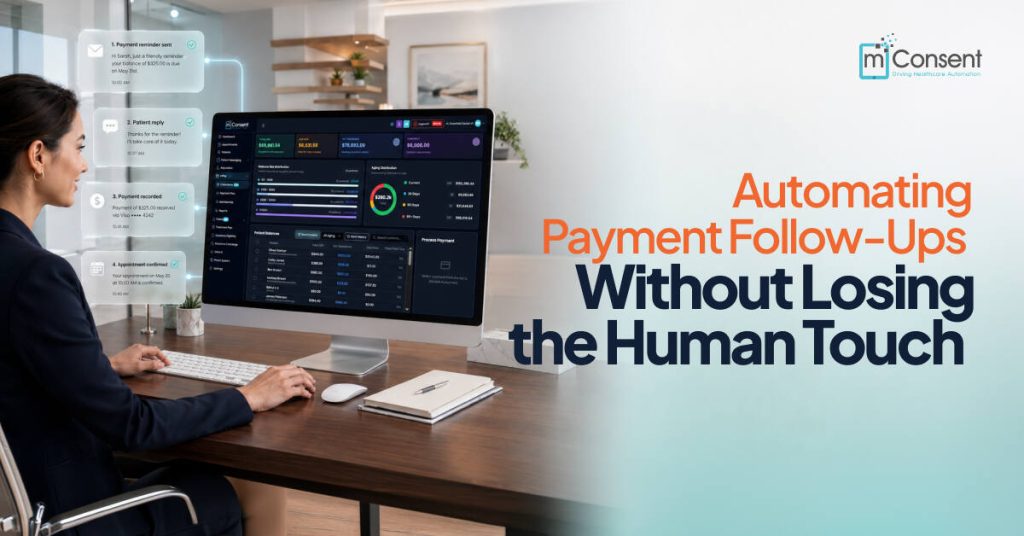
mConsent doesn’t just send reminders automatically; it also organizes the whole follow-up process.
- Personalized Communication Workflows: Messages change based on how the patient interacts.
- Integrated Payment Experience: Patients can easily go from a reminder to a payment.
- Two-Way Conversations: Lets you clarify and get involved in real time.
- Smart Workflow Automation: Starts communication based on actions, not guesswork.
- Performance Visibility: Keep an eye on what works and make it better all the time.
Future of Humanized Automation in Dentistry
- Behavioral-Based Messaging: Communication that happens when intent signals are present.
- Predictive Follow-Ups: Systems guess when patients are most likely to pay.
- Conversational Automation: Automation that makes it feel like you’re having a real conversation.
- Fully Connected Revenue Systems: Everything was in sync, from intake to payment.
Conclusion
Automation alone doesn’t improve collections. Better communication does.
The practices that succeed are the ones that understand this:
Patients don’t ignore payments; they ignore poor experiences.
When follow-ups are
- Timely
- Clear
- Human
Collections improve naturally. The goal isn’t to automate more. It’s to communicate better, at scale.
Automate smarter, not colder.
Build a payment follow-up system that improves collections while strengthening patient relationships with mConsent.
FAQs
1. Can payment reminders be automated while still maintaining a personal touch?
Yes. Automation can feel very personal when there are structured workflows and contextual messaging.
2. Why do patients respond better when people talk to them like people?
It builds trust, clears up confusion, and improves the experience.
3. How often should you send reminders to pay?
Usually 2 to 4 touchpoints, depending on the patient’s behaviour and response.
4. What is the best way to talk to people?
The best strategy is one that uses multiple channels and is based on behavior.
5. What does mConsent do to help?
This system uses automation, personalization, and real-time communication to make collections better.