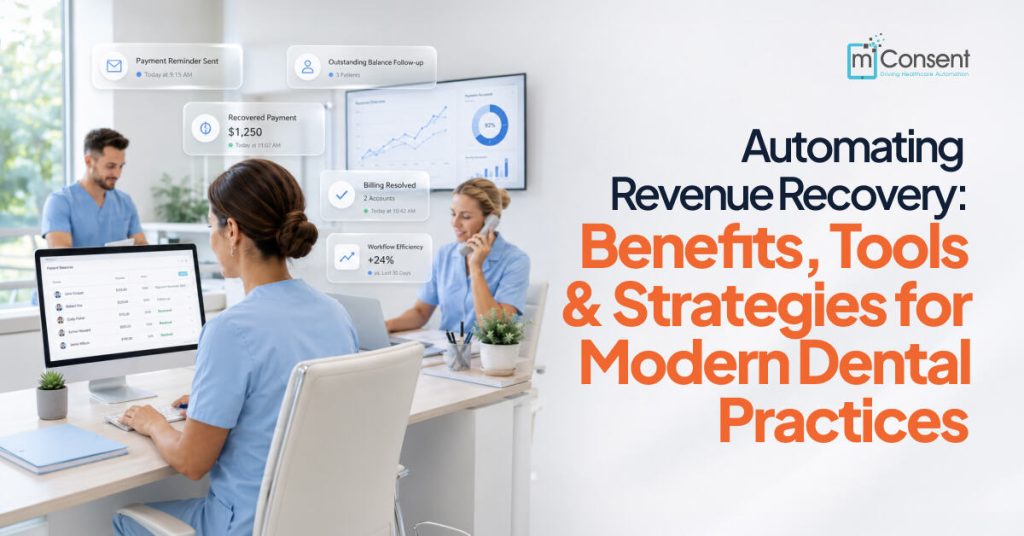




Dental practices today are facing a quiet but growing financial challenge; revenue isn’t always lost at diagnosis, it’s lost in the process.
Patients now carry higher financial responsibility due to rising deductibles. At the same time, front desk teams are juggling manual billing, delayed insurance reimbursements, and endless follow-ups. The result? Staff burnout, inconsistent collections, and revenue leakage often go unnoticed.
Most practices aren’t struggling to produce dentistry. They’re struggling to collect what they’ve already produced.
A lot of the problem is with manual workflows:
- Billing takes a lot of time and is easy to mess up.
- It takes too long for insurance to be checked.
- Follow-ups depend on how many staff members are available.
- Payments are late because of friction.
This is where automation changes everything.
Modern methods are moving away from reactive revenue management, which means going after payments after the fact, and toward proactive revenue recovery, where systems make sure that everything is consistent, fast, and predictable.
Instead of depending on people to do things, automation:
- Lessens the need for staff to step in
- Keeps every patient from falling through the cracks
- Makes collections happen in a predictable way
Platforms like mConsent are made just for dental workflows. They combine communication, billing, and payments into one system that changes how practices get money back.
Understanding Revenue Recovery in Dentistry
What is Revenue Recovery?
The process of revenue recovery in dentistry is
- Getting patients to pay their bills
- Making billing and financial processes as efficient as possible
It makes sure that diagnosed and finished treatment leads to real revenue being collected.
Why Revenue Recovery is Critical
Revenue recovery has become essential due to:
- Increasing patient financial responsibility
- Growing competition among dental practices
- The need for consistent and predictable cash flow
Without structured recovery systems, even busy practices experience cash flow gaps.
Common Revenue Recovery Challenges
Most practices have the same problems:
- Payments from patients that were missed or late
- Mistakes in billing and entering data by hand
- Delays in getting paid by insurance
- Not talking to patients well
- Not following up means losing money.
These problems aren’t because people aren’t trying hard enough; they’re because things aren’t organized.
What is Revenue Recovery Automation?
Definition
Revenue cycle automation in dental practices involves using technology to automate:
- Billing
- Payment collection
- Patient communication
- Insurance workflows
Key Components
A fully automated system typically includes:
- Automated billing and invoicing
- Payment reminders
- Insurance verification tools
- Reporting and analytics dashboards
Manual vs Automated Systems
| Feature | Manual | Automated |
| Billing | Time-consuming | Instant |
| Follow-ups | Inconsistent | Scheduled |
| Payments | Delayed | Faster |
| Accuracy | Error-prone | High |
Automation replaces inconsistency with structured, repeatable workflows.
Benefits of Automating Revenue Recovery
Faster Cash Flow
Automation helps practices get paid faster because they can bill patients on the same day and get payments sooner. Billing happens right away instead of having to wait, which keeps money coming in and improves cash flow.
Reduction in Accounts Receivable (AR Days)
Automation significantly reduces AR days. What usually takes 45 to 60 days can drop to 15 to 25 days, which helps practices get paid faster and stay financially healthy.
Higher Collection Rates
Patients get timely follow-ups and reminders to pay their bills. Text-to-pay and online links make it easier to pay, which means that more people will pay on time.
Reduced Claim Denials
Before claims are submitted, automated insurance verification ensures that patient data is correct. This results in cleaner claims, fewer denials, and faster payments.
Better Patient Financial Transparency
Patients get clear estimates of how much their treatment will cost and how much will be due up front. This clears things up, builds trust, and makes people more likely to accept treatment.
Better Efficiency at the Front Desk
Automation saves you time because you can keep track of payments by hand and spend less time on the phone. This gives the front desk staff more time to make sure patients have a good time instead of chasing after payments.
Growth Scalability
Automation makes it easier and more efficient for practices to grow by letting them see more patients and make more money without hiring more staff.
Essential Tools for Revenue Recovery Automation
Smart Billing Systems
Key features include:
- Automated invoices
- Itemized billing
- PMS integration
Automated Reminder Systems
Used for:
- Appointment reminders
- Payment reminders
- Follow-up sequences
Patient Engagement Platforms
Features include:
- Two-way communication
- Real-time messaging
- Payment-related queries
Insurance Concierge Tools
These tools:
- Verify insurance before appointments
- Provide coverage breakdowns
- Track claims
Reporting & Analytics Tools
Key KPIs to track:
- Collection rate
- AR aging
- Payment turnaround time
Text-to-Pay & Mobile Payments
Benefits:
- Instant payment links via SMS
- Faster collections
With SMS open rates around 98%, this is one of the most effective tools.
Step-by-Step Strategy to Automate Revenue Recovery
Step 1: Audit Your Current Revenue Cycle
Identify inefficiencies and workflow gaps.
Step 2: Digitize Patient Intake
Move to paperless forms to:
- Reduce errors
- Improve data accuracy
Step 3: Automate Insurance Verification
Verify insurance before appointments to:
- Reduce claim rejections
- Improve financial clarity
Step 4: Implement Real-Time Billing
Ensure charges are captured immediately after treatment.
Step 5: Enable Instant Payments
Introduce:
- Text-to-pay
- Online payment portals
Step 6: Set Up Automated Follow-Ups
Example timeline:
- Day 1: Invoice sent
- Day 3: Reminder
- Day 7: Follow-up
Step 7: Monitor & Optimize
Track performance and continuously refine workflows.
Automating the Entire Revenue Cycle
Stage 1: Pre-Visit
The revenue cycle begins before the patient arrives. Making appointments, checking insurance ahead of time, and providing cost estimates all help reduce confusion and delays. This helps patients get ready and makes it easier for them to accept the case.
Stage 2: Visit
Real-time billing and collecting co-pays are crucial during the visit. Charging right away ensures everything is correct and prevents missed procedures. Collecting payments up front improves cash flow and reduces follow-ups.
Stage 3: Post-Visit
Patients can pay right away by sending them a digital invoice with a link to pay after the visit. This speeds up collections and stops the delays that happen with regular billing.
Stage 4: Follow-Up
Automated reminders make sure that follow-up happens every time, since not all patients pay right away. Overdue balances undergo escalation workflows to maintain order and ensure timely payments.
Stage 5: Recovery
The last step is to collect past-due payments. Flexible payment plans and campaigns to help people pay their bills again help recover outstanding amounts and improve collections overall.
Common Challenges & How to Overcome Them
Staff Resistance
Staff may not want to change, especially if they are already busy. The key is easy training and getting started. People are more likely to adopt automation when they see that it makes their jobs easier. Teams can also adapt quickly when using easy-to-use systems.
Integration Issues
Practices are often worried that new tools won’t work with the software they already have. Choosing solutions that work with dental systems ensures everything goes smoothly, there is less manual work, and there are no problems.
Patient Adoption
Some patients might not want to use digital tools. Teaching them about the safety and ease of use helps them trust you. Offering simple payment options that work on mobile devices also makes it easier to adopt.
Concerns About Safety
You have to keep your patients’ information private. Using HIPAA-compliant platforms with strong encryption keeps private information safe, builds trust with patients, and makes sure that everything is safe.
Best Practices for Successful Automation
- Use multi-channel communication (SMS + Email)
- Personalize payment reminders
- Offer flexible payment plans
- Maintain human interaction for complex cases
- Continuously optimize workflows
How mConsent Automates Revenue Recovery
mConsent brings all revenue recovery tools into one simple platform, so everything works together in one place.
It helps practices communicate easily through SMS, email, and chat, while also automating billing and payments with digital invoices and text-to-pay. Insurance verification becomes faster and clearer, and two-way messaging keeps patients engaged. With a real-time analytics dashboard and seamless integration with dental software, practices get full visibility and control.
By combining everything into a single system, mConsent eliminates manual work, closes gaps, and improves revenue recovery consistency and efficiency.
Measuring ROI of Automation
Key Metrics to Track
- AR days
- Collection rate
- Patient payment time
- No-show rate
ROI Formula
(Increased collections – cost of tool) ÷ cost
Expected Results Timeline
- Month 1-2: Workflow improvements
- Month 3-6: Increased collections
- Month 6+: Full ROI realization
Future of Revenue Recovery Automation
Revenue Management with AI
AI helps dental offices keep track of their collections more easily. It looks at how patients have paid in the past to make an educated guess about when they will pay again. This helps practices send reminders on time, plan follow-ups, and give patients the right payment options. This way, they can stop missed payments instead of having to chase them down later.
Payment Plans That Are Very Personal
Patients want things to be flexible, and personalized payment plans make it easier for them to pay. Based on a patient’s medical history and the value of their treatment, practices can offer personalized options that make it easier to pay and collect money.
Predictive Billing
Predictive billing helps practices spot potential income gaps early. It can identify late payments, high-risk accounts, and billing issues by analysing historical data. This helps teams work faster and keep the cash flow going.
Digital Ecosystems That Work Together
A fully integrated system puts communication, billing, payments, and analytics all in one place. This reduces manual work, eliminates data silos, and gives practices full control and visibility over their revenue cycle.
Conclusion
Billing alone isn’t enough anymore; practices need a system that finds every payment opportunity and turns it into real collections.
Automation helps reduce waste, improve cash flow, and enhance the patient experience. Practices don’t have to chase payments anymore because they know their income will grow steadily through the system.
With mConsent, practices can automate getting money back and make collections easier by using one platform for communication, billing, payments, and analytics.
FAQs
1. What does “revenue recovery” mean in dentistry?
It is the process of getting people to pay their bills and making billing processes more efficient.
2. How does automation help get back lost money?
It makes sure that follow-ups happen on time, billing happens faster, and payments are easier.
3. What tools do you need to automate?
Tools for billing, communication, payments, and analytics.
4. Can automation cut down on AR days?
Yes, a lot, because it speeds up payments and billing.
5. Is it safe to use automated billing?
Yes, as long as you use HIPAA-compliant platforms like mConsent.
6. What does “text-to-pay” mean in dentistry?
A feature that lets patients pay right away using SMS links.