



Dental software has run the back office for decades, handling scheduling, records, billing, and claims. It’s reliable, but it depends on staff to drive every single step.
A newer category, AI dental software, is changing that. Instead of just storing information, it can analyze data, automate routine work, and interact with patients directly, cutting the manual load on your front desk.
So what’s the real difference between AI and traditional dental software, and does your practice need to switch, upgrade, or combine both? This guide breaks down what each approach does well, where AI changes daily workflows, and how to decide what’s right for your practice.
What Traditional Dental Software Does
Traditional dental patient engagement software centralizes the essentials: appointment scheduling, patient records, treatment plans, billing, insurance claims, communication, and reporting. It replaced paper charts and remains the operational backbone of most practices.
But it’s rule-based. Staff has to spot the task, open the system, and complete it manually: check a file, confirm insurance, send a reminder, log the result. The software supports the process; a person still drives it.
What AI Dental Software Does
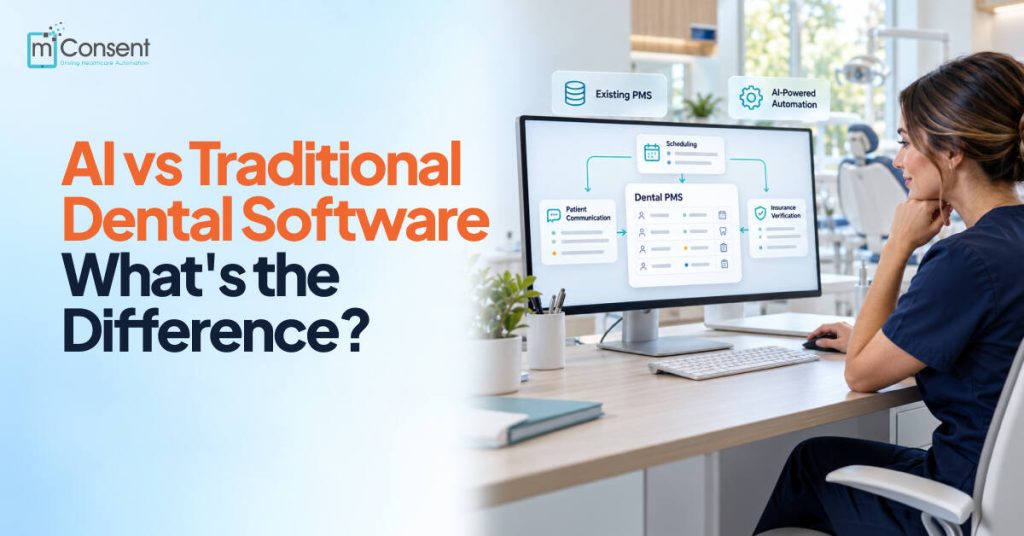
AI dental software layers automation and analysis on top of that infrastructure. Using machine learning, predictive analytics, and natural-language processing, it flags what needs attention, handles routine requests, and learns from patient behavior over time.
That shows up as AI-powered scheduling, automated patient communication, predictive no-show alerts, and intelligent insurance workflows, the core building blocks most dental AI software platforms are built around.
The Core Difference
Traditional software helps your team manage tasks. AI dental patient engagement software helps automate, analyze, and act on them.
Take a missed call. With traditional software, a staff member reviews it, calls the patient back, checks availability, books the slot, and updates the record five manual steps. An AI-powered system can answer the call, understand the request, check availability, book it, confirm it, and update the chart, with staff stepping in only when something’s unusual.
The goal isn’t fewer staff; it’s fewer hours spent on repetitive tasks, so your team can spend more time with patients.
| Traditional Software | AI-Powered Software | |
| Scheduling | Staff or patient books manually | AI handles routine booking and rescheduling |
| Communication | Predefined messages | Conversational, context-aware |
| Insurance | Manual verification | Automated eligibility and benefits checks |
| Reporting | Historical data | Predictive, pattern-based insights |
| Patient reactivation | Manual call lists | Automated prioritization and outreach |
| Payment follow-up | Scheduled reminders | Risk-based, intelligent follow-up |
| Personalization | Same message to everyone | Tailored by behavior and history |
| Staff workload | Higher for repetitive tasks | Lower. Automation absorbs routine work |
Where AI Changes the Day-to-Day Workflow
Automation and personalization
Traditional automation sends the same reminder to every patient. AI tools for dental practices can vary the message, channel, and timing based on appointment type, past no-shows, and how a patient has responded before, which tends to land better than a one-size-fits-all blast.
Data analysis and prediction
A standard report tells you your no-show rate went up. AI can tell you which appointment types, time slots, or patient segments are driving it, shifting reporting from “what happened” toward “what’s likely to happen next.”
Patient communication
Traditional systems send a fixed line: “Your appointment is tomorrow at 10 AM. Reply to confirm.” AI-powered systems can hold an actual conversation, rescheduling, answering insurance questions, and taking a cleaning request without a staff member on the other end.
Insurance verification
Manual verification means logging into payer portals, checking eligibility, and relaying benefits by hand. AI-assisted verification pulls and interprets that information automatically, cutting errors and giving patients accurate estimates faster.
Revenue cycle and patient reactivation
Instead of a flat list of overdue accounts or lapsed patients, AI can rank who to contact first based on payment risk, appointment history, and likely response, turning collections and reactivation into a prioritized workflow instead of a guessing game.
Administrative load
Calls, confirmations, rescheduling, payment reminders, and routine questions eat a large share of front-desk time. Automation absorbs the repetitive work so staff can focus on patients and higher-value tasks.
Is AI Replacing Traditional Dental Software?
No and the AI vs traditional dental software debate isn’t really either/or. Traditional software is still the system of record: it stores the patient data, appointments, and financial history that everything else depends on. AI is the layer on top that turns that data into action, communicating with patients, prioritizing tasks, and flagging what needs attention.
The practices getting the most value aren’t choosing one over the other. They’re running dental patient engagement software with AI automation built in or layered on.
Where AI Makes the Biggest Difference, by Role
- Front desk: Calls, scheduling, rescheduling, and routine patient questions handled automatically
- Insurance team: Eligibility checks, benefit breakdowns, and patient estimates without manual lookups
- Billing: Payment reminders, balance follow-up, and payment plan management
- Marketing: Reactivation campaigns, personalized outreach, and engagement tracking
- Practice owners: Performance trends, revenue insights, and workflow analytics without pulling manual reports
What to Check Before Adopting AI Dental Software
Not every tool labeled dental AI software earns the name. Before you commit, evaluate:
- Integration – Does it connect to your existing PMS (Dentrix, Eaglesoft, Open Dental)?
- Security and HIPAA compliance – How is patient data protected, and is a BAA in place?
- Accuracy – How reliable are its outputs in practice, not just in the demo?
- Human oversight – Can staff review or override AI actions when needed?
- Usability – Will your team actually adopt it, or will it sit unused?
- ROI – Does it save time, recover revenue, or reduce no-shows in a way you can measure?
Which One Does Your Practice Need?
Traditional software alone may be enough if your call volume is low, workflows are simple, and manual processes aren’t creating bottlenecks.
AI tools for dental practices earn their keep when staff are buried in repetitive calls and follow-ups, scheduling creates friction, reactivation is inconsistent, or insurance verification eats hours every week. For most growing practices, the answer isn’t AI instead of traditional software; it’s AI on top of it.
How mConsent Brings AI and Traditional Software Together
mConsent combines the practice-management essentials with AI-powered automation, so you’re not stitching together separate systems.
- Zaha AI – An AI dental receptionist that answers calls, handles scheduling requests, and covers routine front-office conversations 24/7, including after hours
- Paperless Intake – Digital forms that replace manual data entry
- Insurance Concierge – Automated eligibility verification and benefit checks
- mPayr Payments – Digital billing, online payments, text-to-pay, and payment plans
- Communication and reactivation tools – Automated reminders, recall campaigns, and patient outreach
None of it is designed to replace your team. It’s designed to take the repetitive work off their plate so they can spend more time on patients.
See How AI Can Automate Your Dental Practice
Where Dental Software Is Headed
The line between “traditional” and “AI” dental software will blur. Expect more platforms to build AI receptionists, predictive scheduling, automated insurance interpretation, and revenue-risk alerts directly into the core system, not as an add-on. Practices that adopt that combination early will build a real efficiency advantage before it becomes standard.
Conclusion
Traditional dental patient engagement software built the foundation dental practices run on. AI dental software builds on top of it, automating communication, surfacing patterns, and cutting the repetitive work that slows a front desk down.
The opportunity isn’t replacing what you have. It’s adding automation to it.
Ready to see what AI dental patient engagement software can do for your practice?
[ Book a demo with mConsent ]
FAQs
What’s the difference between AI dental software and traditional dental software?
Traditional software manages information and predefined workflows. AI dental software analyzes data, automates tasks, and supports more intelligent, patient-facing interactions.
Is AI dental software better than traditional dental software?
Not on its own. They solve different problems. Traditional software is the system of record; AI adds automation and intelligence on top. Most practices get the most value from both together.
Can AI replace dental office staff?
No. AI is built to absorb repetitive tasks calls, scheduling, reminders- so staff can focus on patient care and higher-value work, not to replace the team.
How does AI improve dental practice efficiency?
By automating scheduling, communication, insurance verification, payment follow-up, and patient reactivation work that otherwise eats significant staff time every week.
Can AI help a dental practice increase revenue?
Yes. AI-driven scheduling, reactivation, and payment-collection workflows can reduce no-shows, close follow-up gaps, and recover revenue that manual processes often miss.
What is an AI dental receptionist?
An AI-powered system like mConsent’s Zaha AI that answers patient calls and handles routine front-office tasks such as scheduling, rescheduling, and common questions, including outside office hours.